Stop 1 of 8Must-see
The arch that changed flags three times
Where to stand
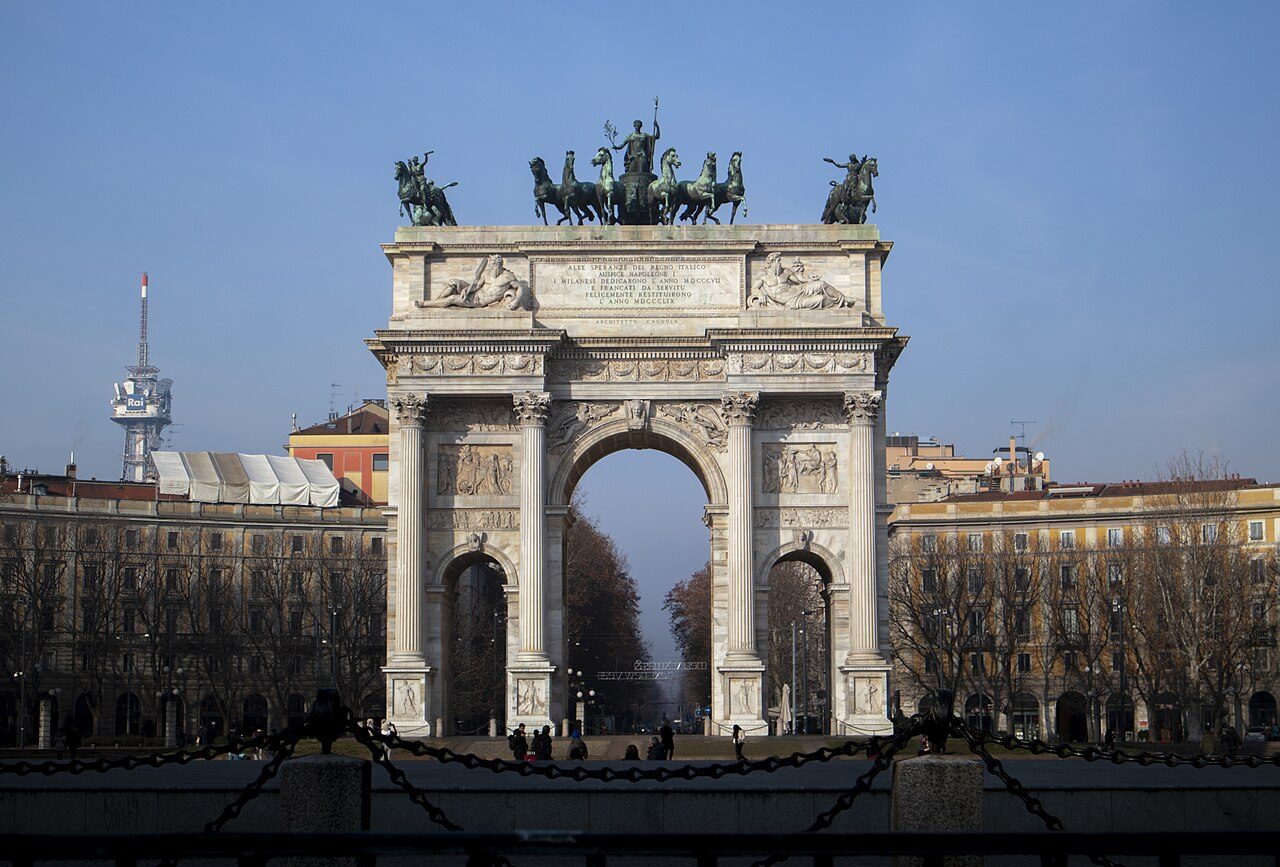
On the park side, a few dozen meters back from the arch: far enough to take it all in, up to the chariot on top
Begun in 1807 to celebrate Napoleon, halted by his fall, finished in 1838 by the Austrians and dedicated to peace. In 1859 the Italians arrived and rewrote the dedications. Few monuments have changed flags so often.
Spot the detail
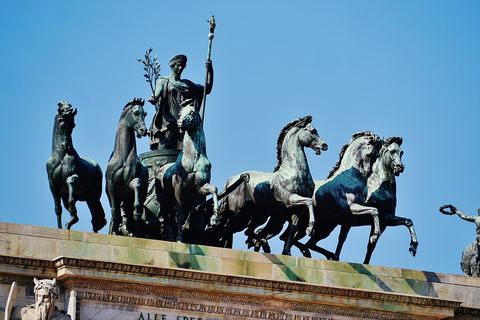
Count the bronze horses on top of the arch. How many are there in all?
The full story
Look at it from a distance, the whole thing. Three openings, which architects call . Four giant columns on each side. And on top, on the , a bronze chariot pulled by six horses.
It is a triumphal arch like those of ancient Rome, remade in the 1800s with one clear purpose: to say who is in charge. The trouble is that, while they were building it, who was in charge changed.
Born from a fake arch
It all starts with a wedding party. The groom is Eugène de Beauharnais, the viceroy who governs Italy on Napoleon's behalf. For the occasion the architect Luigi Cagnola puts up a temporary arch in another part of the city, made of wood, canvas and plaster. A few weeks later the city council decides to build it for real, in marble.
The site chosen is this one, where the Simplon road enters the city, the route that climbs over the Alps and leads to Paris. The first stone is laid in October 1807, on the anniversary of Napoleon's victory at Jena. The arch is meant to celebrate his battles.
Stopped halfway through
Seven years later Napoleon falls, and the building site stops. For a dozen years the arch stands there, unfinished, in the middle of a .
The man who takes it up again is Francis I of Austria, one of the very sovereigns who defeated Napoleon. He doesn't demolish it: he adopts it. He changes the dedication, and the arch of Victories becomes the Arco della Pace, the Arch of Peace, the peace that returned to Europe after the Napoleonic wars.
Cagnola dies before seeing it finished, when construction has risen above the columns. The inauguration comes in September 1838. Emperor Ferdinand I is there, in Milan to be crowned king of Lombardy–Venetia.
The last correction, in Italian
It isn't over. On June 8, 1859, four days after the Battle of Magenta, Napoleon III and Vittorio Emanuele II enter the city through this gate. Milan strips the dedication to the emperor of Austria from the arch and carves two new ones, in Italian.
One recalls the entry of the two liberators. The other hands the arch back to the hopes of 1807, when the Milanese first began it.
So the monument in front of you holds three masters together. The idea is French, the sculptures are from the Austrian era, the inscriptions are Italian. And that is exactly why it is still standing: each of them, instead of knocking it down, chose to rewrite it.
About this stop
Anecdote
The Arco della Pace began in canvas and plaster
Milan's Arco della Pace began as a stage set. In 1806, for the wedding of Eugène de Beauharnais, the viceroy who governed Italy for Napoleon, emperor of the French, the architect Luigi Cagnola designed a temporary arch of wood, canvas and plaster, made to last as long as a party. Milan's city council soon decided to redo it in marble. Cagnola was not an architect by trade: a marquis with a law degree, headed for a career in diplomacy, he called himself a dilettante. Around twenty he caught the craze for hot-air balloons. The final design, though, did not copy the canvas one: it had three openings instead of one.
Record
The Olympic cauldron inside the Arco della Pace
In February 2026, for the Milano Cortina Winter Olympics, Milan's Olympic cauldron was hung inside the central archway of the Arco della Pace, the city's triumphal arch. It was an aluminum structure that opened to about four and a half meters across, inspired by the knots drawn by the painter Leonardo da Vinci. It had a twin in Cortina d'Ampezzo: for the first time in the history of the Games two cauldrons burned together, in two different cities. For a few weeks the arch begun for Napoleon, emperor of the French, and finished by the Austrians had another master, the Olympic flame.
Because it changed its name in mid-construction. It was meant to be the arch of the Victories of Napoleon, begun in 1807. When Napoleon fell, the Austrians decided to finish it anyway, but dedicated it to the peace, pace in Italian, that had returned to Europe after his wars. It was the victors' peace, and sure enough the reliefs tell of Napoleon's defeats and the congresses of the sovereigns who had beaten him. The name stuck even after 1859, when Milan removed the dedication to the emperor of Austria.
This stop on the map
Next stop
Walk up until you are standing under the central archway, the largest one, and look up