Stop 8 of 8
The Arena Civica
Where to stand
In front of the Arena's perimeter wall, on the park side, following it to one of the monumental entrances
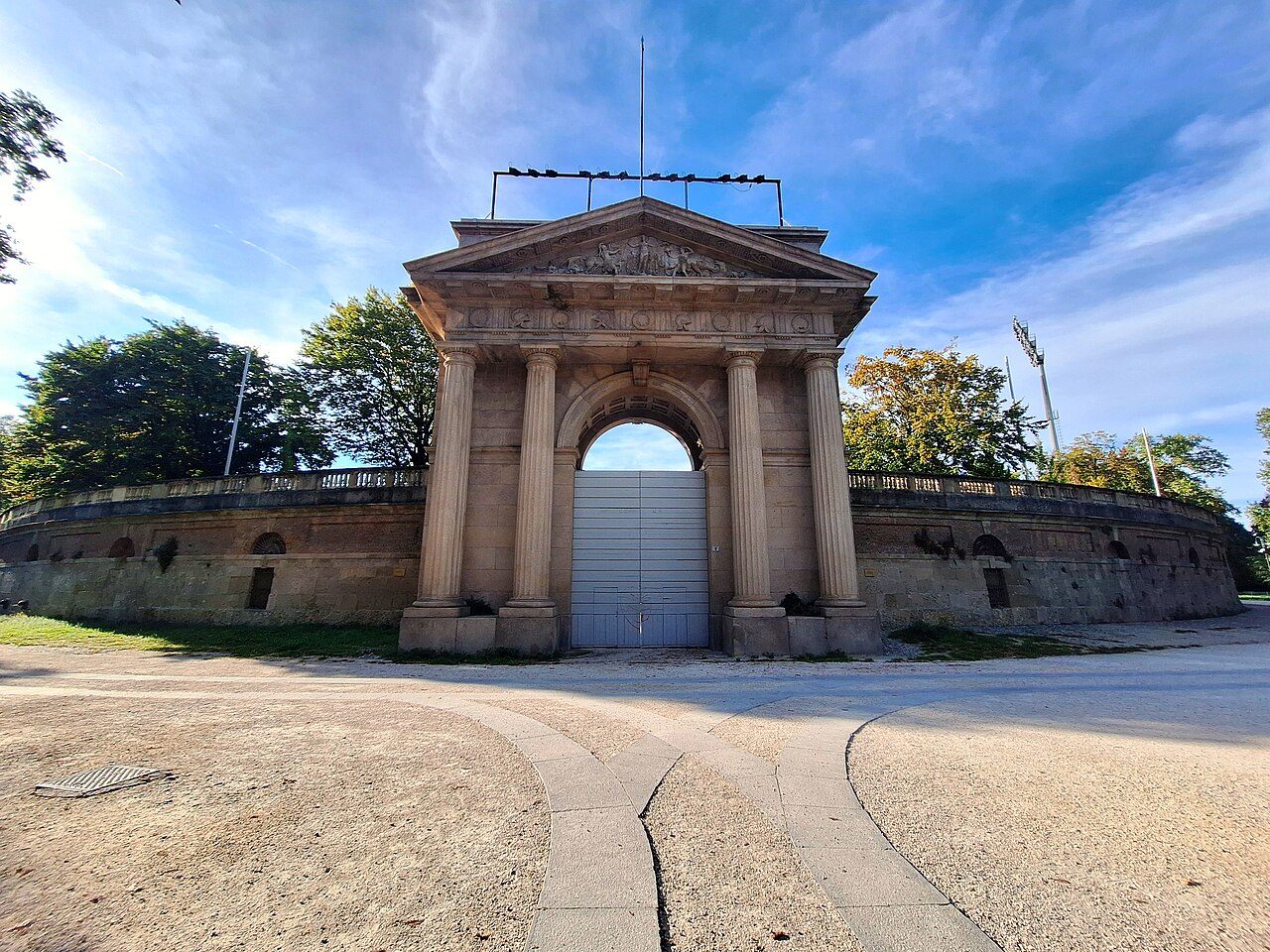
An ancient-style amphitheater commissioned in Napoleon's Milan and opened in 1807, built with stones from the Castello's fortifications. The track was flooded here for naval battles. In 1910 Italy's national soccer team made its debut here.
Spot the detail
Along the enclosure, find the entrance that looks like a small triumphal arch. Does it remind you of anything?
The full story
From outside it is a long curved wall among the trees. Inside is the Arena Civica, the city arena, a stadium more than two centuries old, built for a show you wouldn't expect: naval battles.
A Roman circus for Napoleon
We are in the same years as the Arco della Pace, the triumphal arch at the far end of the park. Milan is the capital of Napoleon's kingdom and wants buildings worthy of a capital. The project goes to Luigi Canonica, the official state architect. The model is a circus of ancient Rome, on the Appian Way.
The shape is a long ellipse, almost 240 meters by 120, some 790 feet from end to end. It held up to thirty thousand spectators.
The stones are salvaged. They come from the fortifications of the Castello Sforzesco, the dukes' fortress, dismantled in those years, and from the ruins of the castle of Trezzo sull'Adda. To save money, the tiers were made of turf instead of stone.
Ships in the city center
The inauguration is in December 1807, and Napoleon is there in person. On the program is a , a mock naval battle, like those staged in ancient Rome.
That is not a figure of speech. The water came from a nearby canal and really did flood the track. In winter it could freeze, and then people slid across it.
Buffalo Bill and the ball
All through the 1800s the Arena is where Milan goes to have fun. Horse races, fireworks, hot-air balloon ascents, even Buffalo Bill's circus.
Then comes sport. In 1910 the Italian national soccer team plays its first match here, and beats France six to two. In the 1930s and 1940s it is the home stadium of Inter. Today it bears the name of Gianni Brera, journalist and writer.
Not everything is celebration. In December 1943 eight anti-Fascists were shot inside these walls. A plaque remembers them.
So the tour ends as it began, with Napoleon. At the Arco he wanted triumphs, here games. In between, two centuries later, there is a park where everyone is welcome.
About this stop
Anecdote
The first Giro d'Italia ended at the Arena
The Arena Civica, the nineteenth-century stadium inside Milan's Parco Sempione, is where the first Giro d'Italia, Italy's great bicycle race, came to an end. It was May 30, 1909, and more than twenty thousand people were waiting for the riders. The winner was Luigi Ganna, a bricklayer from Lombardy who as a young man rode his bicycle to work in Milan, about a hundred kilometers a day there and back. At the finish, reporters asked him what his most vivid impression was. Ganna answered in dialect that his backside was burning badly. More than a century later, it is still the best-remembered line of that Giro.
Record
Italy's first national team wore white
Italy's national soccer team played its first match in Milan, at the Arena Civica, the stadium inside Parco Sempione. It was May 15, 1910: Italy against France, six to two, in front of about four thousand people. There was nothing blue about that day. The players took the field in a white jersey, apparently because it cost less. The blue arrived the following year, in the third match. They say that at the end of the game the crowd threw packs of cigarettes onto the field: that was the prize for the first Azzurri, the Blues, who were not blue yet.
Yes. The Arena was designed in the early 1800s on the model of Roman circuses, and as in ancient Rome it was also meant to host , mock naval battles. The water came from a nearby canal and flooded the track. A naumachia was staged for the inauguration in December 1807, in the presence of Napoleon. And it was not the only one: over the course of the 1800s the Arena was flooded several more times.