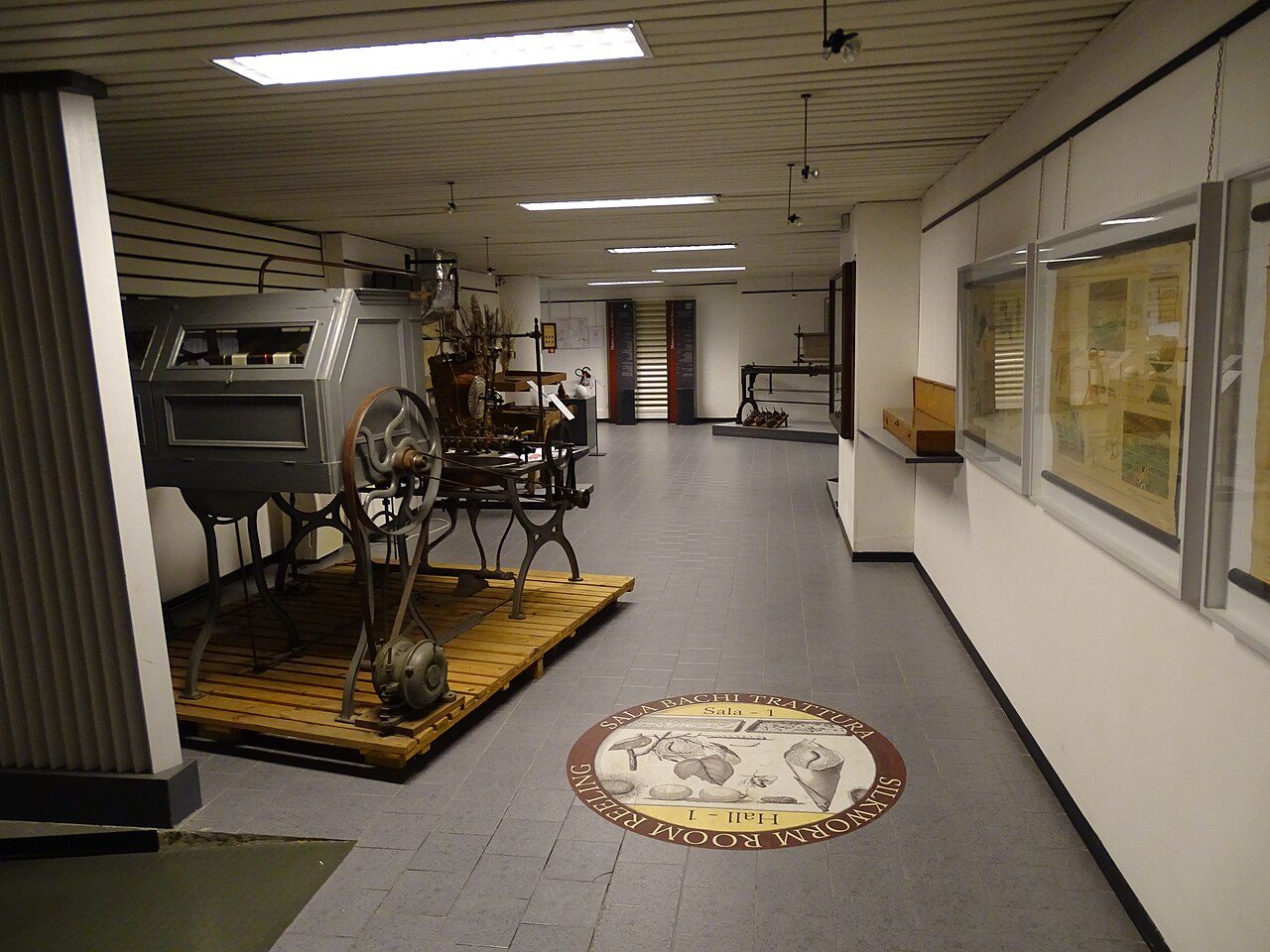
Museum · The Borghi · 1990
Museo della Seta
From caterpillar to scarf: the silk factory, one machine at a time
In brief
In the basement of the Setificio, Como's silk school, the whole production chain that made the city rich: silkworms, reeling, looms, dye works, printing tables. The machines are real, rescued from factories as they closed.
Stories of this place
- Legend · The silkwormReadThe empress's cup of teaThe Museo della Seta, Como's silk museum, begins with the silkworms, and according to Chinese legend silk itself began by accident, almost five thousand years ago. Leizu, wife of the mythical Yellow Emperor, was drinking tea when a cocoon fell into her cup and began to come apart into a fine thread. Curious, she unwound it. Tradition also credits her with inventing the silk loom. How much of it is true, nobody knows. But the detail about the hot water is accurate: that is exactly how cocoons were softened in the reeling mill to find the end of the thread.
- In culture · The silkwormReadPliny and the silk that grew on treesAt the Museo della Seta, Como's silk museum, everything starts with the silkworm. But Pliny the Elder, the Roman writer born in Como in 23 AD, was convinced that Eastern silk grew on trees. In his Naturalis historia he says the Seres, the distant people it came from, combed it off wet leaves like white down. On the rest he had clear ideas. So much labor, he writes, so Roman ladies can appear in public in see-through clothes. And he reckons that India, the Seres and Arabia drain the empire of one hundred million sesterces a year. Almost fifteen centuries later, his city would make a trade of it.
- In culture · The filandinaReadIco Parisi's lost film on silkAt the Museo della Seta, Como's silk museum, a dedicated room shows a film long believed lost. Between 1937 and 1939 Ico Parisi, barely past twenty and later a successful designer, shoots a documentary on silk in the Como area with Pino Costamagna and Giovanni Galfetti: thirty-three minutes that follow the production chain from the fields to the sale, without hiding the children's work or the women's toil. Then the film vanishes. In the mid-1990s the silk entrepreneur Michele Canepa gives the museum a copy on videotape. In 2021 the museum began restoring and digitizing it.
- Anecdote · The filandinaReadThe cooked hands of the reeling womenFacing the filandina, the reeling machine at the Museo della Seta, Como's silk museum, look at the basin and think of hands. The reeling women, who unwound the cocoons, kept theirs in hot water all day, close to boiling where they sought the thread's end. The newspaper Corriere del Ticino reported what Olga Ceppi, among the last reeling women of Switzerland's Canton Ticino, told a 1989 television documentary. She spoke in dialect: hands were cooked, like a chicken cooked too long, after fourteen or fifteen hours in water. A Lombard mill song is harsher: el mestè de la filanda l'è el mestè degli assassini, a trade for murderers.
- In culture · The torcitoioReadRenzo, the most famous silk spinnerIn front of the throwing machine at the Museo della Seta, Como's silk museum, think of Renzo Tramaglino, the hero of Alessandro Manzoni's novel I promessi sposi, The Betrothed: he is the best-known silk worker in Italian literature. Renzo is a silk spinner, a profession, Manzoni writes, hereditary, so to speak, in his family. The novel, set in the 1600s on the other branch of Lake Como, describes it as a once very profitable trade now in decline, so much so that many workers were emigrating to neighboring states. Renzo also has a small plot of land, which he farms when the mill is idle.
- Anecdote · The torcitoioReadThe English spy and the silk millThe torcitoio, the throwing machine at the Museo della Seta, Como's silk museum, is heir to an Italian machine, the silk mill, which in the early 1700s was at the center of an industrial espionage case. An earlier mill in Derby, England, had failed. John Lombe, who had worked there, went to Piedmont and returned with machine drawings and some Italian workers. A few years later a five-story mill rose in Derby, seen as an ancestor of the modern factory. Lombe died in 1722. By a tradition recorded almost seventy years later by William Hutton, a Derby historian, a woman sent from Italy poisoned him. There is no proof.
- In culture · The looms and the Jacquard systemReadThe loom that taught computersIn the weaving section of the Museo della Seta, Como's silk museum, stands a Jacquard loom driven by a chain of punched cards: the system devised in the early 1800s by the Frenchman Joseph-Marie Jacquard. Those cards are considered an ancestor of the computer. Charles Babbage, the English mathematician who designed the analytical engine, planned to program it with punched cards like the weavers'. He owned a portrait of Jacquard woven in silk in 1839: it took 24,000 cards. In 1890 punched cards processed the American census, and from there entered the computing industry. When you look at those cards stitched in a row, you are looking at a program.
- Anecdote · The laboratories: measuring and inventing colorReadThe silk that came down from the skyAmong the measuring instruments of the Museo della Seta, Como's silk museum, in the laboratory section, is a burst tester, the device that checks how much strain a fabric can take. It has a military past. During the Second World War, silk in Como was used to make parachutes for airborne troops, and the quality of that silk was certified with this very instrument. The museum itself tells the story. Look at it with that in mind: for a few years, a lab test carried out here decided whether a cloth was good enough to hold a man in the air.
- Anecdote · The dye worksReadMachines saved from the dumpThe Museo della Seta, Como's silk museum, was born from a rescue. In the early 1980s the Tintoria Pessina, a dye works in business since 1904, is heading for closure and its machines are bound for the dump. Among the heirs another idea takes hold: keep them, to preserve the memory of silk work in Como. Right across the street stood the new buildings of the Setificio, the silk school. The first machines find a home there, today in the dyeing section, and around them forms the group that will open the museum in 1990. Since then, many closing firms have donated their materials.
- Record · FinishingReadMoiré: thirty tons for a shimmerIn the last part of the Museo della Seta, Como's silk museum, an old wooden machine serves a single effect: moiré, the watered look, those veins that seem to move across silk. It is neither a pattern nor a color. The cloth was folded in two, with the weft threads of the two halves lined up perfectly. Being off by one or two threads turned the motif into a messy wave. Two workers followed it, seated face to face. Then the fabric passed between two cylinders, one heated above 100 degrees Celsius, under a pressure the catalog record puts at about thirty metric tons. Thirty tons, for a shimmer.
Ready-made questions
There is no single reason. Silk arrives in the first half of the 1500s, in a city that already lived off textiles, mainly wool. Then there is the water, which drove the machines, and the surrounding countryside, where silkworms were raised and raw silk was produced. From the 1700s weaving spreads across the Como area. In the 1800s come industry and a purpose-built school, the Setificio. The museum's director adds one more ingredient: a reputation for hard work, which apparently impressed even Empress Maria Theresa of Austria.
No. Raising silkworms is the only stage of the process no longer carried out in Italy: according to the museum, the now come from countries such as Vietnam, India and Cambodia. In the 1970s the Chamber of Commerce tried to revive it with an experimental center at Cassina Rizzardi, near Como, but the experiment ended in 1980. What has stayed in the city is what comes afterward: dyeing, printing and . And that is a lot: again according to the museum, more than 70 percent of the silk that reaches Europe passes through here.
Go to stop: The silkwormBecause that is where it was born. The school is the Setificio, founded in the late 1860s to train technicians for the silk industry: UNESCO lists it as the oldest textile school in Italy. When the machines saved from the Tintoria Pessina needed a home, the provincial government, which owns the building, offered some disused rooms in the basement. The museum's director has called it the cellar of the Setificio and compared the entrance to Ulysses' descent into the underworld. Then, he writes, the door opens and you change your mind.
A lot, and all in one piece. The museum speaks of an unbroken thread two kilometers long; other sources give anything from a few hundred meters to a kilometer and a half. But it is so fine that on its own it is useless: in the mill seven were joined to make a workable thread. And the yield was low. A filandina like the one on display produced about half a kilo of silk in eight hours of work. That helps explain why silk has always been a luxury fabric.
Go to stop: The filandinaThe museum gives two reasons, and the first is the less noble one: they were paid less than men. The second is technical. Rejoining a broken thread with a weaver's knot, flat and nearly invisible, took slim fingers and nimble hands. Raising silkworms, which was done at home, also fell to women and children. The documentary shot in the Como area in the late 1930s by Ico Parisi, which the museum screens, highlights exactly this: child labor and the role of women, inside and outside the home.
Go to stop: The filandinaIt lies in the moment the pattern is born. In figured silk the pattern is woven: it is the threads themselves, raised and lowered by the Jacquard loom according to the holes in the cards, that form the motif. In printed silk the fabric starts out plain and the pattern is applied afterward, with wooden blocks or with screens, one color at a time. In the museum you see both routes, first at the looms and then in the print shop.
Go to stop: Printing: wooden blocks and screensIn the lake, by way of the stream. The museum tells it without prettying it up: once the dyeing was done, the contents of the vat were tipped onto the floor and drained into the waterways beside the dye works, which flowed into the Cosia and from there into Lake Como. Water was the resource that had drawn textile firms to this district, because it powered the machines. For a long time it was also their drain.
Go to stop: The dye worksThe stops
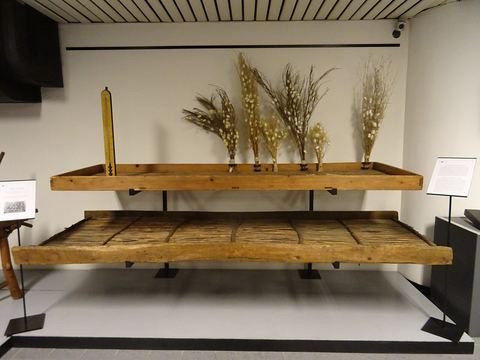
1 The silkworm
It all starts with a caterpillar that eats nothing but mulberry leaves. In two or three days it seals itself inside a cocoon made of a single thread: the raw material of everything you will see in the museum.
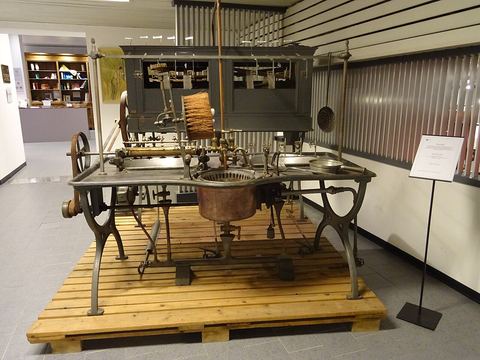
2 The filandina
This is where the cocoon becomes thread. The operation is called reeling and it was done in the filanda, the reeling mill, with hands in hot water. It was work for women and girls.
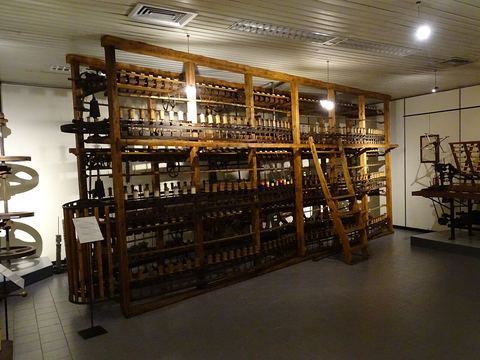
3 The torcitoio
A wooden machine from 1870 that twists hundreds of threads at once. Without twist, silk thread frays apart; with the right twist it becomes a strong yarn, softer or shinier depending on how it is worked.
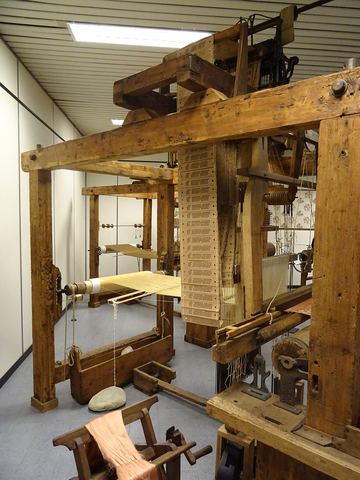
4 The looms and the Jacquard system
This is where thread becomes cloth. The handlooms show how warp and weft interlace; the Jacquard loom, with its punched cards, shows how a pattern is woven. And it looks a lot like a computer.
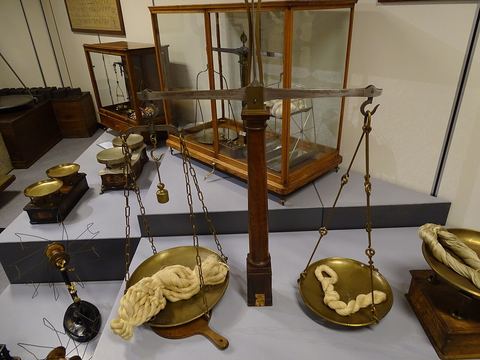
5 The laboratories: measuring and inventing color
Silk was worth a lot and had to be checked with no cheating. Here are the instruments that measured it, including the one that tested parachute silk, and the laboratory where color recipes were born.
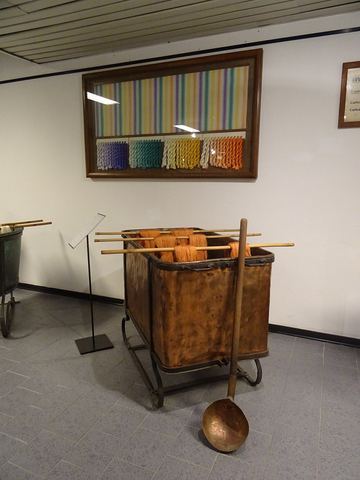
6 The dye works
First the thread's natural glue is washed away, then comes the dyeing: thread in the copper vat, cloth in the wooden one. A dye works like this, the Pessina, is where the museum began.
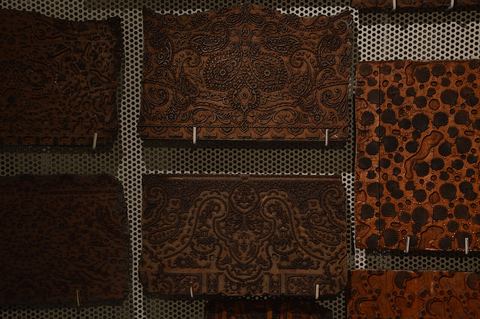
7 Printing: wooden blocks and screens
Patterns printed on silk are one of Como's specialties. First it was done with wooden blocks struck by hand, one color at a time; then with screens, which means screen printing.
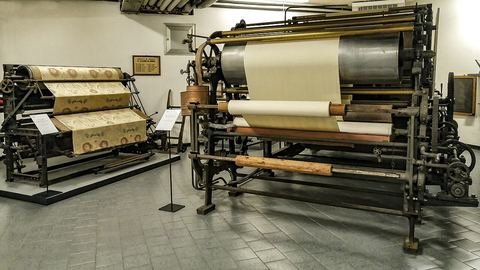
8 Finishing
The last step before sale. The fabric is pressed, pleated or given a moiré effect: this is where silk takes on its final look and feel.
Timeline
- 1510From this date, according to the Treccani encyclopedia, Como's economy also rests on silk production.
- 1868The Setificio school is founded to train technicians for the silk industry. Some sources say 1869.
- 1870The year of the 288-bobbin torcitoio now on display in the museum.
- 1904Gaetano Pessina founds the dye works whose machines will form the core of the collection.
- 1937–1939Ico Parisi, Pino Costamagna and Giovanni Galfetti shoot in the Como area the silk documentary now screened in the museum.
- 1968–1975The Setificio's new home is built to a design by Lorenzo Muzio and Franco Tartaglino. The museum will occupy its basement.
- 1990On October 4 the Museo didattico della Seta opens, promoted by the associations Amici del '27 and Ex allievi del Setificio.
- 2021Como joins the UNESCO Creative Cities Network for crafts and folk art.
Who's who
Gaetano Pessina
founder of the Tintoria Pessina
In 1904 he opens the dye works in Como that bears his name. Closed in 1985, it left its machines to the museum: they are the core of the collection.
Joseph-Marie Jacquard
French inventor
In the early 1800s he perfects the loom controlled by punched cards, which lets a single weaver produce complex patterns.
Ico Parisi
designer
Born in Palermo in 1916, died in Como in 1996, an apprentice in Giuseppe Terragni's studio. As a young man he co-authored the silk documentary screened in the museum.
Leizu
legendary empress of China
Wife of the mythical Yellow Emperor. Tradition credits her with discovering silk, thanks to a cocoon that fell into a cup of tea.
William Henry Perkin
English chemist
In 1856, at eighteen, he tries to synthesize quinine and instead gets a purple dye from aniline: one of the first synthetic dyes.
Lorenzo Muzio
architect
With Franco Tartaglino he wins the competition for the new home of the Setificio school, built between 1968 and 1975. The museum occupies its basement.
Words to know
Where it is
The neighborhood
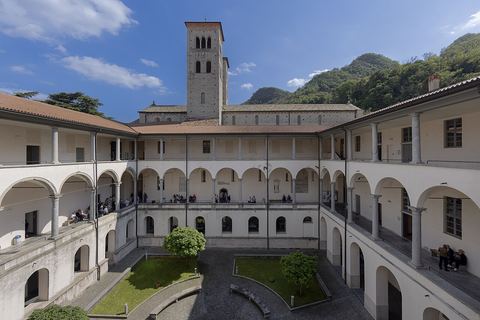
The Borghi
Related places
The story of the place
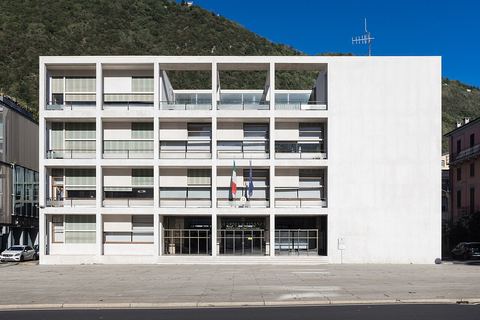
Don't expect a palace. The Museo della Seta, Como's silk museum, sits underneath a school, in a basement that its own director has called the cellar of the Setificio. Go down anyway: behind the door is the industrial history of Como, told by the machines that made it.
Silk comes to Como
Silk reached the city in the first half of the 1500s and never left. For centuries it gave work to farmers, girls, weavers, dyers, printers. Part of the reason, the director says, is water. The Cosia, the stream that runs close by, powered the textile factories of this district from the mid-1800s to the early 1900s.
How the museum began
The museum was born from a rescue. In the early 1980s the Tintoria Pessina, a dye works that had opened in 1904 right across the street, was heading for closure and its machines were bound for the dump. The heirs decided to keep them.
Two associations gathered around them, the Amici del '27 and the Ex allievi del Setificio, the school's alumni, and the provincial government provided the rooms. Other companies that were closing gave looms, instruments, archives. On October 4, 1990, the museum opened.
The building belongs to the Setificio, the school founded in the 1800s to train technicians for the silk industry. It was designed by the architects Lorenzo Muzio and Franco Tartaglino and built between 1968 and 1975.
How the visit works
The visit follows the thread, literally. You start with the silkworm eating mulberry leaves and end with fabric pressed and ready for sale, passing through the mill, the machine, the looms, the laboratories, the dye works and the print shop. That is the museum's strength: not a collection of precious fabrics, but the work behind them. You can also follow the route with your hands and your nose, thanks to a tactile trail and a scent trail.
One warning. Nearly everything you see tells the story of silk between the late 1800s and the early 1900s, but this is not archaeology. Silkworms are no longer raised here.
And yet, according to the museum, more than 70 percent of the silk that reaches Europe still passes through Como to be dyed, printed and finished. Since 2021 the city has been one of UNESCO's Creative Cities for crafts.
If you are short on time, go for four things: the silkworms, the machine, the loom with the punched cards and the wall of printing blocks. When you leave, you will never look at a scarf the same way again.
Sources
- Museo della Seta di Como, sito ufficiale (opens in a new tab)Official site
- Una visita al museo attraverso 10 sale, Museo della Seta di Como (opens in a new tab)Official site
- La seta di Ico, comunicato del Museo della Seta di Como (opens in a new tab)Official site
- Fondazione della Seta ETS, Museo della Seta di Como (opens in a new tab)Official site
- Paolo Aquilini e redazione, Il Museo della Seta di Como, A Campione n. 3, 2020 (opens in a new tab)Other source
- Valentina Longoni, Proposta di un itinerario dell'industria serica comasca, Geotema 35-36, Associazione dei Geografi Italiani (opens in a new tab)Institution
- Como, Enciclopedia Treccani (opens in a new tab)Encyclopedia
- Como, UNESCO Creative Cities Network (opens in a new tab)Institution
- Museo della seta di Como, Wikidata (opens in a new tab)Other source
- Museo della Seta, OpenStreetMap (opens in a new tab)Other source
- La torcitura e le origini del mulino da seta, Fondazione Museo Civico di Rovereto (opens in a new tab)Institution
- The French Connection, Distillations, Science History Institute (opens in a new tab)Institution
- The Hollerith Machine, United States Census Bureau (opens in a new tab)Institution
- Alessandro Manzoni, I promessi sposi, capitolo II, Wikisource (opens in a new tab)Other source
- Carlo Silini, Quel filo luminoso tra noi e Como, Corriere del Ticino, dal sito del Museo della Seta di Como (opens in a new tab)Other source
- Macchina per tracciare il moire, scheda SIRBeC 6m020-00172, Lombardia Beni Culturali (opens in a new tab)Catalog
- Filandina Battaglia, scheda SIRBeC 6m020-00297, Lombardia Beni Culturali (opens in a new tab)Catalog
- Key Sites: The Silk Mill, Derwent Valley Mills World Heritage Site (opens in a new tab)Institution
- Coloured drawing depicting Lombe's silk throwing machine, Science Museum Group Collection (opens in a new tab)Catalog
- Pliny the Elder, The Natural History, libro VI, capitolo 20, Perseus Digital Library, Tufts University (opens in a new tab)Institution
- Pliny the Elder, The Natural History, libro XII, capitolo 41, Perseus Digital Library, Tufts University (opens in a new tab)Institution
- Plinio il Vecchio, Enciclopedia Treccani (opens in a new tab)Encyclopedia
- Mama mia mi sun stufa, canto di filanda, ilDeposito.org (opens in a new tab)Other source
- Mama mia mi sun stufa, Wikisource in italiano (opens in a new tab)Other source
- Lombe, Sir Thomas, Dictionary of National Biography 1885-1900, Wikisource in inglese (opens in a new tab)Encyclopedia
- Pliny the Elder, The Natural History, libro XI, capitolo 26, Perseus Digital Library, Tufts University (opens in a new tab)Institution
- Jeremy Swan, articolo sul Derby Silk Mill e John Lombe, University of Derby (opens in a new tab)Institution
- Thomas Lombe (1685 – 1739), Revolutionary Players, History West Midlands (opens in a new tab)Institution
- Pierluigi Zenoni, Le filandaie, Istituto sondriese per la storia della Resistenza e dell'Età contemporanea (opens in a new tab)Institution
- Seta, Enciclopedia Italiana Treccani (opens in a new tab)Encyclopedia
- Macchina per moire, scheda SIRBeC 6m020-00222, Lombardia Beni Culturali (opens in a new tab)Catalog
- Museo didattico della Seta di Como, Wikipedia in italiano (opens in a new tab)Wikipedia
- Seta, Wikipedia in italiano (opens in a new tab)Wikipedia
- Telaio Jacquard, Wikipedia in italiano (opens in a new tab)Wikipedia
- Jacquard machine, Wikipedia in inglese (opens in a new tab)Wikipedia
- Leizu, Wikipedia in inglese (opens in a new tab)Wikipedia
- Mauveine, Wikipedia in inglese (opens in a new tab)Wikipedia
- Ico Parisi, Wikipedia in italiano (opens in a new tab)Wikipedia
- Renzo Tramaglino, Wikipedia in italiano (opens in a new tab)Wikipedia
- Como, Wikipedia in italiano (opens in a new tab)Wikipedia
- John Lombe, Wikipedia in inglese (opens in a new tab)Wikipedia
- Lombe's Mill, Wikipedia in inglese (opens in a new tab)Wikipedia
- Histoire de la soie, Wikipedia in francese (opens in a new tab)Wikipedia
- Moire (fabric), Wikipedia in inglese (opens in a new tab)Wikipedia