In culture · The looms and the Jacquard system
The loom that taught computers
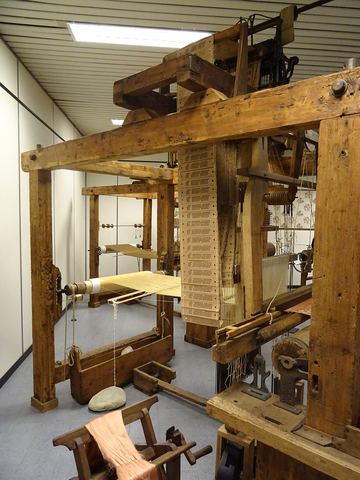
In the weaving section of the Museo della Seta, Como's silk museum, stands a Jacquard loom driven by a chain of punched cards: the system devised in the early 1800s by the Frenchman Joseph-Marie Jacquard. Those cards are considered an ancestor of the computer. Charles Babbage, the English mathematician who designed the analytical engine, planned to program it with punched cards like the weavers'. He owned a portrait of Jacquard woven in silk in 1839: it took 24,000 cards. In 1890 punched cards processed the American census, and from there entered the computing industry. When you look at those cards stitched in a row, you are looking at a program.
The stop
Stop 4 of 8
The looms and the Jacquard system
The place
Museum
Museo della Seta
More stories
- Anecdote · The laboratories: measuring and inventing color
The silk that came down from the sky
Among the measuring instruments of the Museo della Seta, Como's silk museum, in the laboratory section, is a burst tester, the device that checks how much strain a fabric can take. It has a military… - Anecdote · The dye works
Machines saved from the dump
The Museo della Seta, Como's silk museum, was born from a rescue. In the early 1980s the Tintoria Pessina, a dye works in business since 1904, is heading for closure and its machines are bound for… - Record · Finishing
Moiré: thirty tons for a shimmer
In the last part of the Museo della Seta, Como's silk museum, an old wooden machine serves a single effect: moiré, the watered look, those veins that seem to move across silk. It is neither a pattern…