Museum · Historic Center · 1953
Museo del Duomo
The Duomo brought down to earth: statues, stained glass and gold at arm's length
In brief
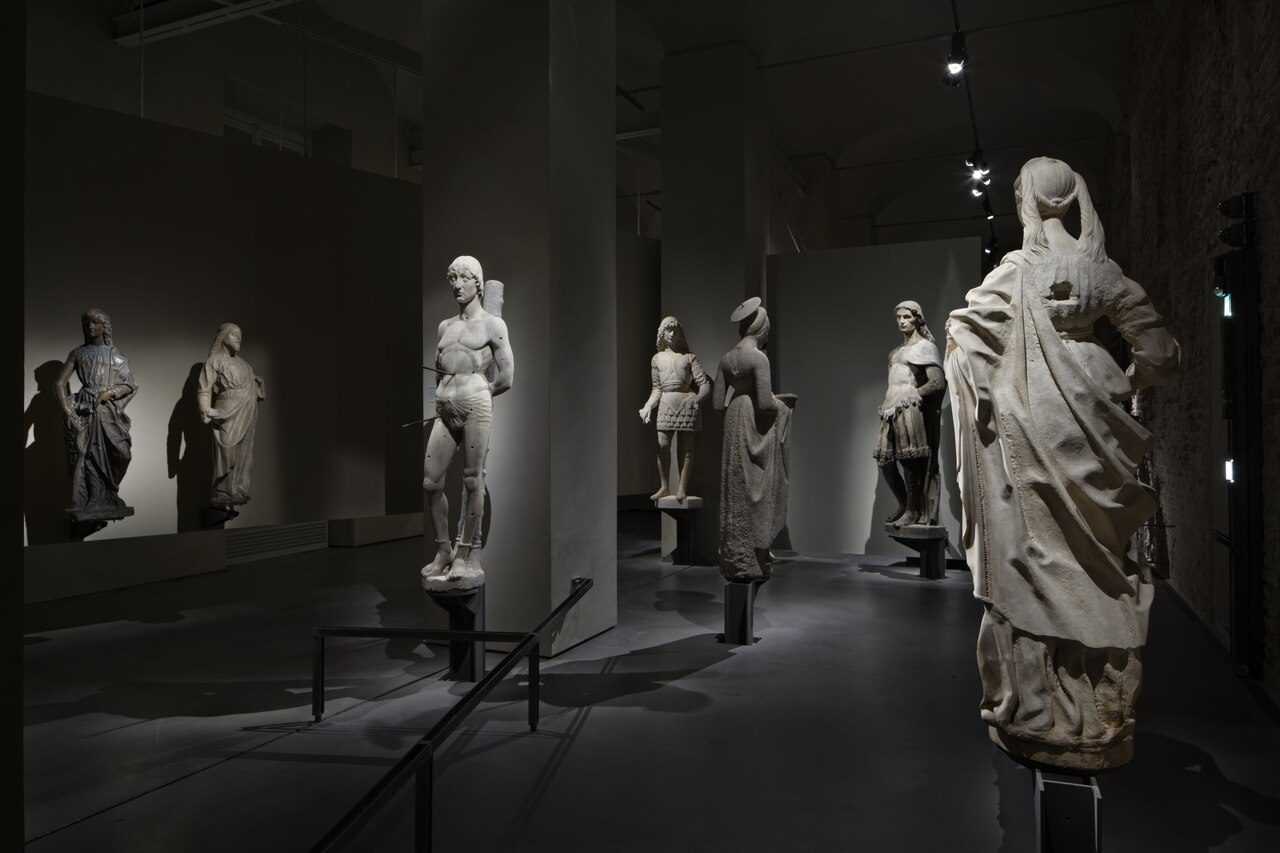
On the ground floor of Palazzo Reale, the former royal palace beside the cathedral, are the real pieces of the Duomo: statues taken down from the spires, stained glass, tapestries, the Treasury and a wooden model five meters tall. Here you see up close what sits too high in the church to be seen.
Stories of this place
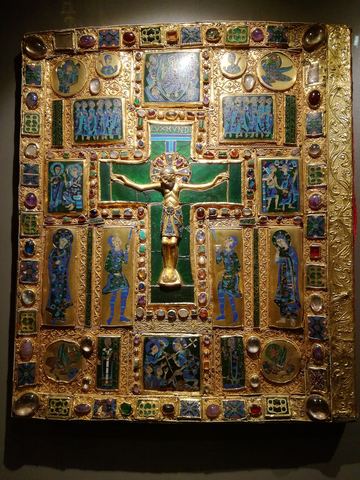
- Anecdote · The TreasuryReadA feather miter from MexicoAmong the gold of the Duomo's Treasury, on display in the museum's first rooms, there is one object that owes its colors neither to gold nor to gems. It is a miter, the headdress of bishops, with scenes of the Passion. The colors are not painted: they are the feathers of tropical birds, glued onto agave paper and cloth. It was made in Mexico, in the sixteenth century, by the amanteca, the feather craftsmen. Pope Pius IV gave it to his nephew Carlo Borromeo, archbishop of Milan. A few decades after the conquest of Mexico, a piece of America was already in Milan.
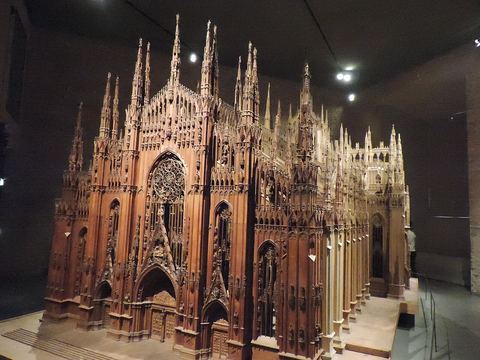
- Anecdote · The ModelloneReadThe facade that exists only in woodIn the museum stands the Modellone, a wooden Duomo over five meters tall, and its facade is not the real one. In 1886 the Fabbrica, the body that builds and maintains the cathedral, held a competition to redo the facade, the one Napoleon had wanted, which many disliked. The winner was a very young architect, Giuseppe Brentano, with a neo-Gothic design: three pointed-arch entrances and lacy gables. Brentano died in 1889, not yet thirty, and the facade was never redone. His design was built once, though, at a scale of 1 to 22, on the Modellone. There the Duomo has the face it might have had.
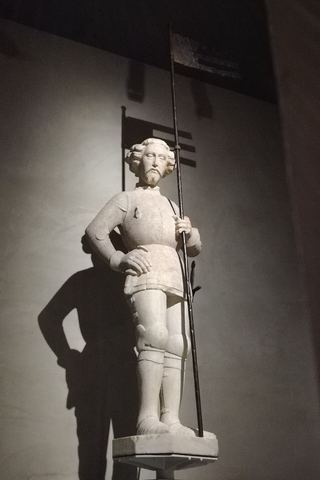
- Anecdote · San Giorgio and the first spireReadThe merchant who bought himself a spireThe oldest spire on the Duomo is named after neither a saint nor a duke. It honors a merchant. Marco Carelli was hugely rich, and at the end of the fourteenth century he left everything to the Fabbrica, the body building the cathedral: over sixty houses, warehouses of goods and other property, worth 35,000 ducats. Alone he outdid all the offerings collected by the site that year. The Fabbrica regards him as the forefather of its donors. In return he got the first spire, and on top of it the San Giorgio statue now in the museum. Proof that the city paid for the Duomo, not just the court.
- Anecdote · San Giorgio and the first spireReadThe sculptor who vanished into thin airVery little is known about Giorgio Solari, the sculptor of the San Giorgio that came down from the Duomo's oldest spire and is now in the museum. The documents mention him almost only for the Duomo, between 1397 and 1405, where he carved a few statues. Then his name disappears from the archives. Recent research suggests a lead: he may have moved to Venice. On the roofline of St. Mark's Basilica there is in fact a San Michele that looks strikingly like the warrior in Milan. It is a hypothesis, not a certainty. But if you pass through Venice, look up.
- Anecdote · The Padre EternoReadA God designed for the darkThe Padre Eterno, the large gilded head of God the Father on display in the museum's Visconti room, was meant to be Candoglia marble, like the whole Duomo. Instead it was made of embossed copper, silvered and gilded, so its gleam would stand out in the cathedral's half-light. The job went to a goldsmith, Beltramino de Zutti, not a sculptor. From 1426 the head shone above the high altar, at the top of the apse vault. In 1964 the Fabbrica, the body that runs the Duomo, took it down to protect it. The one in the cathedral today is a bronze and copper copy, put up on March 11, 1965.
- Anecdote · Gargoyles, saints and a dukeReadThe stonecutters' saintAmong the statues that came down from the flanks of the Duomo into the museum there is a Santa Lucia, Saint Lucy, holding a small dish. On the dish are her eyes: they are the symbol of her martyrdom, and the reason people pray to her for their sight. But at the Duomo she had an extra job. She was the patron saint of the building site's stonecutters, who risked a splinter in the eye every day as they worked the marble. She was carved around 1470 by a master who has remained nameless. Scholars consider her one of the most original statues of the cathedral.
- In culture · The stained glassReadArcimboldo before the fruit headsGiuseppe Arcimboldo is the painter of heads made of fruit, vegetables and animals, painted for the Habsburg emperors. Before that, though, he was an artist of the Duomo. Between 1549 and 1558 he worked for the cathedral, at first alongside his father Biagio, and prepared the cartoons, the full-size drawings, for some of the stained glass windows. One, with the stories of Saint Catherine of Alexandria, is still in the church. In the museum's stained glass room, scholars attribute to him the design of one panel, the Creation of the Firmament. In 1562 he left for the imperial court, and the rest is art history.
- Anecdote · Tintoretto and the Gonzaga tapestriesReadThree tapestries gone up in smokeThe series of tapestries with the Stories of Moses, on display in the museum, once numbered seven pieces: six stories and a scene of cherubs at play. The Gonzaga, dukes of Mantua, had ordered them in the mid-sixteenth century, Duke Guglielmo had given them to Carlo Borromeo, archbishop of Milan, and he had passed them on to the Duomo. In 1906 Milan hosted the International Exposition, and three tapestries were shown in the decorative arts pavilion. On August 3 the pavilion burned down. Moses before Pharaoh, the Passover and the Gathering of the Manna were gone. The four that were saved are the ones you see today.
- Anecdote · The skeleton of the MadonninaReadThe Madonnina sculptor's entrance examTo join the sculptors of the Fabbrica del Duomo, the body that builds and maintains Milan's cathedral, you had to pass a test of skill, alone or in competition with other candidates. One of these tests has come down to us, signed: a Hercules Slaying the Nemean Lion, from 1754. Its author is Giuseppe Perego. He passed the exam, and some fifteen years later the Fabbrica entrusted him with the model for the statue to be set on the tallest spire. It was the Madonnina, the symbol of Milan. In the museum the exam piece and the model are a few rooms apart.
- In cultureReadFontana, Minguzzi and the last doorIn 1950 the Duomo was missing just one bronze door, the first on the right of the facade. The Fabbrica, the body that runs the cathedral, held a competition on the theme of the cathedral's origins and history. After a first selection three were left, and in 1952 the jury declared two sculptors equal, Lucio Fontana and Luciano Minguzzi. Only years later did the Fabbrica choose Minguzzi: his style seemed to it better suited to the Duomo than Fontana's, poised between figure and abstraction. The door was inaugurated on January 6, 1965. The sketch models from the competition are in the last room of the museum.
Ready-made questions
To save them. Many stood out in the open, on the and flanks of the cathedral, exposed to the rain and later to the smog. Others were damaged by the bombings of 1943. The took down the most fragile or most precious originals and brought them here, especially after World War II. There is another advantage too: in the church many works sit so high up that nobody really manages to see them.
In some places, yes. On top of the Carelli there is a copy of the San Giorgio, made by the Fabbrica in the 1950s. Above the high altar, at the center of the apse vault, shines a copy of the Padre Eterno, put there in 1965. It is not a trick: it is the way the Duomo has been kept going for centuries. The Fabbrica replaces the worn-out pieces and puts under cover the ones that cannot be remade.
It is the body that built the Duomo and still maintains it today. It was founded by Gian Galeazzo Visconti, lord of Milan, in 1387, to coordinate the design, the building site and the upkeep of the new cathedral. It has never closed. It owns the museum, and almost everything you see here comes from its storerooms and workshops. The exception is the Treasury, which belongs to the Chapter, the college of the Duomo's canons.
For deciding. A drawing shows a facade or a floor plan, but it does not make clear how the parts of a building fit together. A model does. On cathedral building sites, models were used to try out solutions and check proportions. The Modellone, begun in 1519, was updated for centuries, until 1891, following the growth of the cathedral. That is why it is so big: it had to show the details too.
Go to stop: The ModelloneFrom the bottom up. Every window in the Duomo is made of many panels, the , and each one tells a scene. The story starts at the bottom and climbs. In the church it is almost impossible to follow, because the highest antelli are a very long way off. In the stained glass room, though, you have them right in front of you, arranged by the window they come from. Start with Genesis: the creation of the world takes up several panels.
Go to stop: The stained glassNo. The real Madonnina is still in its place, on top of the tallest , where it has been since December 1774. Here you find what lies behind it. There is the original iron frame, replaced in 1967 with a steel one. There are the terracotta models by the sculptor Giuseppe Perego and a full-size wooden model of the head. In a courtyard along the route there is also a copy of the statue, which you can look at up close.
Go to stop: The skeleton of the MadonninaBecause it is right next door. The palace stands beside the Duomo and was for centuries the seat of power in Milan, first of the city government and then of the dukes. In 1948 the state granted the Fabbrica a few rooms on the ground floor of the oldest wing, and in 1953 the museum opened. In the same year, and in the same palace, Milan saw something else memorable: Picasso's Guernica, shown in the Sala delle Cariatidi, the Hall of the Caryatids, still scarred by the bombs.
The stops
1 The Treasury
The most precious and most ancient objects in the museum: fifth-century ivories, medieval crosses, chalices. Some already existed nine centuries before the Duomo. And there is a miter made of feathers that came from Mexico.
2 The Modellone
A wooden Duomo more than five meters tall, at a scale of 1 to 22. It was begun in 1519 to help the architects decide, and updated for almost four centuries. It is the cathedral's design in three dimensions.
3 San Giorgio and the first spire
The statue that stood for more than five centuries on top of the Duomo's oldest spire. Carved in 1403, it fell under the bombs in August 1943. According to tradition it has the face of Gian Galeazzo Visconti.
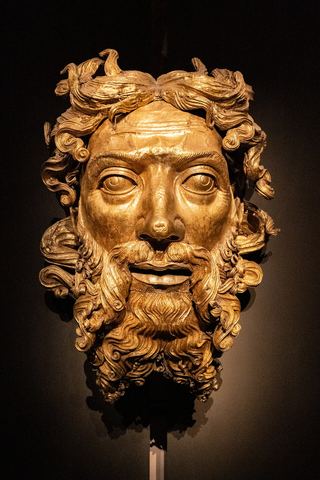
4 The Padre Eterno
A head of God more than a meter tall, in gilded copper. From 1426 it closed the vault of the apse above the high altar, where nobody could see it properly. Here you look it in the face.
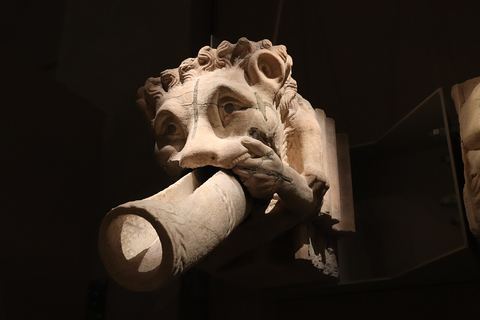
5 Gargoyles, saints and a duke
Monsters that drained off the rain, fifteenth-century saints and the portrait of a duke. These are the sculptures that stood outside, on the flanks of the Duomo. The most original is a Santa Lucia who protected the stonecutters' eyes.
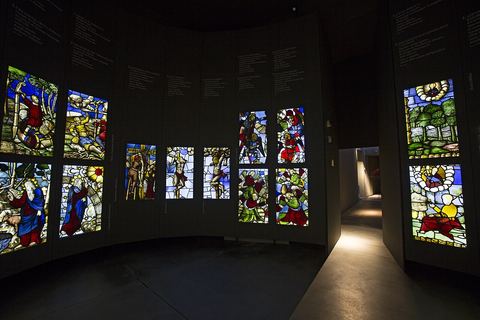
6 The stained glass
The painted glass panels that sit very high up in the Duomo, here at eye level. Many come from the great Old Testament window in the apse. One was designed, according to the latest studies, by the young Arcimboldo.
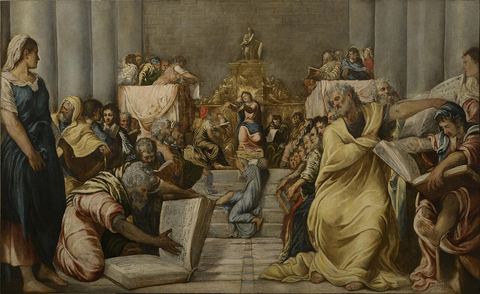
7 Tintoretto and the Gonzaga tapestries
The sixteenth century of Carlo Borromeo in two masterpieces. A large early canvas by Tintoretto, forgotten for centuries and rediscovered in 1954. And the tapestries the duke of Mantua gave the archbishop: there were seven, four remain.
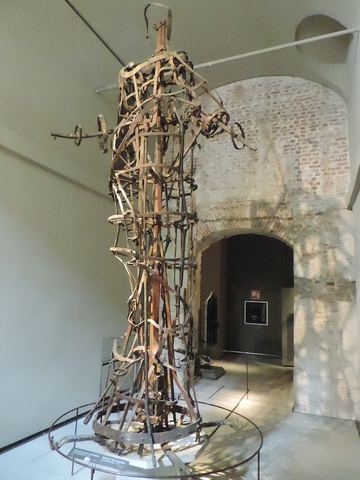
8 The skeleton of the Madonnina
The Madonnina, the gilded Virgin on top of the Duomo, is not solid: it is a shell of gilded copper sheets. This is the iron frame that held it up on the tallest spire from 1774 to 1967, 108 meters above the ground.
Timeline
- 1387Gian Galeazzo Visconti founds the Veneranda Fabbrica to build and preserve the Duomo.
- 1403Giorgio Solari carves the San Giorgio for the top of the Carelli spire, the Duomo's first.
- 1426The gilded copper Padre Eterno is set at the center of the apse vault, above the high altar.
- 1519The Fabbrica entrusts Bernardo Zenale with the big wooden model of the Duomo, which will be updated until 1891.
- 1774The Madonnina is set on the main spire, held up by the iron frame now on display in the museum.
- 1943On August 15 an air raid knocks the San Giorgio off the Carelli spire and hits Palazzo Reale.
- 1953The Museo del Duomo opens on the ground floor of Palazzo Reale, in a display designed by Ugo Nebbia.
- 2013On November 4 the museum reopens, after a long closure, with the new display by Guido Canali.
Who's who
Marco Carelli
fourteenth-century Milanese merchant
He left his fortune to the Fabbrica del Duomo, which regards him as the first of its great donors. The oldest spire, where the San Giorgio comes from, bears his name.
Beltramino de Zutti
fifteenth-century Milanese master goldsmith
Maker of the Padre Eterno in embossed and gilded copper, finished in 1425. He was also prior of the Scuola degli orafi, Milan's goldsmiths' guild.
Bernardo Zenale
painter and architect, architect of the Duomo from 1522
In 1519 the Fabbrica commissioned from him the big wooden model of the Duomo, the Modellone, whose design is attributed to him, Cristoforo Solari and Gerolamo della Porta.
Giuseppe Arcimboldo
sixteenth-century Milanese painter
Before winning fame in Prague for his heads made of fruit and vegetables, he prepared cartoons for the Duomo's windows. The design of the Creation of the Firmament is attributed to him.
Carlo Borromeo
archbishop of Milan, later a saint
He was given the feather miter by Pope Pius IV, his uncle, and the Moses tapestries by the duke of Mantua. He later handed the tapestries over to the Duomo.
Giuseppe Perego
eighteenth-century sculptor of the Fabbrica
He made the terracotta model of the Madonnina, on display in the museum. In 1754 he had passed the entrance test for the Duomo's sculptors with a Hercules and the Nemean Lion.
Words to know
Where it is
The neighborhood
Historic Center
Related places
The story of the place
The Duomo has one flaw: its best things are too high up. Statues on top of the , stained glass far out of reach, a gilded head hanging from the vault of the apse. This museum solves the problem in the simplest way: it brings them down.
Everything you see here comes from the cathedral. Many pieces were removed to save them, especially after World War II, and up there in their place today there is often a copy. First the bombs and then the smog made it urgent to get the originals under cover.
The museum of the Fabbrica
Your host is the , the body that Gian Galeazzo Visconti, lord of Milan, founded in 1387 to build the Duomo. It still exists, and in six centuries it has set aside models, trial pieces, drawings and replaced parts.
The idea of a museum was already in the air at the end of the nineteenth century. It became real in 1953, in a handful of rooms arranged by Ugo Nebbia. In 1974 the museum was enlarged. Then came a long closure and, in 2013, the reopening to a design by the architect Guido Canali: twenty-six rooms, many of them in half-light.
The house of the dukes
The building has a story too. Palazzo Reale, the royal palace, started out as the Broletto Vecchio, the first seat of the city's government, and then became the palace of the Visconti and the Sforza. The sober look it has today dates from the eighteenth century and is the work of Giuseppe Piermarini, the architect of La Scala.
The museum occupies the oldest wing, on the ground floor. On the night of August 15, 1943, the bombs hit both the palace and the Duomo. You will meet one of the statues that fell in those days shortly.
How to look at the museum
The route follows time. It starts with the Treasury, with objects older than the Duomo itself, and ends in the twentieth century. In between are six centuries of building site, told by things rather than dates.
One piece of advice: use the museum like the key to a map. Here you learn to recognize a , a saint, the face of a duke. Then you step out into the piazza, look up, and the Duomo is no longer a mountain of lace that all looks the same.
Sources
- Veneranda Fabbrica del Duomo di Milano, Museo del Duomo (opens in a new tab)Official site
- Veneranda Fabbrica del Duomo, DescriVedendo: testo guida per l'orientamento alla visita del Museo del Duomo (opens in a new tab)Official site
- Veneranda Fabbrica del Duomo, Le dieci opere imperdibili del Museo del Duomo (opens in a new tab)Official site
- Catalogo del Museo del Duomo, Coperta di evangeliario detta Dittico delle cinque parti (opens in a new tab)Official site
- Catalogo del Museo del Duomo, Modello del Duomo di Milano (opens in a new tab)Official site
- Catalogo del Museo del Duomo, San Giorgio (opens in a new tab)Official site
- Catalogo del Museo del Duomo, Padre Eterno (opens in a new tab)Official site
- Catalogo del Museo del Duomo, Santa Lucia (opens in a new tab)Official site
- Catalogo del Museo del Duomo, Creazione del firmamento (opens in a new tab)Official site
- Catalogo del Museo del Duomo, Disputa di Gesù fra i dottori del tempio (opens in a new tab)Official site
- Catalogo del Museo del Duomo, Passaggio del Mar Rosso (opens in a new tab)Official site
- Catalogo del Museo del Duomo, Intelaiatura della Vergine Assunta (opens in a new tab)Official site
- Catalogo del Museo del Duomo, Bozzetto per la quinta porta del Duomo di Milano (opens in a new tab)Official site
- Chiesa di Milano, Il percorso museale del Museo del Duomo (opens in a new tab)Institution
- Arcimboldi, Giuseppe, Dizionario Biografico degli Italiani, Treccani (opens in a new tab)Encyclopedia
- Veneranda Fabbrica del Duomo su Google Arts & Culture, Il Tesoro del Duomo (opens in a new tab)Institution
- Martina Saltamacchia, The Donation of Marco Carelli, American Historical Association, convegno 2011 (opens in a new tab)Institution
- Veneranda Fabbrica del Duomo su Google Arts & Culture, il Modellone (opens in a new tab)Institution
- Veneranda Fabbrica del Duomo su Google Arts & Culture, San Giorgio e la guglia Carelli (opens in a new tab)Institution
- Museo del Duomo (Milano), Wikipedia in italiano (opens in a new tab)Wikipedia
- Palazzo Reale (Milano), Wikipedia in italiano (opens in a new tab)Wikipedia
- Bernardo Zenale, Wikipedia in italiano (opens in a new tab)Wikipedia
- Cristoforo Solari, Wikipedia in italiano (opens in a new tab)Wikipedia
- Royal Palace of Milan, Wikipedia in inglese (opens in a new tab)Wikipedia
- Museo del Duomo, Wikidata Q16337697 (coordinate) (opens in a new tab)Other source