Stop 1 of 8
The Treasury
Where to stand
In the first rooms of the museum, in front of the cases holding the ivories, the crosses and the gold and silver objects
The most precious and most ancient objects in the museum: fifth-century ivories, medieval crosses, chalices. Some already existed nine centuries before the Duomo. And there is a made of feathers that came from Mexico.
Spot the detail
Find the miter with the scenes of the Passion and step closer: what are the colors made of?
The full story
The museum starts with the thing furthest from a building site: gold. Before the marble it sets you in front of the objects that were used to say Mass, and that were kept in the Duomo for centuries.
The Treasury does not belong to the Fabbrica, the body that built the cathedral, but to the Chapter, the college of the cathedral's canons. It gathers objects ranging from the fifth to the seventeenth century, and it has been on display here since 2013.
Older than the Duomo
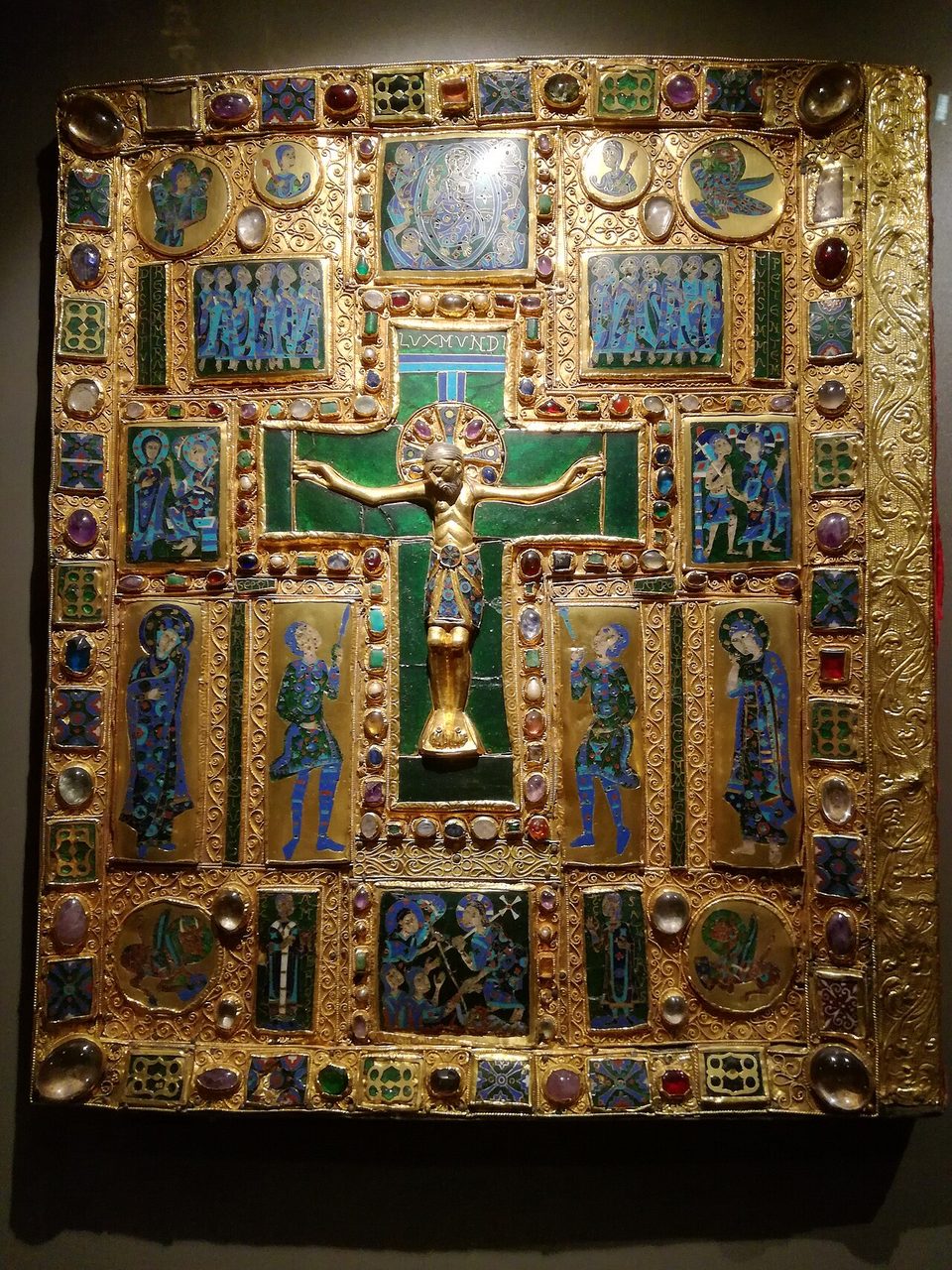
The piece not to miss is among the first: the Five-Part Diptych. These are two ivory panels carved in the fifth century, perhaps in Ravenna. In all likelihood they served as the cover of an evangeliary, the book with the Gospel passages read during Mass. When someone carved them, the first stone of the Duomo was about nine hundred years away.
Each panel is made of five small plaques, hence the name. Along the sides run little scenes from the Gospels: the Nativity, the Magi, the wedding at Cana, the raising of Lazarus. At the center, in place of ivory, there is a jewel. On one side a lamb of red garnets inside a wreath of fruit and ears of wheat, on the other a cross of precious stones and pearls.
The cross of the battle
Then look for the Cross of Chiaravalle, a thirteenth-century processional cross, the work of Venetian goldsmiths. It comes from the abbey of Chiaravalle and brings a story with it.
According to tradition, Archbishop Ottone Visconti carried it into battle at Desio, in 1277. That was the victory that opened the way for the Visconti to rule Milan. Nobody can prove the cross was really on the field. But the tradition alone explains why an object like this was kept with such care.
Gifts for San Carlo
Further on, the Treasury reaches the sixteenth century and Carlo Borromeo, the archbishop who redesigned the interior of the Duomo and was later made a saint, San Carlo. The gold cross that bears his name is not just a museum piece: it still accompanies the ceremony in which every new archbishop of Milan takes office.
The Treasury also holds a panel painted on both sides. It is the Madonna dell'Idea by Michelino da Besozzo, from 1418. On one side the Madonna enthroned with the Child, on the other the presentation of Jesus in the temple. It is tied to a procession: the one for Candlemas, on February 2.
Down the middle runs a long row of cases with chalices and monstrances. Take your time over them: this is the finest work in the whole museum. From here on, things turn to marble, and get much bigger.
About this stop
Anecdote
A feather miter from Mexico
Among the gold of the Duomo's Treasury, on display in the museum's first rooms, there is one object that owes its colors neither to gold nor to gems. It is a , the headdress of bishops, with scenes of the Passion. The colors are not painted: they are the feathers of tropical birds, glued onto agave paper and cloth. It was made in Mexico, in the sixteenth century, by the amanteca, the feather craftsmen. Pope Pius IV gave it to his nephew Carlo Borromeo, archbishop of Milan. A few decades after the conquest of Mexico, a piece of America was already in Milan.
Next stop
Carry on to the room with the big wooden model of the Duomo