Stop 4 of 8Must-see
The Padre Eterno
Where to stand
In the room of the Visconti era, in front of the large gilded head on the wall
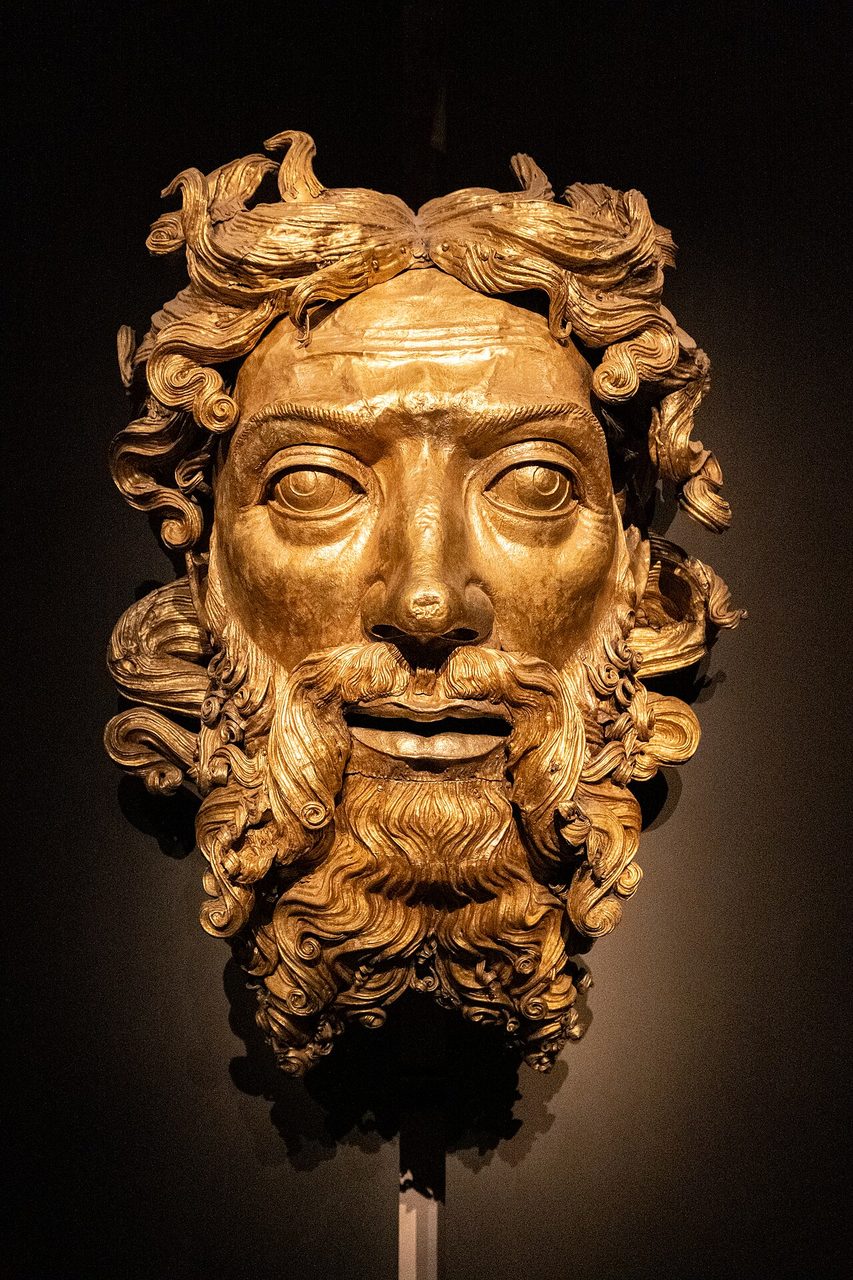
A head of God more than a meter tall, in gilded copper. From 1426 it closed the vault of the apse above the high altar, where nobody could see it properly. Here you look it in the face.
Spot the detail
Look closely at the beard and hair: they seem carved. What is the head made of?
The full story
A huge head, all gold, more than a meter tall. It has no body and does not need one. It is the Padre Eterno, the Eternal Father, the face of God the creator, and for more than five centuries it looked down on the Duomo from the highest point of the apse.
It was not made by a sculptor. It was made by Beltramino de Zutti, a Milanese master goldsmith who rose to head the city's goldsmiths' guild. He worked on it for almost ten years.
A keystone of gold
In 1426 the head went up above the high altar. It was the of the apse vault: the keystone, the piece that closes the crossing of the ribs at the center. Usually it is a carved stone. Here it is goldsmith's work, on a giant scale.
The plan called for Candoglia marble, as for everything else. Then somebody reasoned like a goldsmith. The apse of a Gothic cathedral is dark, and a marble head up there would have vanished. Gilded copper, on the other hand, catches every thread of light and sends it back.
Around the head were nine music-making angels, the work of another goldsmith, Giovannolo da Seregno. Anyone who looked up from the floor saw a glow of gold in the middle of the dark.
How it got here
The gilding was redone several times between the sixteenth and seventeenth centuries. In the nineteenth century came the additions: a round frame, a piece of drapery and a triangular halo, symbol of the Trinity.
In 1964 the , the body that has looked after the Duomo since its founding, took the head down from the vault to keep it safe. Here you see it without the nineteenth-century additions. The following year a copy in bronze and copper went up in its place. If you go into the Duomo and look at the vault above the altar, the one shining up there is the copy.
The room around you
Do not leave right away. The large statues around you come from the capitals of the piers and from the outside of the apse, the oldest part of the church. They date from the decades when the Visconti ruled Milan and the building site was calling in sculptors from half of Europe: Rhinelanders, Burgundians, Bohemians, alongside the Lombards.
Among the Lombards the name to remember is Jacopino da Tradate. He is the one who sets the standard in these years, and among the statuettes you will see in the nearby rooms his school is easy to recognize.
Then go back to the gold head for a moment. In the church it was a point of light a very long way off. Here it is at your height, and you are the one who has to hold its gaze.
About this stop
Anecdote
A God designed for the dark
The Padre Eterno, the large gilded head of God the Father on display in the museum's Visconti room, was meant to be Candoglia marble, like the whole Duomo. Instead it was made of embossed copper, silvered and gilded, so its gleam would stand out in the cathedral's half-light. The job went to a goldsmith, Beltramino de Zutti, not a sculptor. From 1426 the head shone above the high altar, at the top of the apse vault. In 1964 the Fabbrica, the body that runs the Duomo, took it down to protect it. The one in the cathedral today is a bronze and copper copy, put up on March 11, 1965.
Next stop
Move into the nearby rooms: first the monster-shaped gargoyles, then the statues of the Sforza era