Stop 3 of 8
San Giorgio and the first spire
Where to stand
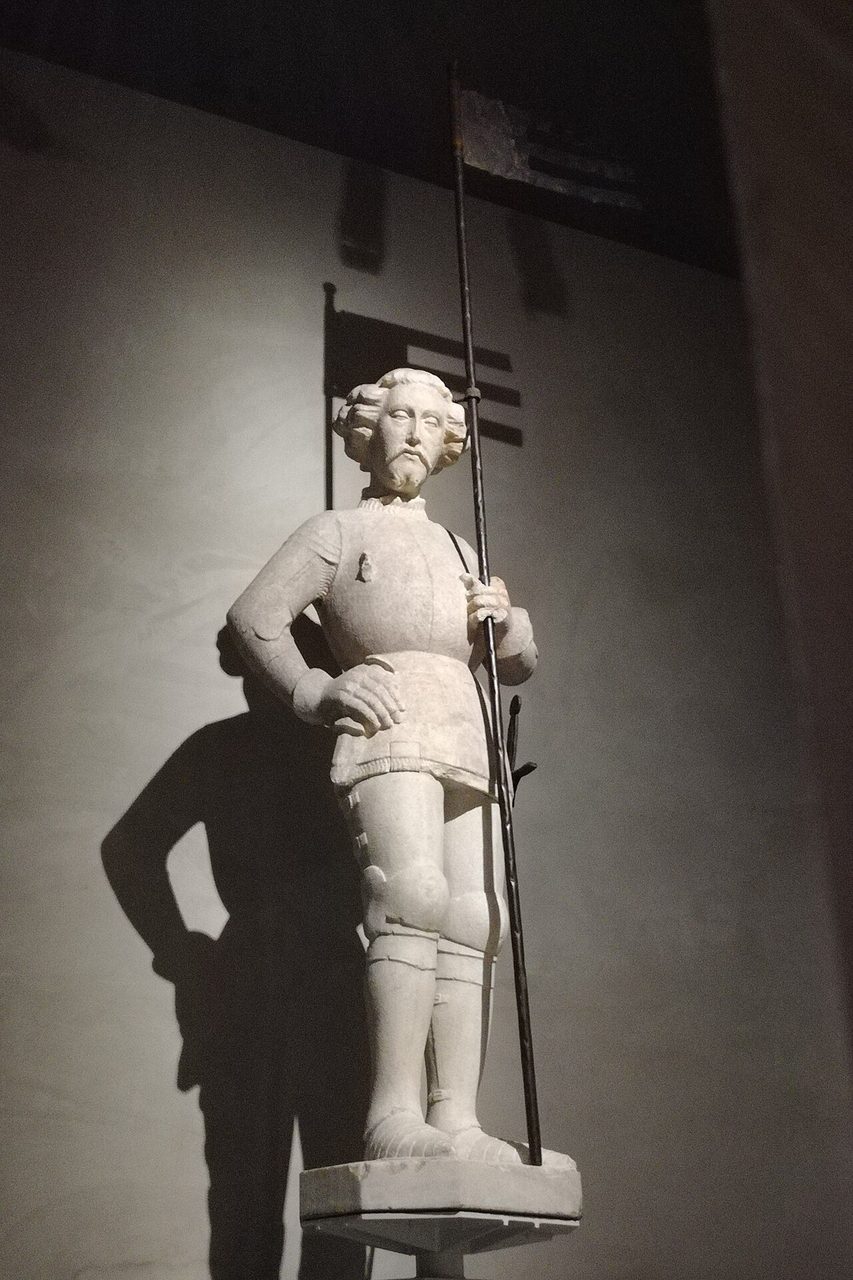
In the room on the origins of the Duomo, in front of the statue of the warrior in armor
The statue that stood for more than five centuries on top of the Duomo's oldest . Carved in 1403, it fell under the bombs in August 1943. According to tradition it has the face of Gian Galeazzo Visconti.
Spot the detail
Look at the saint's face: his beard is parted in two. Who is he supposed to look like?
The full story
A warrior in armor, more than two meters tall, with a banner in one hand and a dagger in the other. He has the air of someone used to looking down on everybody. And in fact he stood on top of a from the early fifteenth century until 1943.
Not just any . The Carelli spire is the oldest on the Duomo. It stands on the north side of the apse, toward Corso Vittorio Emanuele. It was built between the end of the fourteenth century and the first years of the fifteenth, when most of the church was yet to be made.
The merchant who paid
The carries the name of Marco Carelli, a hugely rich merchant who at the end of the fourteenth century left the Fabbrica, the body that built the Duomo, his entire fortune: houses, goods and property worth 35,000 ducats. The Fabbrica regards him as the first of its great donors, and dedicated the first spire to him.
It is a detail that says a lot. The Duomo was not paid for by the dukes alone. It was paid for by the Milanese, nobles and commoners, with offerings and bequests. Carelli is just the biggest name on the list.
The saint with the duke's face
The sculptor is Giorgio Solari. The marble is from Candoglia, the same as the whole Duomo. The sword and the banner are metal. The dagger gripped in the right hand, though, is marble.
San Giorgio, Saint George, is the martyr who, according to legend, killed a dragon. But here it is the face that matters most. Tradition has it that it is a portrait of Gian Galeazzo Visconti, the lord of Milan who founded the . If that is true, the duke had reserved the highest spot on the building site for himself.
The fall of 1943
On August 15, 1943, an air raid knocked the statue off the . The damage was serious. After a thorough restoration, the San Giorgio has been in the museum ever since it opened, in 1953.
Up there, on top of the Carelli , there is now a copy made by the Fabbrica in the 1950s. It is a story you will find all through the museum: the original comes down under cover, the copy goes up to take the rain and the wind.
About this stop
Anecdote
The merchant who bought himself a spire
The oldest on the Duomo is named after neither a saint nor a duke. It honors a merchant. Marco Carelli was hugely rich, and at the end of the fourteenth century he left everything to the Fabbrica, the body building the cathedral: over sixty houses, warehouses of goods and other property, worth 35,000 ducats. Alone he outdid all the offerings collected by the site that year. The Fabbrica regards him as the forefather of its donors. In return he got the first spire, and on top of it the San Giorgio statue now in the museum. Proof that the city paid for the Duomo, not just the court.
Anecdote
The sculptor who vanished into thin air
Very little is known about Giorgio Solari, the sculptor of the San Giorgio that came down from the Duomo's oldest and is now in the museum. The documents mention him almost only for the Duomo, between 1397 and 1405, where he carved a few statues. Then his name disappears from the archives. Recent research suggests a lead: he may have moved to Venice. On the roofline of St. Mark's Basilica there is in fact a San Michele that looks strikingly like the warrior in Milan. It is a hypothesis, not a certainty. But if you pass through Venice, look up.
Next stop
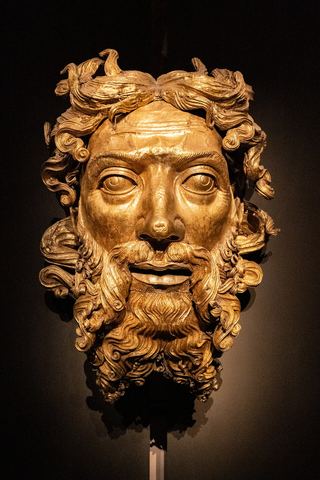
Carry on into the large rooms of the Visconti era and look for a gilded head on the wall