Stop 3 of 6
The Canals You Can't See
Where to stand
Still on the bank of the Darsena: look at the water, then at the houses and streets on the city-center side
The is what's left of a much larger network. Around the center ran the Cerchia dei , a ring of water that began as a defensive moat. It was covered over between 1929 and 1930 and today it is a ring of streets.
Spot the detail
Count the canals that reach the Darsena. One is missing, the one that came down from the center: where did it go?
The full story
What you have in front of you is a fragment. For centuries another canal set out from here, toward the heart of the city, and reached a ring of water that ran all the way around the center. Today you won't see a drop of it.
From moat to navigable ring
The ring starts out as a moat. In 1156 Milan digs it around the walls for defense. A few years later the emperor Frederick Barbarossa destroys the city and the moat with it.
The Milanese dig it again, this time at the foot of masonry walls, and fill it with water from the Olona river as well. Later the Visconti and the Sforza, the ruling families of Milan, make it navigable. That is how the Cerchia dei , the ring of canals, is born.
How a lock works
There was one problem, though: the ring sat about two meters higher than the , the city's dock. To lift the boats you needed a .
It is a chamber closed by two gates. The boat goes in, the gate shuts behind it, the water rises or falls, and the boat comes out at a different level. A water elevator.
The first on Milan's was the di Viarenna, the Viarenna lock, built in 1438 on the orders of Filippo Maria Visconti, duke of Milan. Its main job was to bring the marble closer to the building site of the Duomo, the cathedral.
A is still there, without boats now, in Via Conca del , not far from here: it is the one rebuilt in the 1500s, when the Spanish walls went up. If you make the detour, look for the plaque with the coat of arms of Ludovico il Moro, duke of Milan at the end of the 1400s: it records that cargoes for the Duomo passed without paying.
With the the system is complete. It is Ludovico again who connects the Martesana, the canal that comes from the Adda river, to the ring. From that moment the waters of two rivers, the Ticino and the Adda, meet inside Milan.
Where the Cerchia went
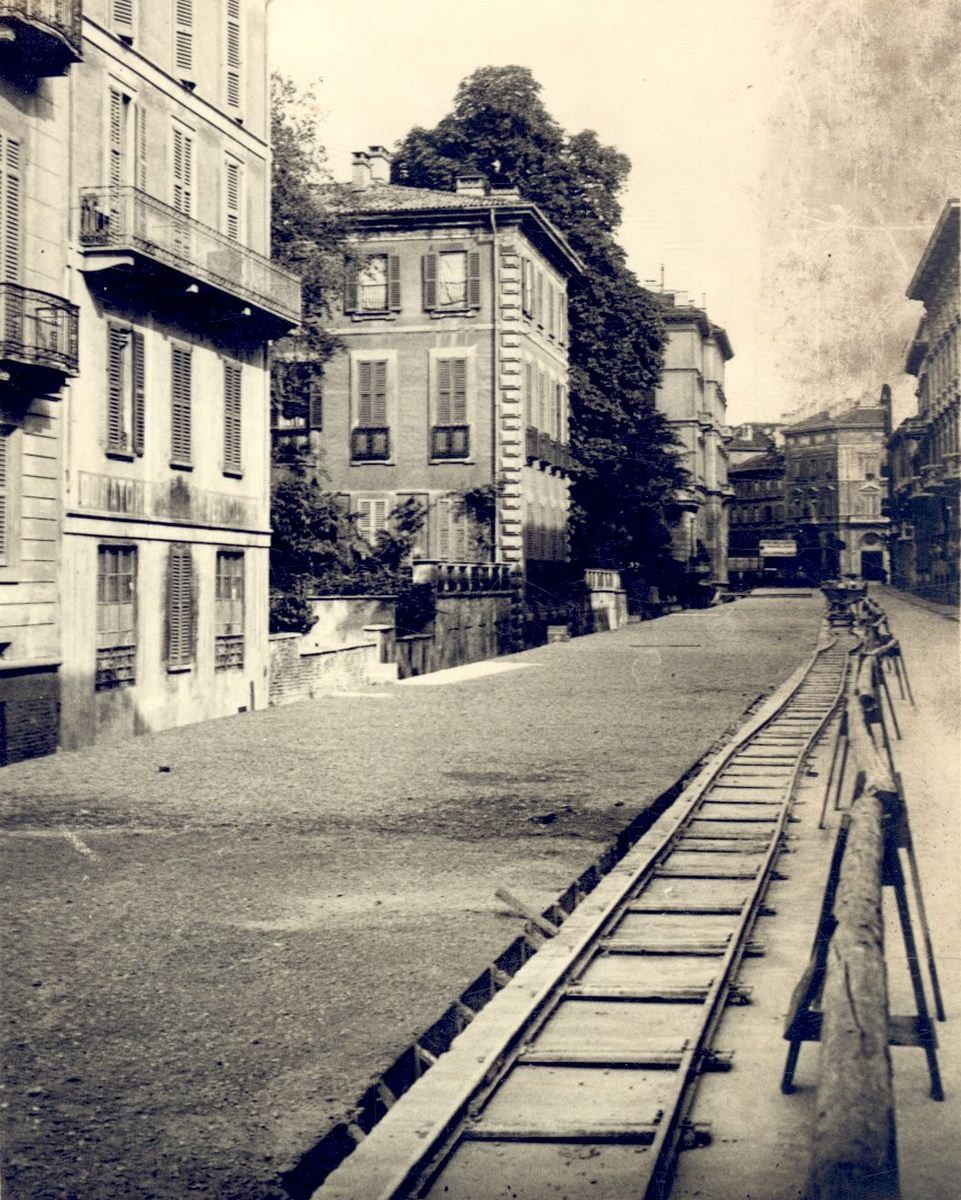
Then the city changes its mind. The water in the Cerchia barely circulates, it is dirty, it raises fears for public health, and it takes up room that traffic needs. Between 1929 and 1930 the ring is covered over, along with the canal that came down to this spot.
If you want to find it again, don't look for water: look at the street names. Via Fatebenefratelli, Via Senato, Via Visconti di Modrone, Via Francesco Sforza, Via Santa Sofia, Via De Amicis and Via Carducci still draw the circle. One piece has even moved house: the Ponte delle Sirenette, the bridge of the little mermaids that used to cross the Cerchia, now stands inside Parco Sempione.
Remember it when you look at the . It's not a stray pond: it's the piece that survived of a city you could get around by boat.
About this stop
No, though you'll often hear it said. When Leonardo da Vinci arrived in Milan, the Grande had existed for nearly three centuries and the first for a few decades. Leonardo studied the canals and drew lock gates in the Codex Atlanticus, the kind still called vinciane, after him, today. But he didn't invent them, and a curator at Milan's Museo della Scienza, the science museum, admits that nobody quite knows what his contribution was. He may have advised Duke Ludovico il Moro on the locks that linked the Martesana canal to the Cerchia.
Under the streets. Around the center ran the Cerchia dei , a navigable ring of water. Between 1929 and 1930 it was covered over: the water barely circulated, it was polluted, it raised health worries and it took space away from traffic. Today its course is a ring of streets, made up of roads like Via Senato, Via Visconti di Modrone, Via Francesco Sforza and Via Carducci. In this area the Naviglio Grande, the Naviglio Pavese and the are still open to the sky, which is exactly what you see on this walk.
It is how a boat climbs or descends a step of water. Picture a chamber closed by two gates, one upstream and one downstream. The boat goes in, the gate shuts behind it, the water is raised or lowered to the level of the next stretch, then the other gate opens. In Italian it is called a . Milan's first was the Conca di Viarenna, of 1438: it overcame the difference of about two meters between the and the Cerchia dei .
Next stop
Walk along the bank to the point where two canals open onto the Darsena, each under its own bridge