Stop 4 of 6
The Scodellino and the Trofeo
Where to stand
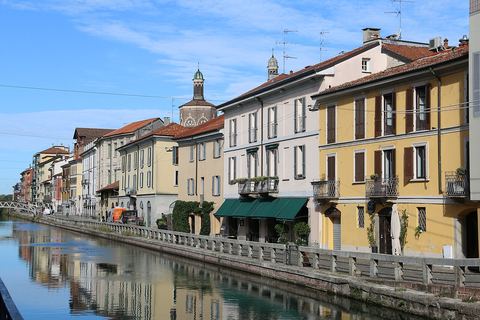
On the bank of the Darsena, where the two canals open: the Naviglio Grande and the Naviglio Pavese, each with its own bridge
Two bridges, two canals, two curious names. The Scodellino, tradition says, recalls the boatmen's soup. The Trofeo recalls a monument put up in the early 1600s to celebrate a canal that would be finished more than two centuries later.
Spot the detail
Watch the water under the two bridges: which canal does it come into the Darsena from, and which does it leave by?
The full story
Here the , Milan's old dock, shows you how it works. Two canals open onto the basin, one bringing water in and one taking it away. Each passes under a bridge, and each bridge has a name that deserves an explanation.
The Ponte dello Scodellino
The first is the Ponte dello Scodellino, the bridge of the little bowl, where the Grande, the great canal, enters the . For the boatmen it was the end of the journey. According to tradition, there was a tavern nearby where you got your strength back with a bowl of soup. The name is said to come from that: no hero, no saint, just a hot meal after hours on the water.
The Ponte del Trofeo
The second is the Ponte del Trofeo, the trophy bridge, where the Pavese sets out, and its story has more irony in it. Linking Milan to Pavia, and so to the Po and the sea, was an old dream. In the early 1600s the Count of Fuentes, the Spanish governor of Milan, started the digging. As soon as the second was finished, he wanted a monument right away to celebrate the feat: the Trofeo, on the bridge where the canal begins.
The trophy arrived, the canal didn't. Once Fuentes was dead, the Spanish government stopped everything. The canal was left cut short, with a that led nowhere. The Milanese called it the Conca Fallata, the failed lock, and the name has stuck to the place.
It took Napoleon to get things going again. In 1805 he signed a decree that said, in essence: the canal from Milan to Pavia shall be made navigable. He never got to see it.
The work was finished in 1819, when the Austrians were back in Milan, and it was a Habsburg archduke who opened it. The Spanish monument stayed on the bridge for a few more decades, then was taken down. The name wasn't.
Two canals, two directions
Now look at the two canals as two roads. Down the Grande came everything that traveled from the Ticino river. The Pavese heads south, handles the drop with twelve and returns the water to the Ticino, at Pavia. The sits in the middle, like an interchange station.
A tavern and a monument. The Milan of the is all here, between those who did the work and those who cut the ribbon.
About this stop
Anecdote
The Monument That Beat the Canal
The Pavese, the canal to Pavia, starts from the , Milan's old port. In the early 1600s the Count of Fuentes, the city's Spanish governor, had a trophy put up to celebrate it. Too bad only the start of the canal existed. After Fuentes died the work was suspended, and a left in the middle of nowhere earned the name Conca Fallata, the failed lock. The Naviglio Pavese was finished only in 1819. The trophy was later removed, but the bridge where the canal leaves the Darsena is still called the Ponte del Trofeo, the trophy bridge.
It comes from the Ticino river. The Grande draws it off at Tornavento, some fifty kilometers from here, and carries it to the , dropping about thirty meters in all. It leaves the Darsena by the Naviglio Pavese, which in just over thirty kilometers returns it to the Ticino, at Pavia. There the drop is more than fifty meters, and the canal handles it with twelve . A small outflow canal, the Cavo Ticinello, carries off the excess water.
This stop on the map
Next stop
Make your way to the Naviglio Grande and take the alzaia, the towpath that runs along the canal