Stop 2 of 8
The Candoglia marble
Where to stand
Outside, along one of the sides, close enough to the wall to make out the veins in the stone
All the marble of the Duomo comes from a single quarry near Lake Maggiore. It reached Milan by boat, with no charge for transport. The quarry is still open, and it is still the , the cathedral's own works office, that runs it.
Spot the detail
The lowest band of the wall, the one that touches the ground: is it the same marble as the rest?
The full story
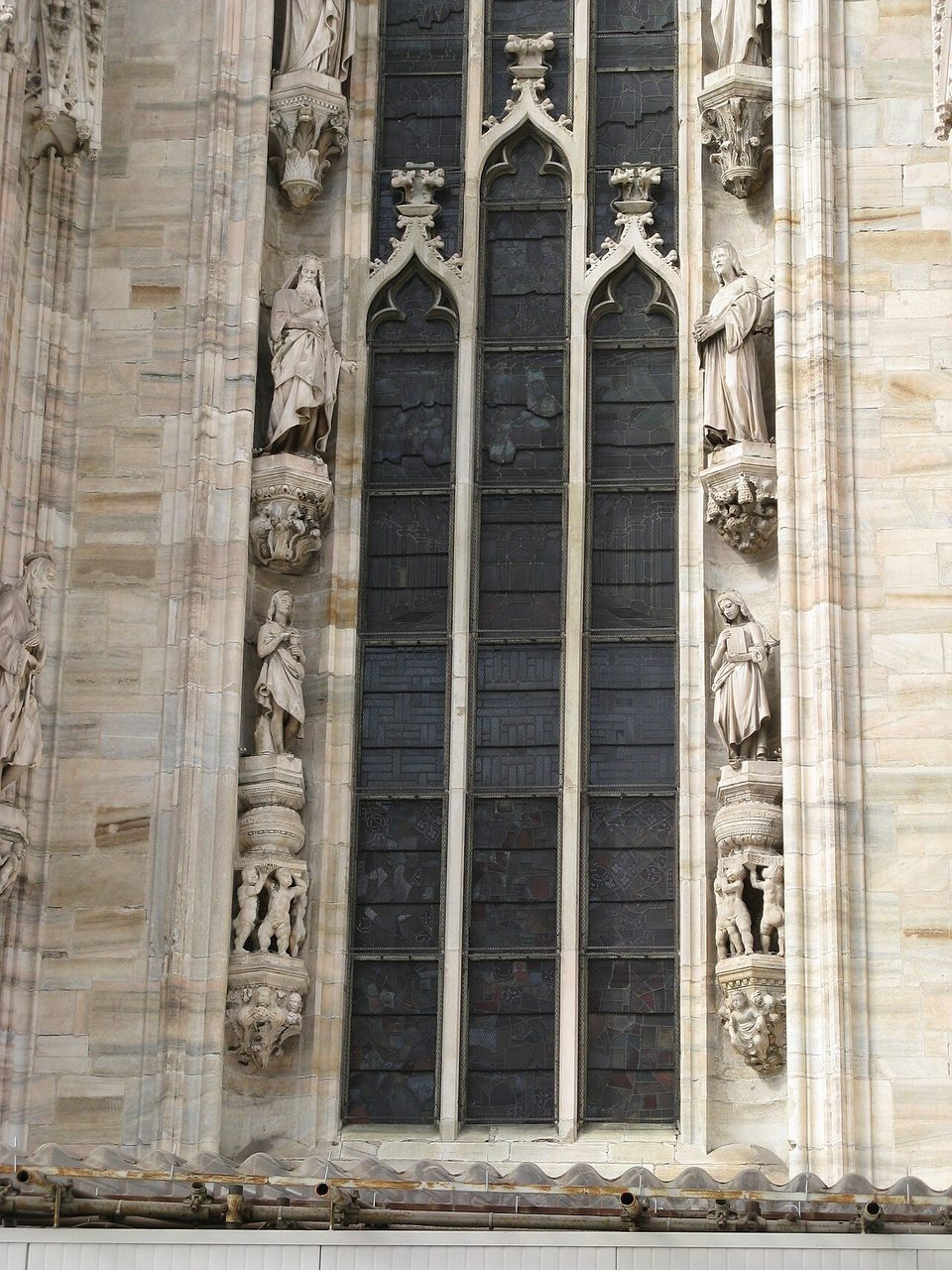
Step up to the wall and look at it from arm's length. It is not white. It is a white streaked with pink, and it changes with the light and with the rain.
The quarry at Candoglia
This marble all comes from the same place: Candoglia, a village at the mouth of the Val d'Ossola, an Alpine valley near Lake Maggiore. The choice was made by Gian Galeazzo Visconti, lord of Milan. The first plan called for a church of brick, the way Lombardy has always built. He wanted marble, and in 1387 he put the quarry at the disposal of the , the body that ran the building site.
The journey by water
That left the job of getting it here, and the road was water. The blocks went down the Toce River, crossed Lake Maggiore, followed the Ticino River and then the Naviglio Grande, the great canal, into the city. A system of locks brought them to a small landing basin a few hundred meters from the building site. The basin is gone, but the street is still called Via Laghetto, the street of the little lake.
The journey was free: Gian Galeazzo had also granted the Fabbrica the transport of its marble. According to a tradition much loved in Milan, the blocks carried the initials AUF, from the Latin ad usum fabricae, meaning for the use of the Fabbrica, and that is supposedly where the Italian expression a ufo comes from, which means without paying. Linguists do not buy it, though: the origin of the expression remains unknown, and this should be taken as a story, not as a fact.
Statues, gargoyles and patches
Now tilt your head back. On the buttresses, the great piers that prop up the wall from outside, there is a crowd of statues. The Duomo has about 3,400 in all, and most of them are out here. Higher up the jut out, stone mouths shaped like monsters that throw the rainwater clear of the walls.
Even the best marble wears away in the air of a big city. That is why the quarry is still working, and the Fabbrica cuts new blocks there to replace the damaged ones. If you look closely you can find the patches: lighter pieces next to darker ones.
It is the reason the Milanese say of anything that never ends that it is lungo come la , as long as the building of the Duomo. It is not a criticism. It is a description.
About this stop
Legend
A ufo: the marble that traveled free
The marble for the Duomo di Milano came by boat from a quarry near Lake Maggiore, and it traveled free of charge: Gian Galeazzo Visconti, lord of the city, had granted that in 1387. According to a widespread Milanese tradition, the blocks carried the initials AUF, from the Latin ad usum fabricae, meaning for the use of the Fabbrica, the cathedral's works office, and that is supposedly the source of the Italian expression a ufo, without paying. It is a good story, but take it for what it is. Similar stories are told about other great churches, and the Treccani dictionary rates the origin of the expression as unknown.
Because it comes from Candoglia, near Lake Maggiore, and the marble from that quarry is white streaked with pink. Gian Galeazzo Visconti, lord of Milan, chose it in 1387, in place of the brick called for in the first plan. The quarry is still open, and it is still the , the cathedral's own works office, that runs it. The lowest band of the walls, on the other hand, is a gray stone, harder than marble.
Next stop
Go into the church and stop at the start of the central nave, with your back to the facade