Stop 4 of 7Must-see
The chapel of the missing Titian
Where to stand
In the right aisle, in front of the fourth chapel counting from the entrance
One of the most important paintings in Milan used to hang here: Titian's Crowning with Thorns. Since the late 1700s it has been in the Louvre. What stayed are Gaudenzio Ferrari's frescoes, which nobody could load onto a cart.
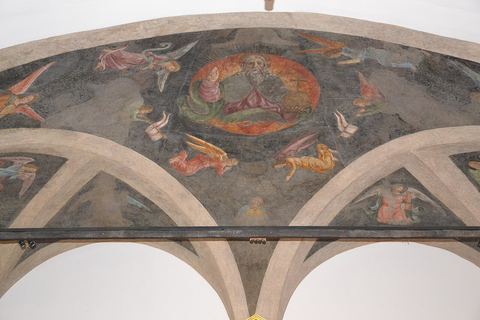
Spot the detail
Look up at the curved sections of the vault. Who is up there?
The full story
This chapel is famous for an absence. Look at the altar: the painting you see, a Deposition from the Cross from the 1600s, is a stand-in. A Titian used to hang in its place.
The chapel belonged to the confraternity of the Santa Corona, the Holy Crown, dedicated to Christ's crown of thorns. Around the middle of the 1500s its members decided to do things in style. For the walls they called in the painter Gaudenzio Ferrari. For the altar they aimed even higher and turned to Venice, to Titian.
The painting sent from Venice
Titian sent a painting three meters tall, about ten feet. It shows Christ seated, his body twisting, while his tormentors drive the crown onto his head with canes. That body is taken from the Laocoon, the ancient statue found in Rome a few decades earlier, which for artists had become the very model of pain. Into the scene the painter also put a bust of the emperor Tiberius: the power of Rome looking on and letting it happen.
The painting stayed here for two and a half centuries. Then, in 1797, Napoleon's French arrived, with an eye for masterpieces and carts to carry them. The Titian left for Paris.
After Napoleon fell, the Austrian government that then ruled Milan did not ask for it back. It is still in the Louvre.
The frescoes left on the walls
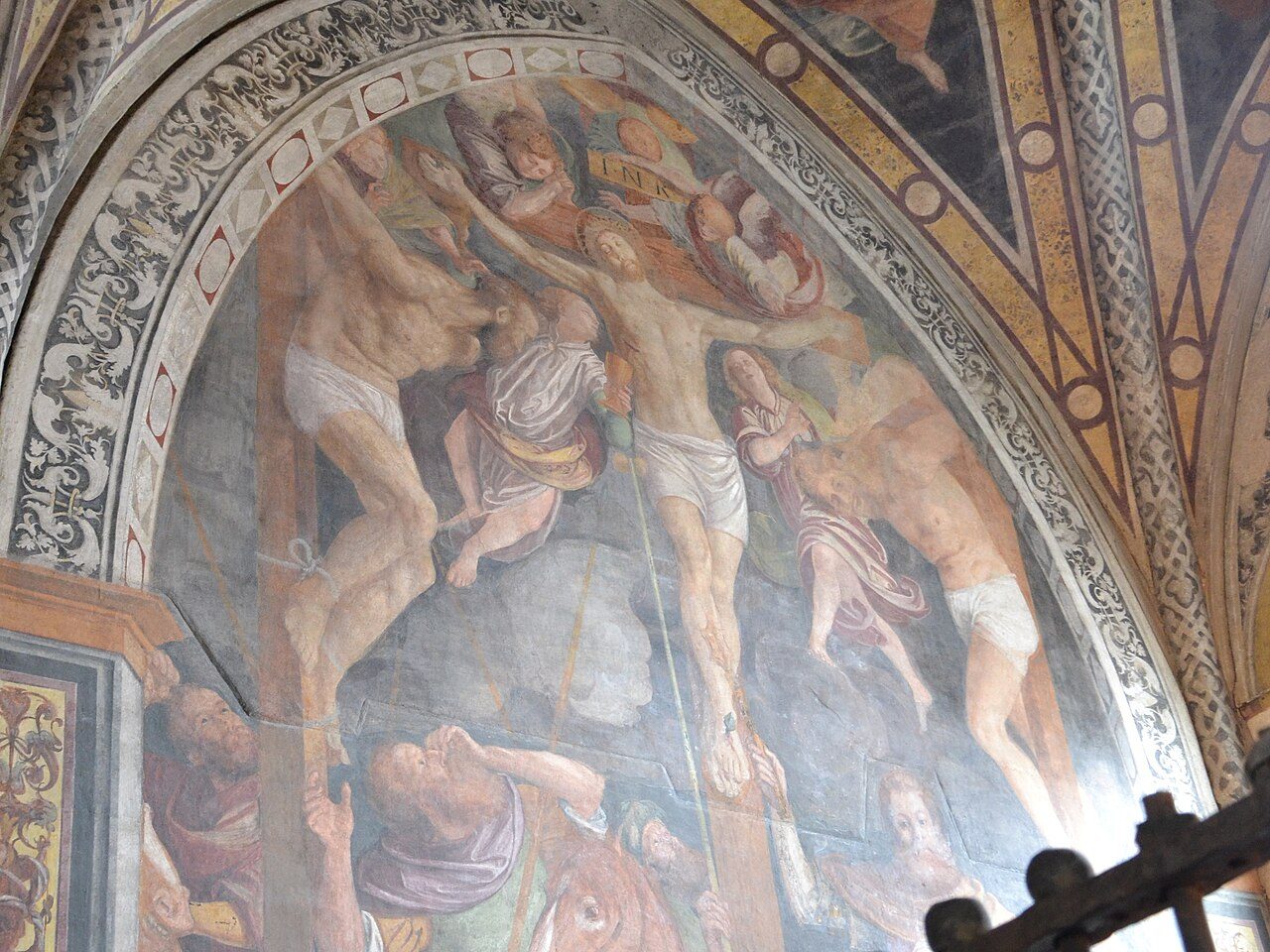
Now look at what stayed, because it is no consolation prize. On the walls, around 1540, Gaudenzio Ferrari painted the stories of the Passion. Find the Crucifixion: the subject is the same as in the lost painting, the suffering of Christ, but told by another hand and across an entire wall.
The comparison teaches something that holds for almost every Italian church. Paintings travel: they get sold, seized, they end up in museums. Frescoes stay where they were born, because they are plaster. That is why the walls of a chapel often tell more of the truth than its altar.
If you are ever in the Louvre, look for the Crowning with Thorns and remember this half-empty altar.
About this stop
It is in the Louvre, in Paris. Titian painted the Crowning with Thorns in the early 1540s for the altar of the chapel of the Santa Corona, the Holy Crown, the fourth on the right. In 1797 Napoleon's French carried it off. After Napoleon fell, the Austrian government that then ruled Milan did not ask for it back. On the altar today is a Deposition from the 1600s. Gaudenzio Ferrari's frescoes on the walls, however, are still the ones from back then.
Next stop
Cross the church to the far end of the left aisle: the last chapel before the tribuna