Stop 5 of 7
The chapel where it all began
Where to stand
At the far end of the left aisle, in front of the last chapel before the tribuna
The starting point. Here stood the little chapel with the image of the Madonna delle Grazie that gave its name to the church, the convent and the neighborhood. Inside you'll find the founder's portrait and a memory of the plague of 1630.
Spot the detail
In the altarpiece, next to the Madonna, there are two people who are not saints. Who are they?
The full story
Of all the chapels in the church, this is the least showy and the most important. Without it there would be nothing: no nave, no dome, no refectory with the Last Supper.
Before the friars, there were soldiers here. The land belonged to Count Gaspare Vimercati, commander of the troops of Duke Francesco Sforza, who quartered his men on it. On the land stood a tiny chapel with an image of the Madonna and Child, known as the Madonna delle Grazie, Our Lady of Graces, and believed to work miracles. When Vimercati gave the site to the Dominicans in 1460, the chapel came with the rest.
The architect Guiniforte Solari didn't demolish it. He built the new church around it, swallowing it whole.
And the church, which at first was to be dedicated to Saint Dominic, ended up taking the name of the image. Then the convent took it, then the whole area, which to the Milanese became the Borgo delle Grazie, the Grazie quarter. An entire piece of the city is named after a painting in a barracks chapel.
The founder inside the altarpiece
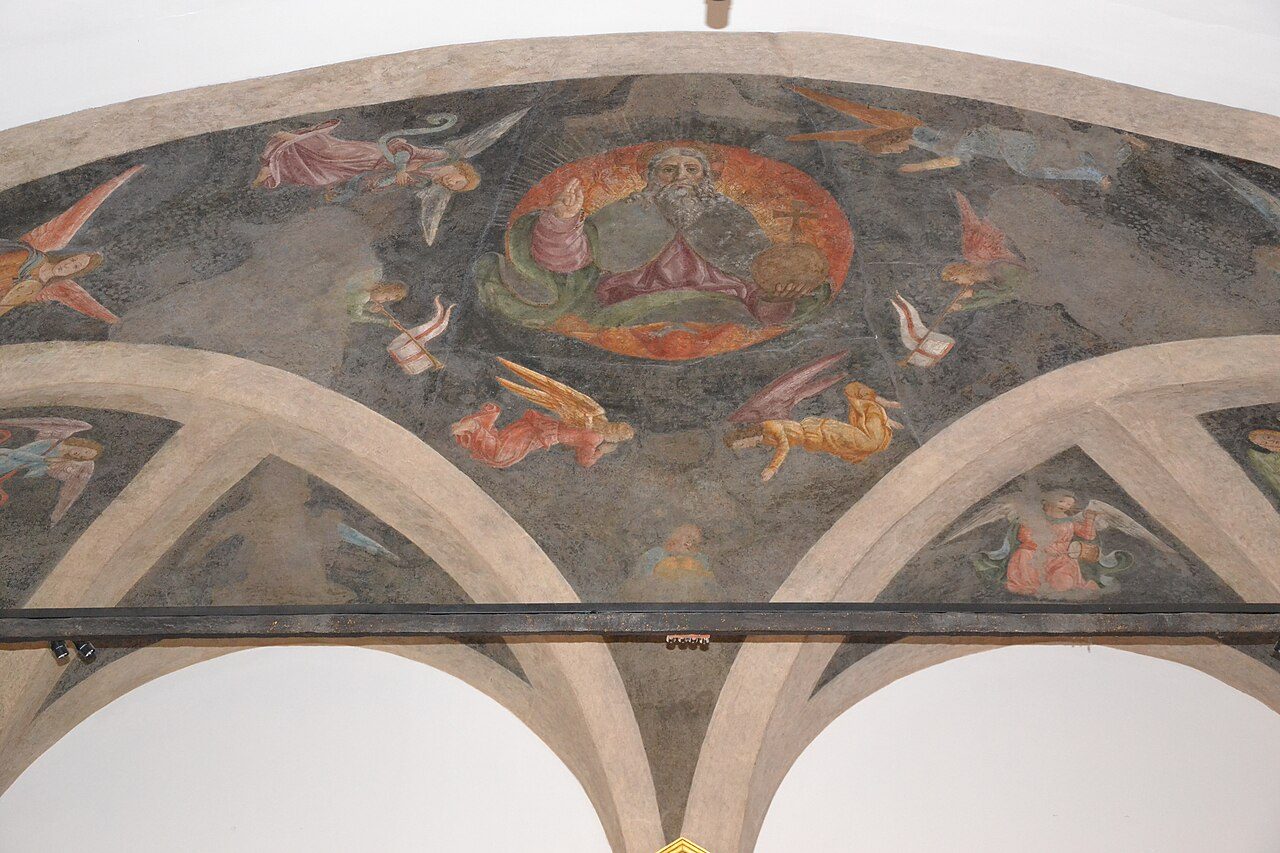
Look at the altarpiece, from the late 1400s. The Madonna is not alone: beside her appear Vimercati and his wife. This was how a benefactor signed his name back then, by having himself painted into the picture. Above, on the vault, is a fresco of God the Father surrounded by angels.
The memory of the plague
Then find the canvas by Cerano, a Lombard painter of the 1600s. It tells of a different fear. In 1630 the plague emptied Milan: it is the same epidemic that Alessandro Manzoni puts at the heart of I promessi sposi, his novel known in English as The Betrothed. When it was over, the city gave thanks in this way too, with a painting in which the Virgin frees Milan from the contagion.
In a few feet you have two centuries of devotion, one on top of the other. The soldier of the 1400s who gives away a piece of land and has his portrait painted. The city of the 1600s that survives and gives thanks. The stained-glass windows, on the other hand, are from the 1900s.
It is something churches do better than museums: they don't line the eras up in a row, they let them live together. People were praying in this corner before the walls around you existed.
About this stop
In culture
The plague of The Betrothed, in a painting
In Santa Maria delle Grazie, in the chapel at the end of the left aisle, hangs a canvas by Cerano, a Lombard painter of the 1600s: the Virgin frees Milan from the plague. It was painted as a thanksgiving after the epidemic of 1630 ended. This is the same plague Alessandro Manzoni puts at the heart of I promessi sposi, known in English as The Betrothed, the great Italian novel of the 1800s. But the novel comes two centuries later. The painting dates from those very years.
Because of an image. On the land given to the friars there was already a small chapel with a Madonna and Child known as the Madonna delle Grazie, Our Lady of Graces, believed to work miracles. The new church, first intended for Saint Dominic, was built around the chapel and took its name. The chapel still exists: it is the last one off the left aisle, near the . From the name of the church came that of the whole area, which the Milanese called the Borgo delle Grazie, the Grazie quarter.
Next stop
Take a few steps toward the center of the church and stop under the dome