Stop 6 of 7Must-see
Under Il Moro's dome
Where to stand
At the center of the tribuna, at the far end of the church, under the dome: look up first, then toward the choir
A cube, a half sphere and a lot of light: the space Ludovico il Moro wanted as the Sforza mausoleum. His wife Beatrice d'Este was buried here. The marble tomb of the duke and duchess existed, but since the 1500s it has been at the Certosa di Pavia.
Spot the detail
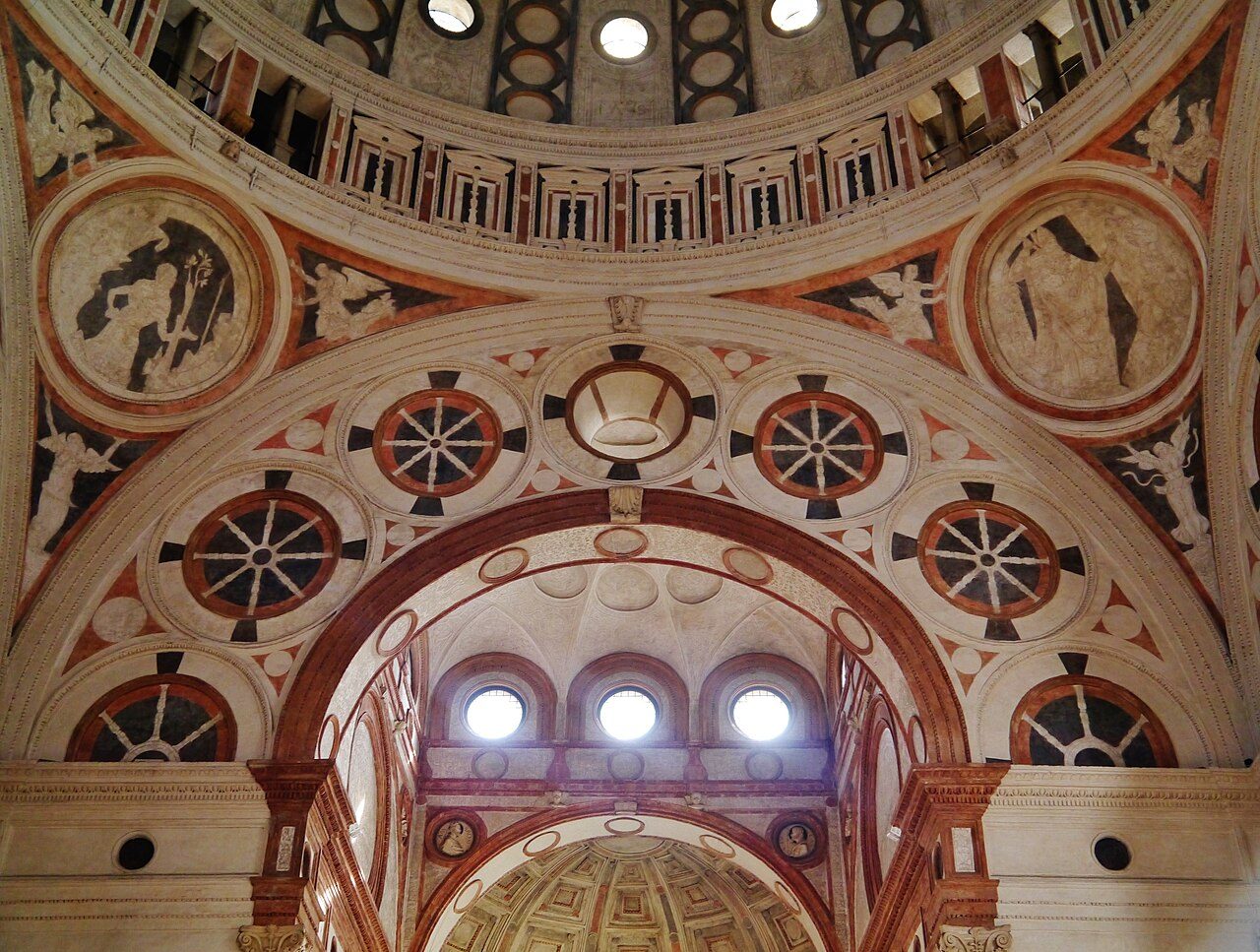
On the walls, look for a pattern that repeats: a wheel with spokes. Is it painted or incised?
The full story
Stand in the center and turn slowly all the way around. After the friars' low nave, everything here is taller and brighter.
The recipe is extremely simple, and that is the beauty of it. Below is a cube. Above is a half sphere, the dome. In between, to get from the square to the circle, are four curved triangles called : in each one a roundel with one of the four Doctors of the Church.
At the sides two widen the space, and at the far end the choir opens up. No dramatic scenes, no gold. Just dark circles on pale plaster, repeated with a surveyor's calm.
This is the Renaissance arriving from Florence: the model is Brunelleschi's Sagrestia Vecchia, the Old Sacristy, in the church of San Lorenzo. Tradition gives the design to Donato Bramante.
The duchess buried in the choir
Ludovico il Moro, duke of Milan, wanted this as his family's mausoleum. The first to enter it was the wrong person.
On the night between January 2 and 3, 1497, his wife Beatrice d'Este died after giving birth. She was just over twenty. She was buried here, in the choir.
It shattered Ludovico. He is said to have shut himself in the dark for weeks and to have worn only black from then on. Then he ordered from the sculptor Cristoforo Solari a monument in Carrara marble with two figures lying on the lid: Beatrice and, beside her, himself. He had himself carved dead while he was still alive.
The monument that went to Pavia
He never used it. In 1499 the French took Milan, and Ludovico ended his days a prisoner in France. The monument was left unfinished.
In 1564, in the years when Cardinal Carlo Borromeo was zealously enforcing the Church's new rules on burials, it was broken up. The lid with the two statues survived and ended up at the Certosa di Pavia, the Carthusian monastery south of Milan, where it still is. According to studies from the 1800s it was let go for thirty-eight scudi, the gold coins of the day. The whole monument is said to have cost fifteen thousand.
Now look toward the choir, with the friars' inlaid wooden stalls: geometric patterns in the lower row, saints and flowers in the upper one. In the middle of it stood the marble of the duke and duchess.
What is left is a perfect mausoleum, without its monument.
About this stop
Anecdote
The plaque where an unborn child speaks
In January 1497 Beatrice d'Este, duchess of Milan, died after delivering a stillborn son. Her husband, Duke Ludovico il Moro, wanted a plaque for the child too in Santa Maria delle Grazie, the church where she was buried. It speaks, in Latin, as the son who was never born: “I lost my life before I came into the light. More unhappy still, because in dying I took my mother's.” One thing consoles him: his parents are Ludovico and Beatrice, duke and duchess of Milan. The marble slab, almost two meters wide, is no longer there. It is now at the Castello Sforzesco, the Sforza castle, in the Museo d'Arte Antica.
Anecdote
The ducal tomb sold for thirty-eight scudi
In Santa Maria delle Grazie, Ludovico il Moro, duke of Milan, had a tomb carved for himself and his wife Beatrice d'Este. The Carrara marble was brought in from Venice and, according to 1800s studies, the work cost fifteen thousand gold scudi. When it was broken up in 1564, the lid with the statues of the duke and duchess reportedly went for thirty-eight scudi and ended up at the Certosa di Pavia, the Carthusian monastery south of Milan. There the two were long kept apart. Only at the end of the 1800s were they reunited on a single base, lying side by side as they had been carved.
Legend
Where is Ludovico il Moro really buried?
Ludovico il Moro, duke of Milan, had prepared his tomb in Santa Maria delle Grazie, beside his wife Beatrice d'Este. Instead he died in 1508, a prisoner in the castle of Loches, in France, and where his body ended up is not certain. In the 1600s Father Gattico, the convent's chronicler, wrote that the friars had brought him back to Milan and buried him next to her. There is no proof. Other sources say he stayed in France. At Loches, between 2019 and 2021, archaeologists dug in the castle church and found a burial that, they say, could be his. A possibility, not yet a certainty.
It was meant to be the mausoleum of the Sforza, but history went another way. Beatrice d'Este, the young wife of Ludovico il Moro, died in 1497 and was buried in the choir. The duke instead died a prisoner in France, at Loches, in 1508. Their marble monument was never used as a tomb and is now at the Certosa di Pavia, the Carthusian monastery south of Milan. The side chapels still carry the names of the Milanese families that were their patrons, such as the Bolla, the Marliani and the Atellani.
Next stop
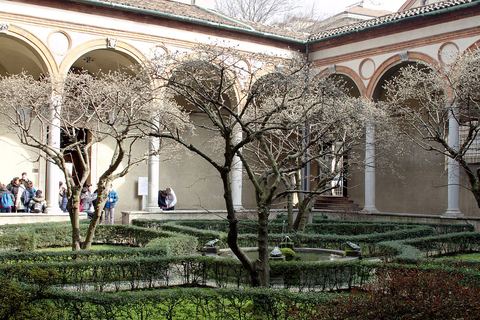
From the tribuna, look for the passage to the small cloister, the one with the fountain