Stop 1 of 6
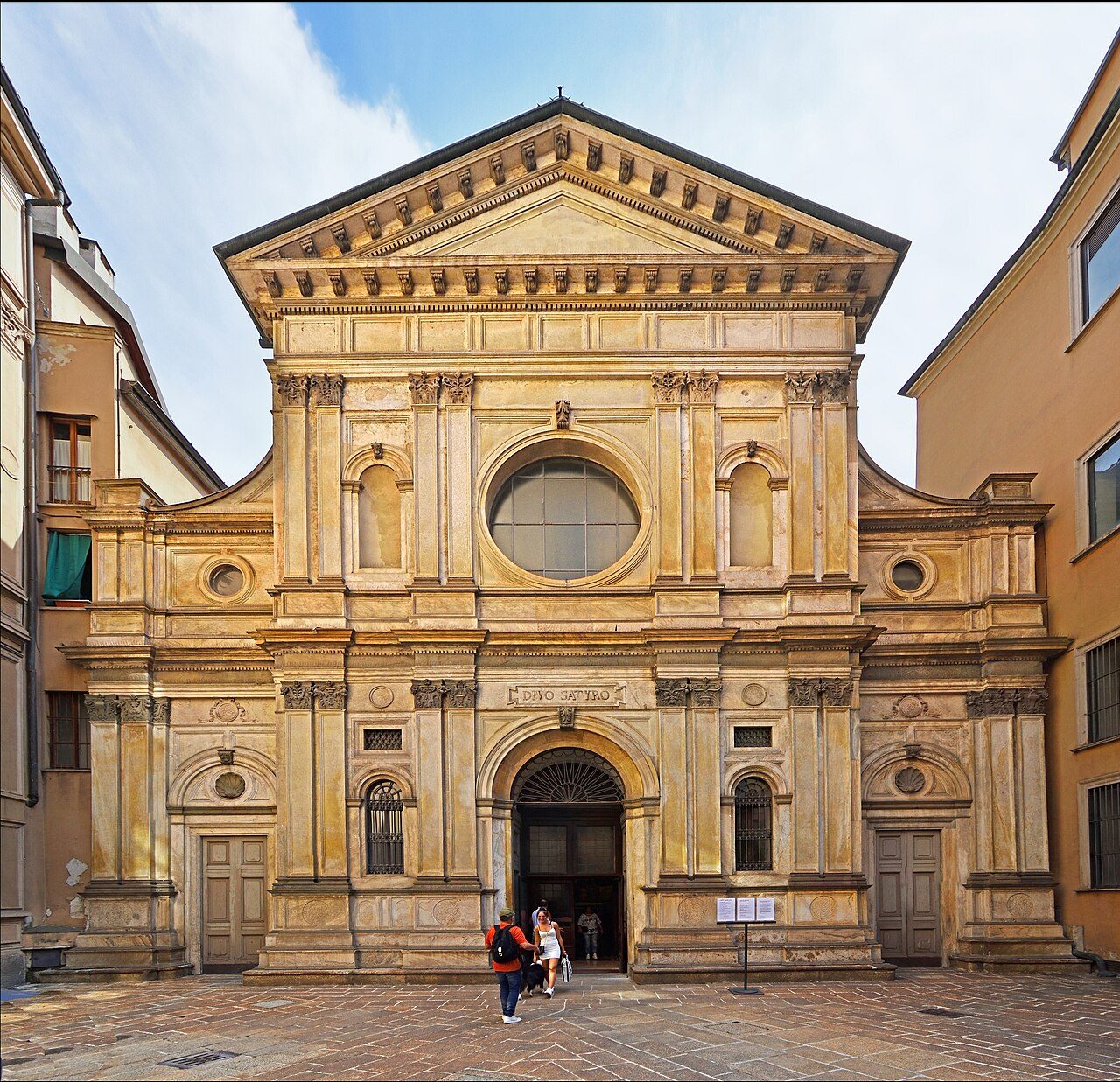
The facade on Via Torino
Where to stand
On Via Torino, in front of the facade, which sits a little back from the street
A nineteenth-century facade for a fifteenth-century church, born from a story of knives and blood. The name says it all: a church of Mary built next to the much older one of San Satiro.
Spot the detail
Only two elements of this facade were kept from the original design. Which ones?
The full story
You would walk past without turning your head. Via Torino is a street where people are in a hurry, and this marble facade keeps to itself, as if it didn't want to bother anyone. Stop anyway. Behind it is one of the most surprising churches in Milan.
Start with the name, which sounds like a tongue twister. Santa Maria presso San Satiro means the church of Mary built next to the church of San Satiro, Saint Satyrus in English.
There are in fact two churches. The older one is a ninth-century chapel, which you will find inside. The other is this one, from the fifteenth century.
It all starts with a stabbing
What brought it into being was an image. On the outer wall of the old chapel was a painted Madonna and Child. According to tradition, in 1242 a certain Massazio da Vigolzone, beside himself after losing at gambling, struck it with a knife. And blood came out of the image.
True or not, the story went around the city. The wounded Madonna drew the faithful, and two centuries later it was decided to build a shrine around her. Work began in 1478, at the wish of Duke Gian Galeazzo Sforza and his mother Bona di Savoia, who ruled in his place.
A facade left half done
The facade had to live up to all this. At the end of the fifteenth century it was entrusted to Giovanni Antonio Amadeo, sculptor and architect, with marbles in colors chosen by Bramante. Amadeo got no further than the base. Then the work stopped, and for almost four centuries the church had no face.
The one you are looking at dates from 1871. Giuseppe Vandoni, an architect, designed it in a style that imitates the Renaissance: , a rose window, a triangular pediment on top. The critics were not kind, and you can see why. It is correct, polite, and tells you nothing about what lies behind it.
Maybe that is for the best. A modest facade is the perfect setup for a plot twist.
About this stop
Legend
The Madonna that bled
Santa Maria presso San Satiro, in Milan, was born from a stabbing. According to tradition, one evening in 1242 a certain Massazio da Vigolzone stormed out of a game of dice gone wrong. Passing the old chapel of San Satiro, he struck the Madonna painted on its outer wall with a dagger. Blood, the legend says, came out of the image. The man repented, people came running, and a cult was born that two centuries later led to the building of the church, next to the chapel. The wounded image is now on the high altar. Accounts differ: for some Massazio was a gambler, for others an unbalanced young man.
Because there are two churches. The older one is the , the little chapel dedicated to San Satiro, founded in the ninth century by Archbishop Ansperto. The second is the large church, built at the end of the fifteenth century to house an image of the Madonna believed to be miraculous, and so dedicated to Mary. It was put up right against the old chapel, which is what presso means: next to San Satiro. The saint's name has not taken second place, though: the parish too is called San Satiro.
No, it is a nineteenth-century imitation. At the end of the fifteenth century the facade was entrusted to Giovanni Antonio Amadeo, who built only the base. The church stayed unfinished until 1871, when the architect Giuseppe Vandoni built the present facade in Renaissance Revival style. From the original design it keeps only the rose window and the frame of the doorway. For real fifteenth-century work on the outside, go around the back, to Via Falcone.
Next stop
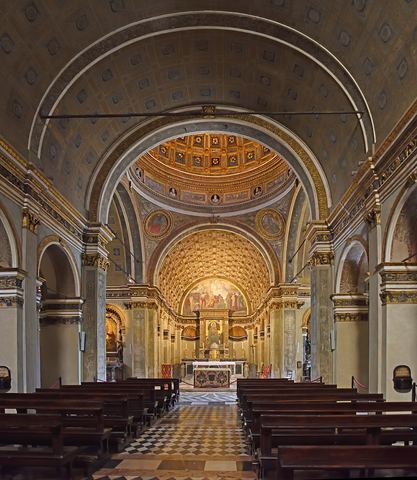
Go in and stop right away, at the start of the central nave, looking straight toward the far end