Stop 2 of 6Must-see
The choir that isn't there
Where to stand
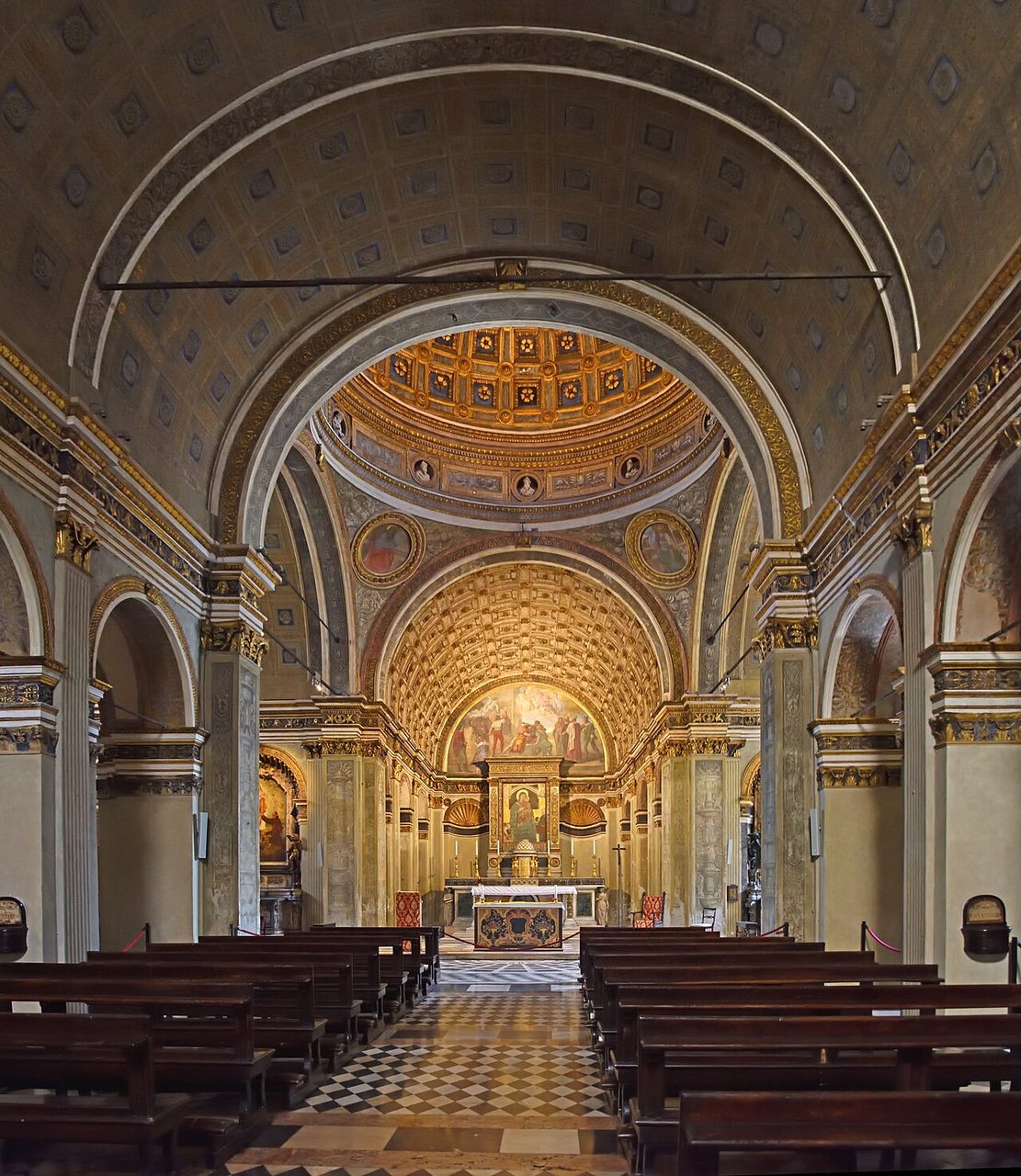
At the start of the central nave, a few steps from the entrance, in the middle, looking straight toward the altar
At the far end of the church you see a deep with a vault. It is a trick: the real space is about one meter deep. Bramante invented it because a street ran behind the wall and the church could not grow any longer.
Spot the detail
Walk slowly down the nave with your eyes on the choir. At what point do you stop believing it?
The full story
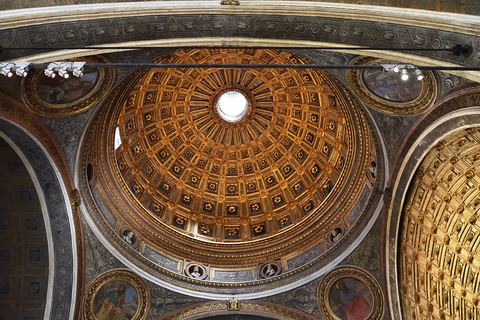
Stay where you are, just inside, in the middle of the nave. Look to the far end, beyond the altar. There is a deep , covered by a vault that seems to continue the one above your head. You would say it is as long as the arms of the .
None of that is there. That is about one meter deep, roughly three feet. What your eye reads as ten meters or so of architecture is a painted relief, set into the back wall.
A street instead of a choir
The reason is very practical. When the church was designed, in the late 1470s, the plot ended right there. Behind it ran the contrada del Falcone, a busy street that nobody could move. The plan stayed T-shaped, without the top arm.
A church like that would have looked cut short. Donato Bramante, who came from the Urbino area, had started out as a painter and was known as a master of perspective, solved the problem the way he knew best. The could not be built. It could, however, be made visible.
How the trick works
In paintings, perspective gives depth to a flat surface. Here Bramante applies it to a real thing, at full scale. Pillars, cornices and are modeled in relief, but they narrow and shorten much faster than they normally would. It is the principle of Donatello's , the sculptors' extremely shallow relief, taken to the scale of a building.
There is a clever touch too. The of the real vault, the one above you, are only painted. Those of the fake are in relief. The real dresses up as painting and the painting as real: that way you don't notice where one turns into the other.
The effect works best from a distance, standing in the middle of the nave. A laser survey by researchers at the Politecnico di Milano, the city's technical university, calculated that the ideal spot is about seventeen meters from the , with your eyes at the height of a person standing. In practice, more or less where you are now.
People at the time called it mirabile, wonderful, and they were right. It was the first time anyone had dared to use perspective at full scale, not to depict a space but to manufacture one that doesn't exist. Stage designers, later on, would do nothing else.
Now put it to the test. Walk toward the altar, and watch the deflate with every step.
About this stop
Anecdote
Bramante's fake choir, measured by laser
In Santa Maria presso San Satiro the architect Bramante used perspective to fake a that looks about ten meters deep and measures about one. Where should you stand? Some put the ideal viewpoint over two meters off the ground, too high for anybody. In 2019 researchers at the Politecnico di Milano, the city's technical university, surveyed the church by laser and redid the math: the right spot is about seventeen meters from the choir and a meter and a half above the floor, at eye level. The survey also found that the choir is slightly off axis from the nave. The decoration hides it well: nobody notices.
In culture
The fake choir, from Masaccio to the stage
The of Santa Maria presso San Satiro in Milan is a fake: a relief about one meter deep, which the architect Bramante makes look like ten. It has illustrious ancestors. The model is the Trinity painted by Masaccio, with its vault in perspective. Then the of the sculptor Donatello, the very shallow relief that suggests depth: Bramante takes it to full scale. The choir has descendants too. Scholars see here the first model for modern stage design, where a few meters of stage must look like a whole street. Later, in Rome, the architect Borromini took up the idea in the perspective gallery of Palazzo Spada.
About one meter. The figure you read most often is 97 centimeters. Other sources say 90, and a recent survey speaks of three Milanese feet, which is slightly more. The depth the eye thinks it sees, on the other hand, is ten meters or so, the same as the arms of the . The ratio is roughly one to ten: every real centimeter fakes ten.
Because there was no room. Behind the ran the contrada del Falcone, a busy street, and the church could not grow any longer. The plan stayed T-shaped. Without a , though, the building would have looked cut short, and the miraculous image on the altar would have been left against a bare wall. Perspective solved both problems: it gave the church the look of a cross and the Madonna a solemn frame.
Next stop
Walk toward the altar to the point where the nave crosses the transept, under the dome