Stop 4 of 7
Piero della Francesca, Pala Montefeltro
Where to stand
In front of the large panel by Piero della Francesca. Stand in the center, a few steps back, to take it in whole
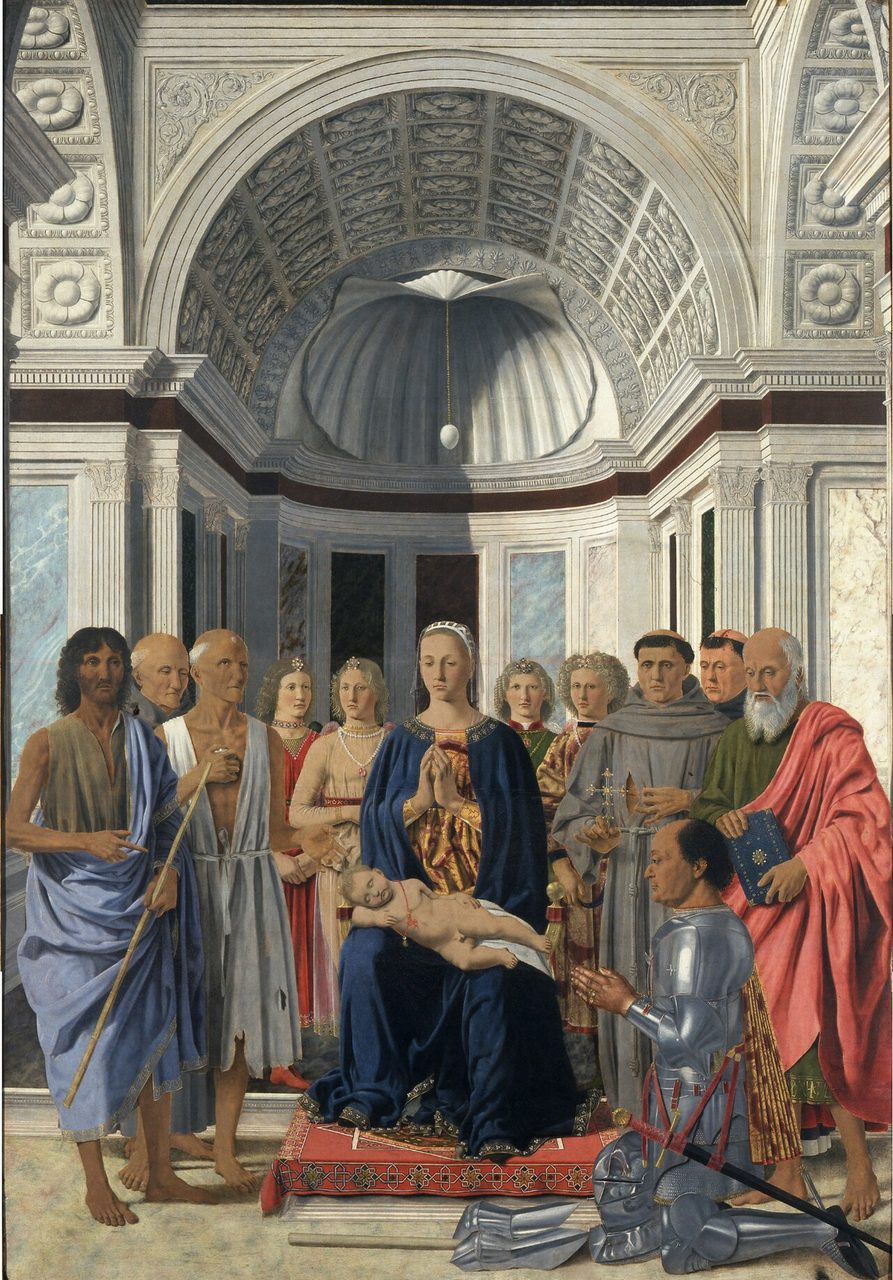
A Madonna with the sleeping Child, saints, angels and a duke in armor, motionless beneath a marble apse. Piero della Francesca painted it for Federico da Montefeltro, lord of Urbino. Everything here is calculated, even the egg.
Spot the detail
Above the Madonna's head, hanging at the back of the shell: what is it?
The full story
The first thing you notice is the silence. There is a Madonna, a child, six saints, four angels and a man in armor, and nobody is looking at anybody. They stand as still as columns.
Piero della Francesca was a painter and a mathematician in one, the author of a treatise on perspective. He painted the Pala Montefeltro, the Montefeltro , between 1472 and 1474 for Federico da Montefeltro, lord of Urbino and a mercenary commander. It is a : the Madonna enthroned in the center, the saints all around her, in the same space.
But look at that space. It is an apse lined with marble, with a great shell carved into the vault, built with an architect's precision. The lines run toward a single point, the . That point is Mary's left eye.
The kneeling duke
Now find the duke. He is at the bottom right, on his knees, encased in his armor. You see him in profile, and from the left side. That is no accident: Federico had lost his right eye in a tournament, and that side of his face was never shown.
Look at his joined hands too. According to scholars they are not by Piero: they are attributed to Pedro Berruguete, a Spanish painter working at the court of Urbino, who is thought to have repainted them a few years later. Why, nobody knows for sure.
Then go back to the center. The Child sleeps on his mother's knees, limp, with a coral pendant around his neck. It looks like a tender scene and it is not. For viewers at the time, that sleep foretold the death on the cross, and the red of the coral the blood.
There is a real bereavement behind all this. In 1472 Federico had at last had his heir, and right afterward had lost his wife, Battista Sforza. Many scholars read the this way: a man placing his dynasty under the Virgin's protection, between a birth and a death. What each single detail means, though, is still debated.
From Urbino to Milan
The panel came to Milan in 1811, with the Napoleonic suppressions. It came from Urbino, from the church of San Bernardino, which Federico had wanted as his own burial place. It is not even certain that it was painted for that spot.
And it is not whole: at some point it was trimmed at the sides. According to the studies, the architecture Piero had in mind was broader and brighter than the one you see.
Stand still for a minute yourself. This is not a painting that comes to meet you. You are the one who has to lower your voice.
About this stop
Legend
The cut nose of the Duke of Urbino
In Piero della Francesca's at Brera a man kneels in armor: Federico da Montefeltro, Duke of Urbino and a mercenary commander. At the root of the nose his profile has a sharp step, as if a piece were missing. For a long time the story went that he had a surgeon remove it: having lost his right eye in a joust, he could then see to that side with the other. The story is unproven, and many scholars doubt it. More likely the lance that pierced his visor took the eye and the top of the nose together. That famous profile is, first of all, a wound.
It is an ostrich egg, and it is no whim. According to the museum it recalls the Virgin's miraculous motherhood and is also an emblem of the Montefeltro, the family of the duke who commissioned the painting. Other scholars have seen in it divine perfection, life, even a pearl. There is no single explanation. What is certain is that Piero della Francesca placed it in the most conspicuous spot, in line with Mary's oval face, which repeats its shape.
Next stop
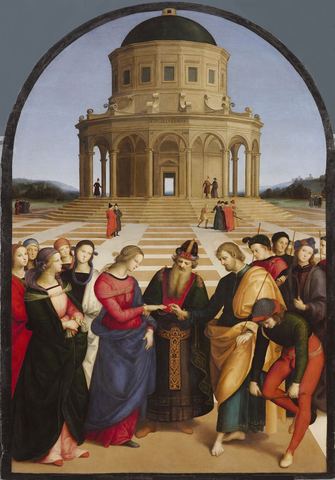
Stay in the same room: Raphael's Sposalizio della Vergine, the Marriage of the Virgin, is a few steps away