Stop 6 of 6Must-see
The Vicolo dei Lavandai
Where to stand
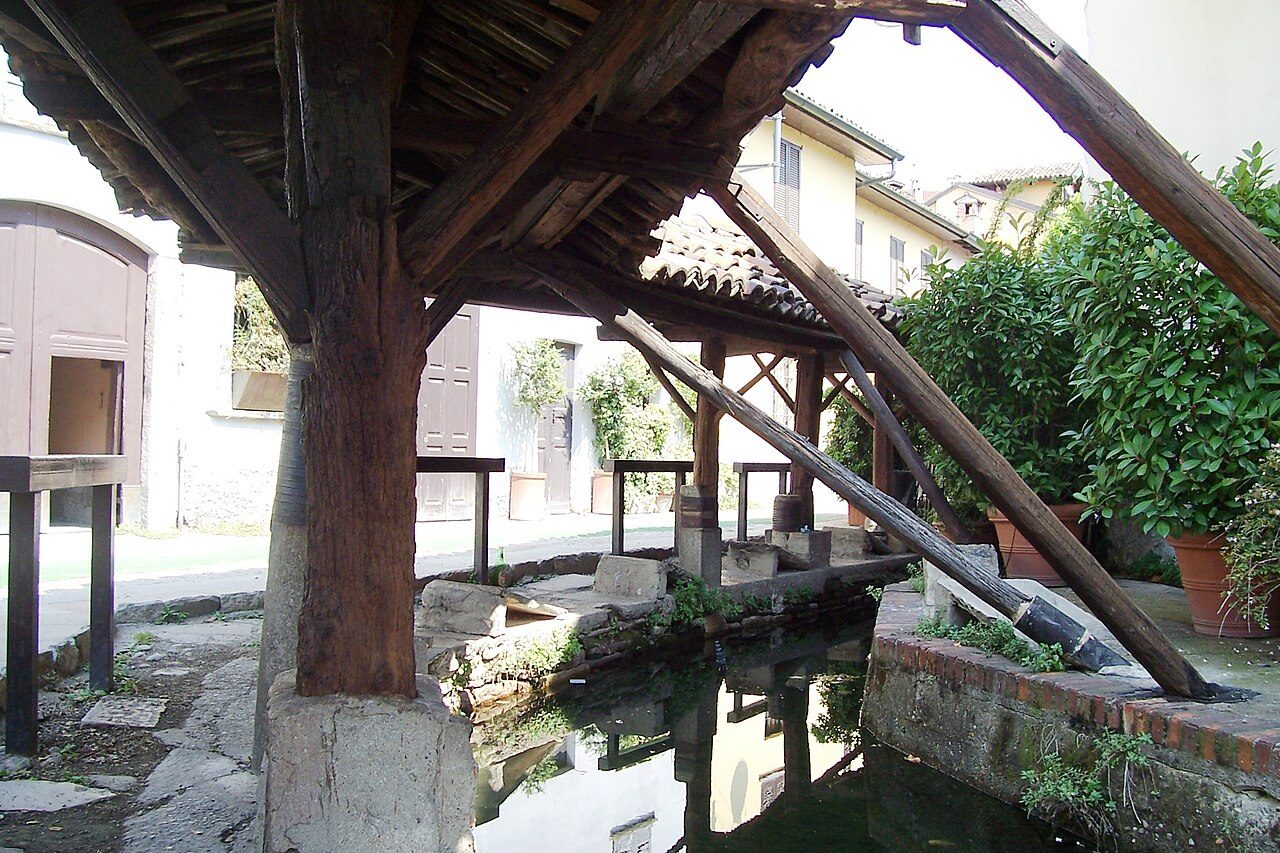
At number 14 of the Alzaia Naviglio Grande, inside the alley, in front of the roofed shelter over the little channel
A public that has survived almost intact, in use from the 1800s to the 1950s. At first the washing was done not by women but by men, gathered in a confraternity. Here the stop being engineering and become everyday life.
Spot the detail
Under the roof, along the little channel, find the stone slabs. What were they for?
The full story
The last stop is the smallest, and perhaps the one you'll remember most. An alley, a thread of water, a roof on posts. No dukes, no governors.
The name says it all: Vicolo dei Lavandai, the washermen's alley. There was a public here, working from the 1800s to the 1950s, and it has come down to us almost intact. In Milanese dialect it was el Vicol de Bugandee, from bugada, which means laundry.
A trade for men
Notice the masculine: lavandai, washermen, not lavandaie, washerwomen. The trade was plied by men, gathered in the Confraternita dei Lavandai, the washermen's confraternity, active in Milan since the 1700s. They had a patron saint, Sant'Antonio da Padova, and an altar dedicated to him in the church nearby, Santa Maria delle Grazie al . The women came later: by the time of the Second World War it was they who did the washing.
How the washing was done
Now picture the work. You knelt on the , a wooden rest, in the shelter of the roof. The laundry was rinsed in the fossett, the little channel fed by the Grande, the great canal just outside the alley, and scrubbed on the stone slabs you can still see in place.
Not a trace of detergent: ash, soda, soap and boiling water. In the alley there was a grocer's that sold soap, bleach and brushes. In a courtyard nearby there is still a spin dryer from the early 1900s, used to dry the laundry.
At the end of the alley a small square opens up. Goods from barges bound for the , the city's dock, were once unloaded there. This corner too, in miniature, was a port.
Simenon in the alley
A place like this was never going to escape anyone hunting for atmosphere. In the late 1950s the writer Georges Simenon, creator of Inspector Maigret, came to Milan looking for ideas and was photographed right here for the weekly magazine Epoca.
The walk ends here, and not by chance. You've seen a gate, a port, canals ordered by dukes and governors. But above all the were this: people on their knees at the water's edge, earning their day's pay.
About this stop
In culture
Simenon in the Washermen's Alley
In the late 1950s Georges Simenon, the Belgian writer who invented Inspector Maigret, visited Milan looking for ideas. The photographer Emilio Ronchini portrayed him in the Vicolo dei Lavandai, the washermen's alley, home to an old public just off the Grande canal. The feature ran in the weekly magazine Epoca at the end of December 1957.
Because the washing was done by men. Milan had a Confraternita dei Lavandai, a washermen's confraternity, from the 1700s, with a patron saint, Sant'Antonio da Padova, and an altar in the nearby church of Santa Maria delle Grazie al . They worked on their knees at the water's edge, rinsing the laundry in the little channel and scrubbing it on stone. By the time of the Second World War it was women who did the washing. The in the alley stayed in use until the 1950s.