Stop 2 of 7
The spiral ramp
Where to stand
Just inside the entrance, at the foot of the ramp that winds its way up inside the tower
The entrance is a spiral about 140 meters long, slipped into a 1930s palace. It is the idea the architect Italo Rota used to turn an office building into a museum: before you see a single painting, you climb.
Spot the detail
As you climb, look into the void at the center of the spiral: there is a group of sculptures
The full story
A museum usually begins with a door and a first room. This one begins with a climb.
In front of you is a ramp that turns on itself and works its way up inside the tower for about 140 meters, some 460 feet. It is not a flourish. It is the answer to a problem: how do you fit a museum into a palace that was never meant to be one?
From offices to museum
The , in the 1930s, had been conceived as a stage set for the square, with grand, solemn rooms. After the war, converted into offices, it lost its monumental character and became almost off-limits to the public. When the city held a competition to transform it in the early 2000s, the winner was the team led by the Milanese architect Italo Rota. Rota knew museums well: as a young man he had worked with the architect Gae Aulenti on the fitting-out of the Musée d'Orsay in Paris.
His decision was clear-cut. Outside, nothing gets touched: the marble facades were simply restored. Inside, everything is redone.
The route moves through constant changes of level, and the ramp is the first: it pulls you away from the square and hands you over to the galleries. As you climb, you are already making the move the museum will ask of you for the whole visit. Walking around things, shifting your point of view, leaving the city behind only to find it again from above.
The painting no longer here
Until 2022 the climb also came with a specific reward. Waiting for you along the ramp was Il Quarto Stato, The Fourth Estate, by Giuseppe Pellizza da Volpedo, the huge canvas of workers advancing shoulder to shoulder toward the viewer. It was the first work on the route, the threshold between the nineteenth century and the twentieth.
Today it is back at the Galleria d'Arte Moderna, the city's modern art gallery, and here the visit starts straight in with the . If you came for that painting, your time is not wasted: the rest is worth the climb.
One last thing. The museum was supposed to open at the end of 2009, the year the Manifesto turned one hundred. It opened a year late.
The coincidence slipped away, but something stayed in the shape: a spiral is a line that never stands still. The Futurists, whom you will meet as soon as you get upstairs, would have approved.
About this stop
Anecdote
De Chirico's bathers, in from the park
At the center of the ramp of the Museo del Novecento, Milan's twentieth-century art museum, are two stone bathers and a fish, from the Bagni misteriosi, the Mysterious Baths, by Giorgio de Chirico, a founder of . They are pieces of a fountain he made for the 1973 Milan Triennale, the year he turned eighty-five. The basin is still in Parco Sempione. The idea was decades old: in a house with a wax-polished floor he watched a gentleman walk, legs reflected, and felt he might sink as into a pool. Outdoors the stone was deteriorating. So the originals came into the museum, and the copies bathe in the park.
In culture
Il Quarto Stato, a painting on the move
For years a visit to Milan's Museo del Novecento began with Il Quarto Stato, The Fourth Estate, by Giuseppe Pellizza da Volpedo, the great canvas of marching workers. The 1901 painting is one of the most quoted images of twentieth-century Italy: it appears behind the opening credits of Bernardo Bertolucci's film Novecento. Milan bought it by public subscription and in 1921 showed it at the Castello Sforzesco. Under Fascism it went into storage, after the war to a room at city hall, then to the Galleria d'Arte Moderna. In 2010 it came here, along the entrance ramp. Since July 2022 it has been back at the Galleria d'Arte Moderna.
Next stop
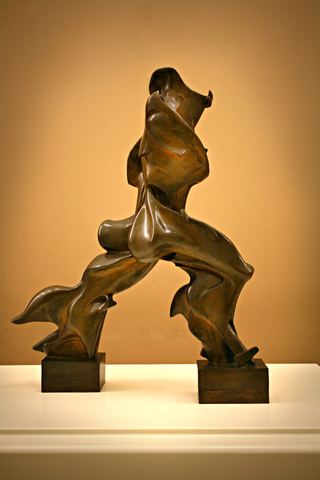
At the top of the ramp, go into the first rooms and look for the one devoted to Umberto Boccioni