Stop 3 of 7Must-see
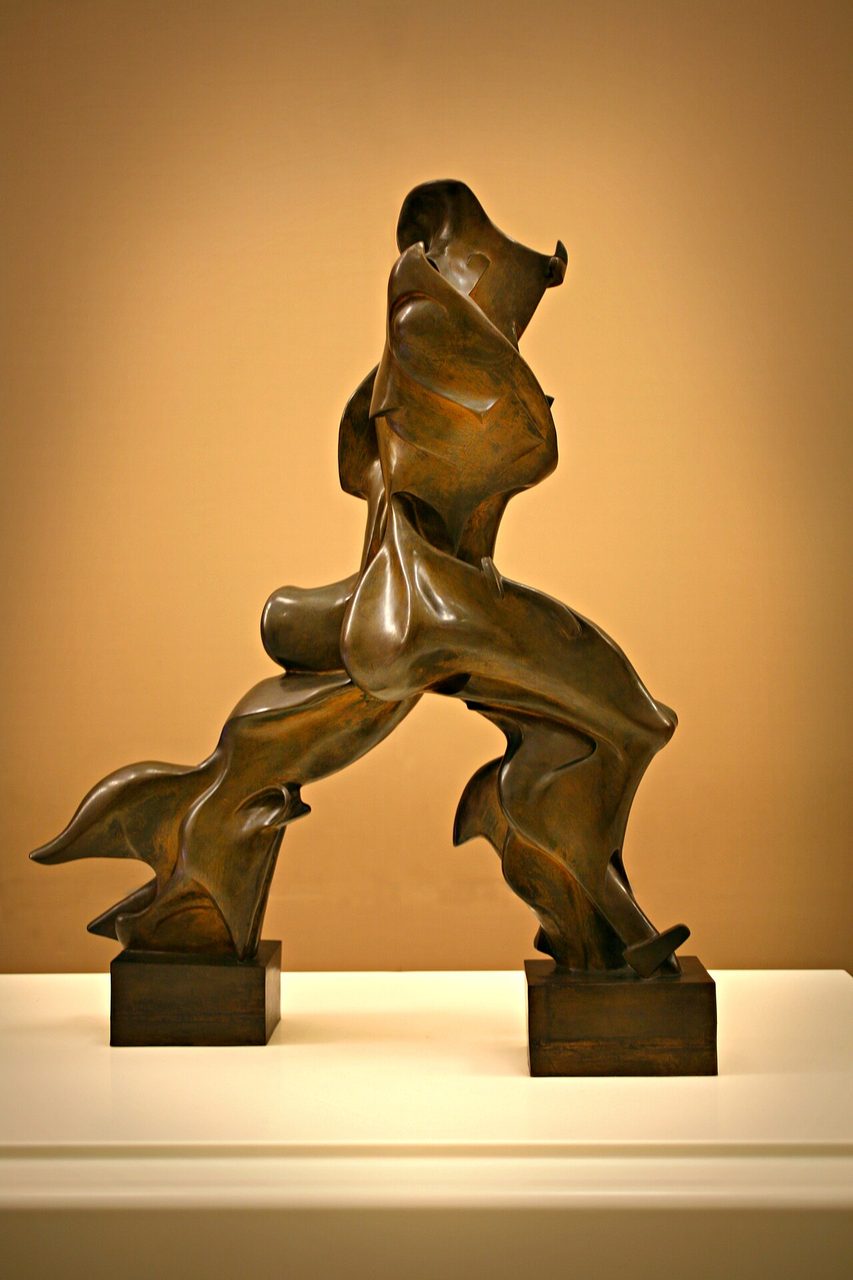
Boccioni, Unique Forms of Continuity in Space
Where to stand
In the Futurism rooms, in front of the striding bronze figure. If you can, walk all the way around it
The most famous sculpture of : a body at full stride that the air seems to shape as it goes. Umberto Boccioni made it in plaster in 1913 and never saw it in bronze. You already know it: it is on Italy's twenty-cent coin.
Spot the detail
Look at the figure from one side, then from the other: does the outline stay the same?
The full story
Dig into your pocket. If you find an Italian twenty-cent coin, take a good look: the figure on it is this one.
Umberto Boccioni modeled it in 1913. Boccioni was a painter, and he had come to sculpture just a year earlier, with the fury of someone in a hurry. In a letter he called himself obsessed, and described the sculpture of his day as a mummified art.
He was the most gifted of the , the artists who at the start of the century celebrated speed and the modern world. Their leader, the poet Filippo Tommaso Marinetti, claimed that a roaring car is more beautiful than the Victory of Samothrace, the celebrated winged Greek statue.
How the figure is made
Now look: Boccioni remade that Victory his own way. The figure strides forward, with no arms and no real face. It has no skin. In place of muscles it has ridges and blades of bronze that stretch out behind it, as if the air were sculpting it as it runs.
In profile it is a man walking into the wind, and a machine as well. From a three-quarter view the forms seem to twist into a spiral.
This is not a body frozen in an instant, as in a photograph. It is the whole movement, compressed into a single form. The title, for once, says exactly that: in Italian, Forme uniche della continuità nello spazio.
From plaster to bronze
Then there is the story of the object itself, which is almost a novel. What left Boccioni's hands was made of plaster. He died in 1916 and never saw it in bronze.
According to the most widely told account, his plasters were left in a storeroom and years later were smashed to pieces and thrown away. Someone is said to have recognized them among the scrap and pieced the least damaged ones back together. What is certain is that many of his sculptures were lost, and this one survived.
The plaster then passed to Marinetti, and after the war the poet's widow sold it to a Brazilian industrialist. Today it is in a museum in São Paulo.
The bronzes all came later. The first casts date from 1931, and with later replicas the total has reached about twenty, scattered among New York, London, and half the world. The one in front of you is one of them.
Walk around it once, slowly. With every step the figure changes, the way a person changes as they pass you in the street. More than a hundred years on, it still has not stopped walking.
About this stop
Anecdote
Boccioni, the Futurist killed by a horse
Umberto Boccioni, the who modeled the Unique Forms on display at the Museo del Novecento, Milan's twentieth-century art museum, had made engines and speed his banner. When Italy entered the war in 1915, he volunteered with a battalion of cyclists. The following year he was called up again into the artillery, near Verona. On August 16, 1916, during an exercise, his mare bolted, frightened, the story goes, by a passing truck, and threw him. He died the next day, at thirty-three. If that is how it went, the bard of machines was killed by an animal that had been scared by an engine.
In culture
The Boccioni sculpture in your pocket
A bronze figure strides through Milan's Museo del Novecento: Unique Forms of Continuity in Space, by the Umberto Boccioni. It is probably the most handled Italian sculpture in the world: it is on the Italian side of the twenty-cent coin. Its run did not end there. In 1981 it inspired a creature in the British series Doctor Who. Since 2018 a scale replica has been the trophy of the world championship of the racing video game Gran Turismo: it was made from a laser scan of the sculpture. A work created to celebrate speed has ended up as the prize for whoever races fastest, even while sitting still.
Anecdote
Boccioni's plasters that ended up as scrap
At Milan's Museo del Novecento, Unique Forms by the Umberto Boccioni is bronze. The original was plaster: Boccioni died in 1916 without casting any of his sculptures. What happened to the plasters afterward is unclear. By the most widely told account they stayed in the storeroom of a Lombard sculptor and years later were smashed and dumped. Someone is said to have recognized them and reassembled the least damaged. The plaster of Unique Forms passed from the painter Fedele Azari to the poet Marinetti in 1928. In 1952 Marinetti's widow sold it to a Brazilian industrialist, who donated it to a museum in São Paulo in 1963.
An art equal to the modern world: engines, cities, crowds, speed. The movement was born in 1909 with a manifesto by the poet Filippo Tommaso Marinetti, for whom a roaring car was more beautiful than the Victory of Samothrace. The group's painters and sculptors, from Boccioni to Balla, tried to get movement into works that by their nature stand still. This museum is known precisely for its collection.
Next stop
Carry on along the route to the rooms between the two wars and look for Giorgio Morandi's