Stop 5 of 7Must-see
Fontana and the neon
Where to stand
In the big double-height hall devoted to Lucio Fontana, standing under the neon and looking up
An arabesque of light a hundred meters long, hanging over your head. Lucio Fontana devised it in 1951 to show that a work of art can be made of space and light instead of canvas and paint. If you only have time for one room, this is it.
Spot the detail
Follow the neon tube with your eyes from start to finish: what gesture does it remind you of?
The full story
Look up. In this room the main work is not hanging on a wall: it floats in the air.
It is a single stroke of white light that knots itself, darts forward, doubles back. It is called Struttura al neon, Neon Structure, and Lucio Fontana designed it in 1951 for the Milan Triennale, the major exhibition of architecture and design. There it hung over the grand staircase, against a dark blue ceiling, and anyone climbing saw it change shape with every step.
The one above you is a reconstruction, made for this museum when it opened. The earlier versions were lost or ended up elsewhere.
Neon used as a pencil
To grasp how bold the gesture was, think of what neon meant back then: stuff for shop signs. Fontana brings it into a palace of art and uses it like a pencil. He does not draw something. He just draws, in space, and the space becomes the work.
He knew he was being provocative: in a letter to the architect Gio Ponti he boasted of having made it to spite the critics. The Triennale jury gave him the Grand Prize anyway. Its chairman was Piero Portaluppi, one of the architects of the , the very building you are standing in.
Holes and cuts in the canvas
Fontana was born in Argentina to an Italian father, studied sculpture in Milan, and in 1947 founded a movement, . The idea was simple and radical. Painting has been shut inside a flat rectangle for centuries, and it is time to get out.
He got out first by punching holes in his canvases, then by slashing them: these are the , the Spatial Concepts, and you will find some in these rooms. Look at them after the neon. The cut is not a scar, it is an opening. Behind the canvas there is space, and he makes you see it.
Before you leave, look for the other ceiling too. It is the Soffitto spaziale, the Spatial Ceiling, which Fontana devised in 1956 for the dining room of a hotel on the island of Elba, the Hotel del Golfo. Now that it has made it all the way here, the effect is odd: the guests looked at it while they ate, and you look at it in a museum.
With Fontana the question changes. In front of a painting you ask what it represents. Here you ask where you are.
About this stop
Anecdote
The hotel ceiling saved in pieces
Among the Lucio Fontana rooms at the Museo del Novecento, Milan's twentieth-century art museum, is a ceiling that came from a hotel. Fontana, the artist of the slashed canvases, made it in 1956 for the dining room of the Hotel del Golfo, on the island of Elba: he incised and pierced the fresh plaster on site, with long rods and the builders' help. In 2000 a renovation was about to destroy it. The work was not yet fifty years old, too young for the law to protect it. So the state bought it. Restorers divided it into twenty-five panels, planned so no hole was touched, and brought it to Milan.
Anecdote
Fontana's neon, made to spite the critics
In the windowed hall of Milan's Museo del Novecento hangs an arabesque of light a hundred meters long: the Struttura al neon by Lucio Fontana, the artist of the slashed canvases. It is a reconstruction. The original hung at the 1951 Milan Triennale, over the grand staircase, in a space by the architect Luciano Baldessari. Fontana first made a small wire model, later lost. In a letter to the architect Gio Ponti he claimed its novelty: made, he said, to spite the critics. The jury gave him the Grand Prize, shared with the company that bent the tubes. One other reconstruction was destroyed; another went to Barcelona.
Because Fontana did not want to ruin a painting: he wanted to open it. For him the canvas was not a surface to fill but a boundary to cross, and the hole or the cut shows that there is real space behind it. He started with the holes in 1949, and at first he met with puzzlement from critics and ridicule from the public. The cuts came in 1958. He called them all , Spatial Concepts: the title warns you that what counts is the idea, not the skill of the hand. On the back of many canvases he wrote a phrase by hand, ironic or poetic.
Next stop
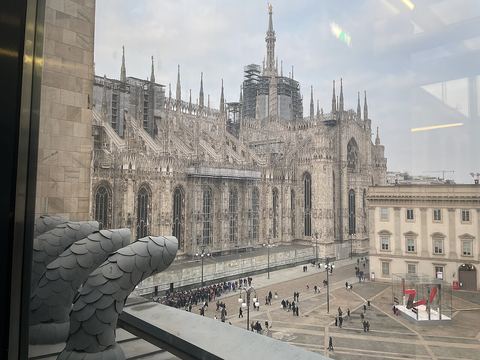
Stay in the hall, turn toward the windows, and walk up to the glass