Stop 6 of 7
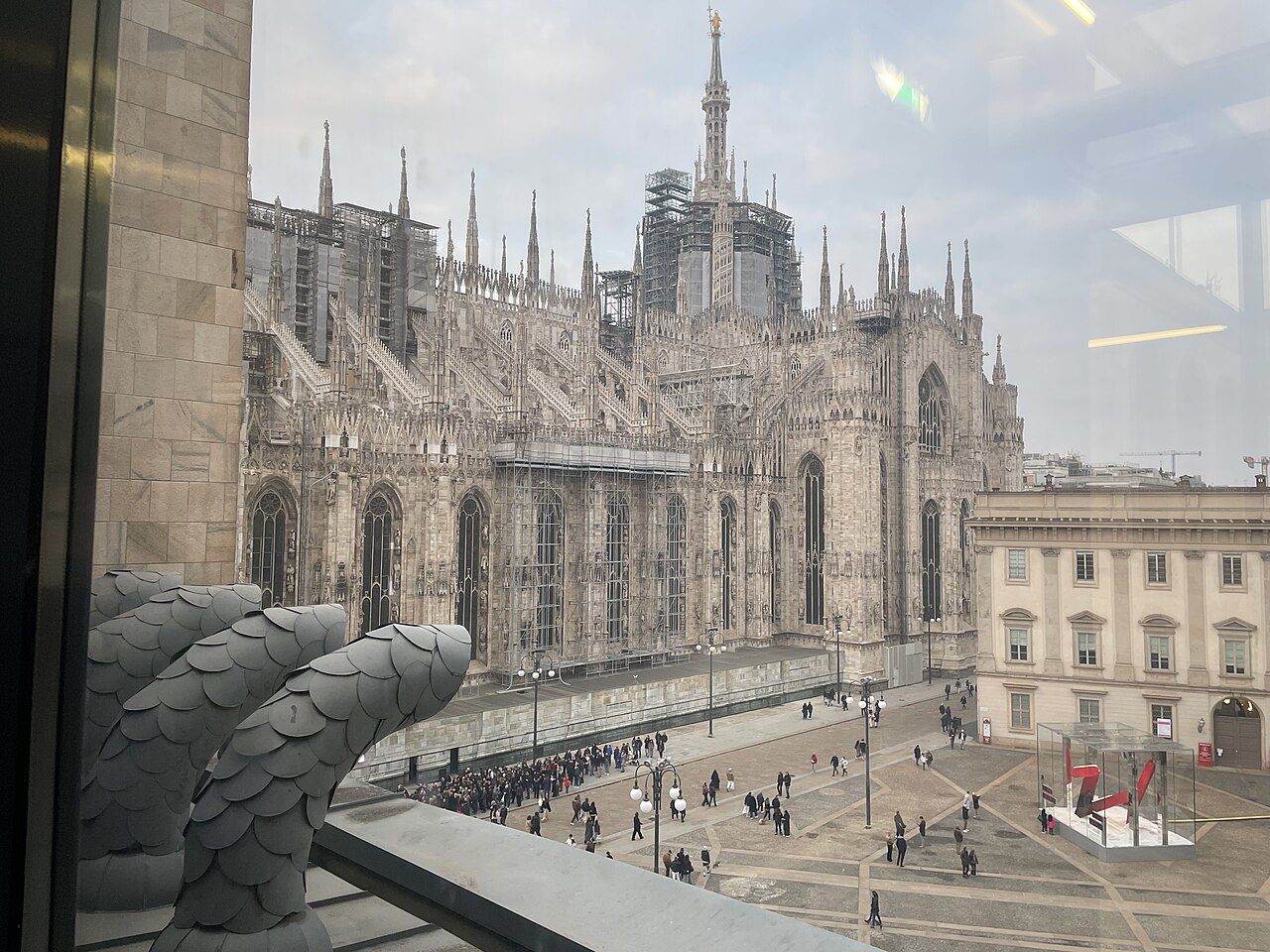
The window on the Duomo
Where to stand
In the same hall as the Fontana, in front of the big windows overlooking Piazza del Duomo
The best view in the museum is not a work of art. From the windows of the you have the Duomo at eye level and the whole square below you. And you understand why this palace stands exactly here.
Spot the detail
Across the square, find the great entrance arch of the Galleria Vittorio Emanuele: how does it relate to the building you are in?
The full story
Now turn around. After so many closed rooms, the city floods back into your eyes all at once.
The Duomo, Milan's cathedral, is right there, and from an unusual height: not from below, crushed under the facade, but almost level with it. From here the spires stop being distant lacework and become what they are, a crowd made of stone. Look at the color of the marble, that white shading into pink. It is the same marble that covers the building you are in, and that is no accident: it is the one thing the two neighbors agree on.
The nineteenth-century square
Then lower your eyes to the square. It looks ancient, and almost all of it dates from the nineteenth century. It was laid out by the architect Giuseppe Mengoni, who won the competition of 1863, widened the space in front of the cathedral, and built the Galleria Vittorio Emanuele, the glass-roofed arcade whose great arch you see on the opposite side. In the middle, on horseback, is the king the Galleria is named after: the monument arrived at the end of the century.
On this side, though, the plan was left unfinished. The gap lasted for decades, until the twin palaces arrived in the 1930s. You are standing inside the missing piece.
The neon seen from the square
There is a play of glances here worth noticing. Right now you are the one looking at the square. But Fontana's neon, behind you, can also be seen from down there through the glass, and anyone crossing the square can look up at a stroke of light hanging in a room. It is the one work in the museum that everybody sees, even people who will never set foot inside.
The city in a frame
In here you have just met artists who wanted to get art out of the frame. This window makes the opposite journey: it takes the city and puts it in a frame.
The Duomo took centuries to become what it is. The palace you are looking from was commissioned by a regime that never saw it finished. And down there, people walk by without a thought for either.
Stop for a moment. It is the biggest picture in the collection, and it changes every minute.
Next stop
Pick the route back up toward the rooms of the 1950s and 1960s and look for Piero Manzoni