Stop 5 of 8Must-see
Saint Bartholomew and the transept
Where to stand
In the right arm of the transept, in front of the statue of a man with no skin, standing on a pedestal
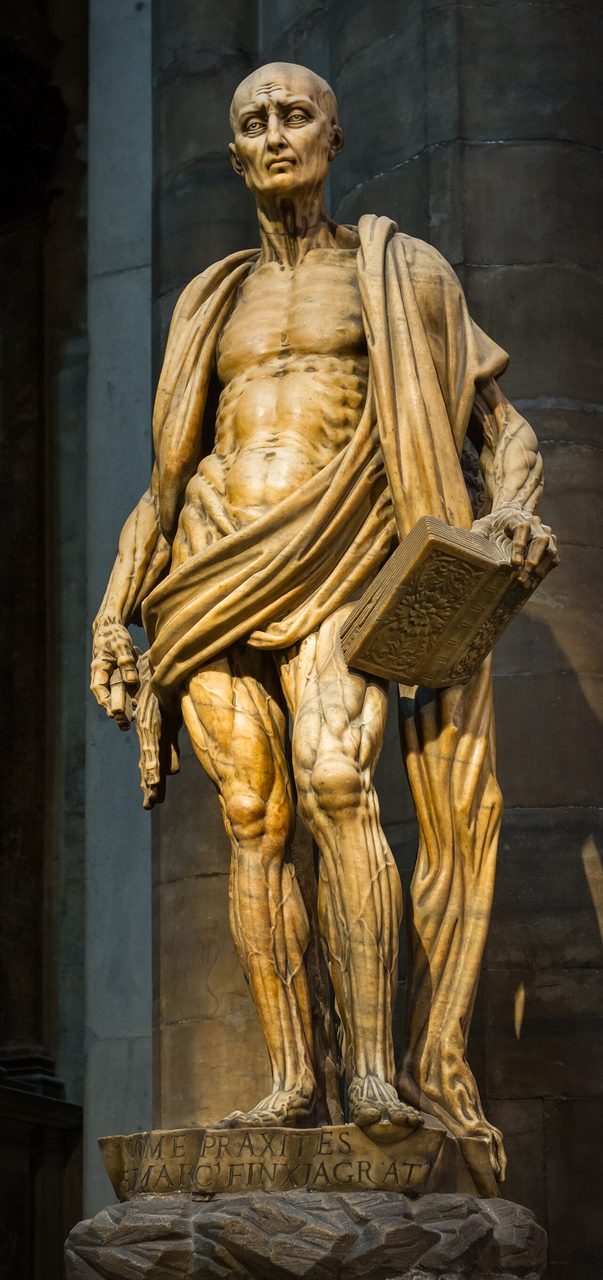
Perhaps the most famous statue in the Duomo: a flayed saint who carries his own skin over his shoulders. Marco d'Agrate carved it in 1562, and he was so proud of it that he signed it with a cocky line.
Spot the detail
The Latin inscription on the base of the statue: the sculptor compares himself to someone
The full story
From a distance he looks like a man wrapped in a cloak. Come closer. The cloak is his skin.
This is Saint Bartholomew, San Bartolomeo in Italian, one of the twelve apostles. According to tradition he died flayed alive, and in 1562 the Lombard sculptor Marco d'Agrate decided to show him after his martyrdom. The saint stands there, calm. His skin winds around his body and hangs from his shoulders like a stole.
What strikes you is the precision. Muscles, tendons, veins: every bundle is in its place. More than a saint, he looks like an anatomy lesson in marble.
That is no accident. In the sixteenth century artists were studying the human body with a new curiosity, and a statue like this was the best way to prove you had understood it.
Sacred art or a display of skill? Marco d'Agrate left his answer written on the base. Look for it.
The tomb of Gian Giacomo Medici
Now turn around. Facing you is a large marble monument with bronze statues. It is the tomb of Gian Giacomo Medici, a military commander, commissioned by his brother, Pope Pius IV.
The sculptor Leone Leoni made it in the very same years as the Saint Bartholomew. In this corner of the Duomo the sixteenth century left two of its most ambitious efforts, one facing the other.
The Trivulzio candelabrum
Then cross the whole to the opposite arm. There you will find a monumental candelabrum. It is called the Trivulzio candelabrum, after the archpriest who gave it to the Duomo in that same year, 1562.
But it is much older than the gift. It is a medieval work, made between the twelfth and thirteenth centuries, older than the cathedral that houses it.
Look at it from below. The foot is a tangle of vine shoots, fantastic animals and small figures. Nobody knows who made it. The name of Nicholas of Verdun, a great goldsmith of northern Europe, has been put forward, and so have artists from the Rhineland, but scholars are still arguing.
Two objects, two ways of astonishing. The Middle Ages bring patience, the sixteenth century brings virtuosity. The Duomo keeps them at the two ends of the same , and you can decide which of the two stays with you longer.
Next stop
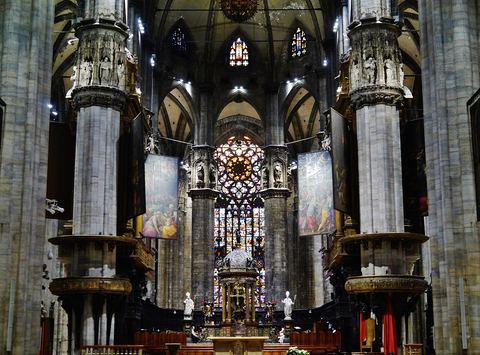
Go back to the center of the church and walk up to the presbytery, the raised area around the high altar