Stop 6 of 8
The presbytery and the Sacro Chiodo
Where to stand
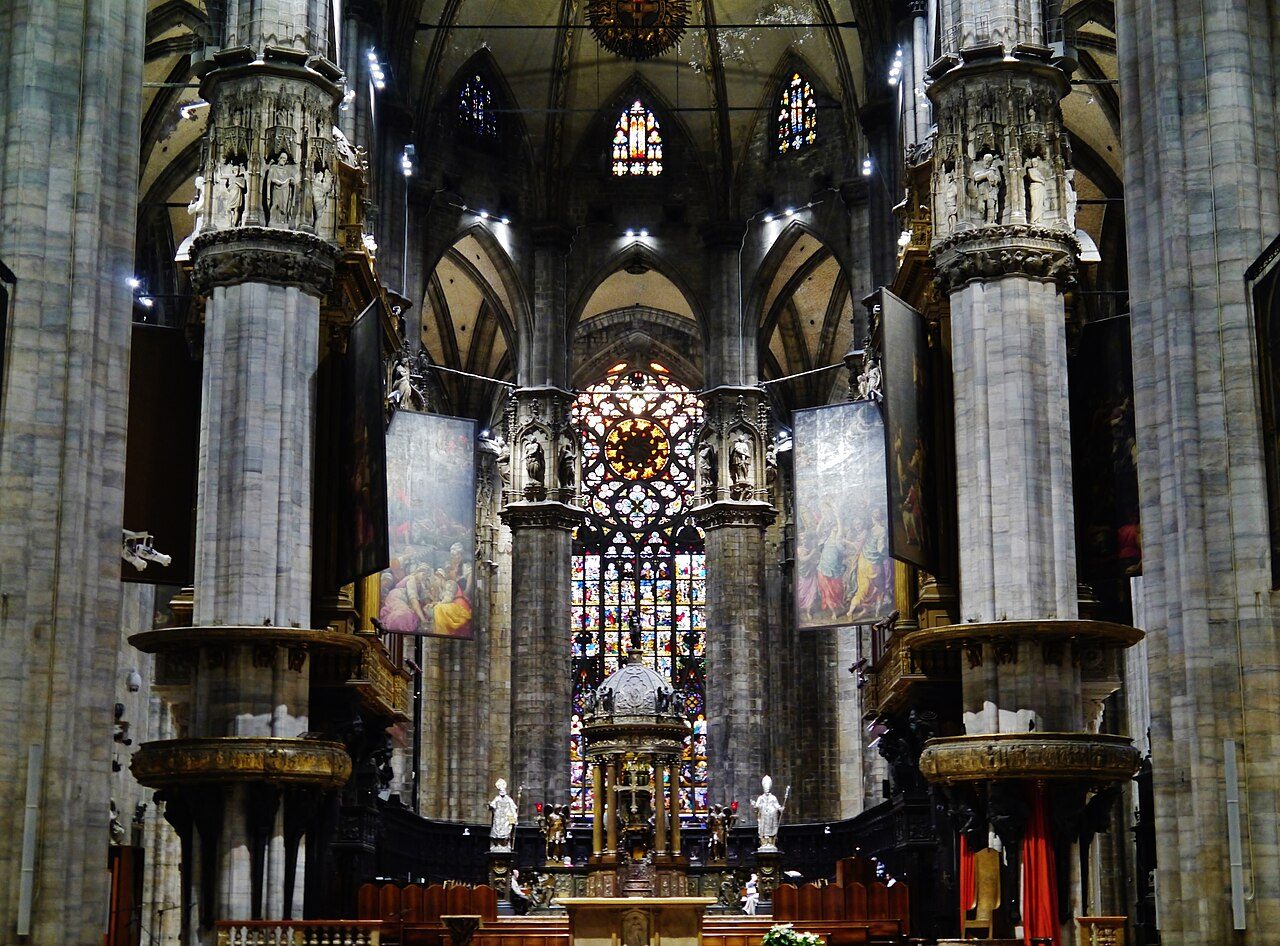
In the center of the church, in front of the raised area around the high altar, looking up toward the far end
The heart of the Duomo holds its most precious relic: the Sacro Chiodo, a nail that tradition says came from the cross of Jesus. It sits at the top of the vault, and to fetch it they use a seventeenth-century machine called the cloud.
Spot the detail
High up, in the vault above the choir, behind the high altar: a small red light
The full story
Here the church changes tone. The floor rises by a few steps, and the high altar, the wooden choir and the organs appear. This area is called the , and it is the part reserved for the clergy.
What Carlo Borromeo changed
The look you see was decided above all by one man: Carlo Borromeo, archbishop of Milan in the second half of the sixteenth century. When he arrived he found a cathedral he judged untidy, full of showy tombs and with the altar pushed away at the back. He wanted the opposite: the altar farther forward, raised, visible to everyone.
He gave the job to his trusted architect, Pellegrino Tibaldi, who raised the floor and redesigned the altar and the choir. He was not a man for half measures.
The Holy Nail and the nivola
Now look up, toward the far end, where the vault closes above the choir. Up there is the most venerated object in the Duomo: the Sacro Chiodo, the Holy Nail.
According to tradition it is one of the nails with which Jesus was crucified. Nobody can prove it. It is a relic, and for the faithful what counts is what it stands for.
The extraordinary thing is the way they go and get it. Every year, in mid-September, the nail comes down among the faithful. To reach it they use the nivola, which means cloud in Milanese dialect: a mechanical lift that rises to the vault and brings the relic back down.
The rite was born in 1576, during the plague: on October 6 Carlo Borromeo carried the nail in procession through the streets and ordered that it be repeated every year. The machine in use today dates from 1624. It is four centuries old and still working.
The scurolo and the apse
Carlo Borromeo, for that matter, never left. After his death he was declared a saint, and his body rests here below, in the scurolo: a small eight-sided chapel, inside an urn of silver and rock crystal.
Before you go, look beyond the altar. The three gigantic windows of the are the oldest part of the building: the Duomo began there. Above, in the rose window of the apse, is a sun with its rays, the razza. Before it is a religious symbol, it is the emblem of Gian Galeazzo Visconti, the lord who wanted the Duomo this big and made sure everyone knew it.
About this stop
Nobody can prove it. The Sacro Chiodo, the Holy Nail, is a relic: according to tradition it comes from the cross of Jesus, and that is why the faithful venerate it. What is certain is the history of the rite. In 1576, during the plague, the archbishop Carlo Borromeo carried it in procession and ordered that the gesture be repeated every year. Today the nail is lowered from the vault with the nivola, a mechanical lift that in its present form dates from 1624.
Next stop
Head back toward the entrance: the remains of the ancient baptistery are under the floor, at the facade end