Stop 4 of 8Must-see
Every line leads to Christ
Where to stand
In the refectory, toward the middle of the room, far enough back to take in the whole painting
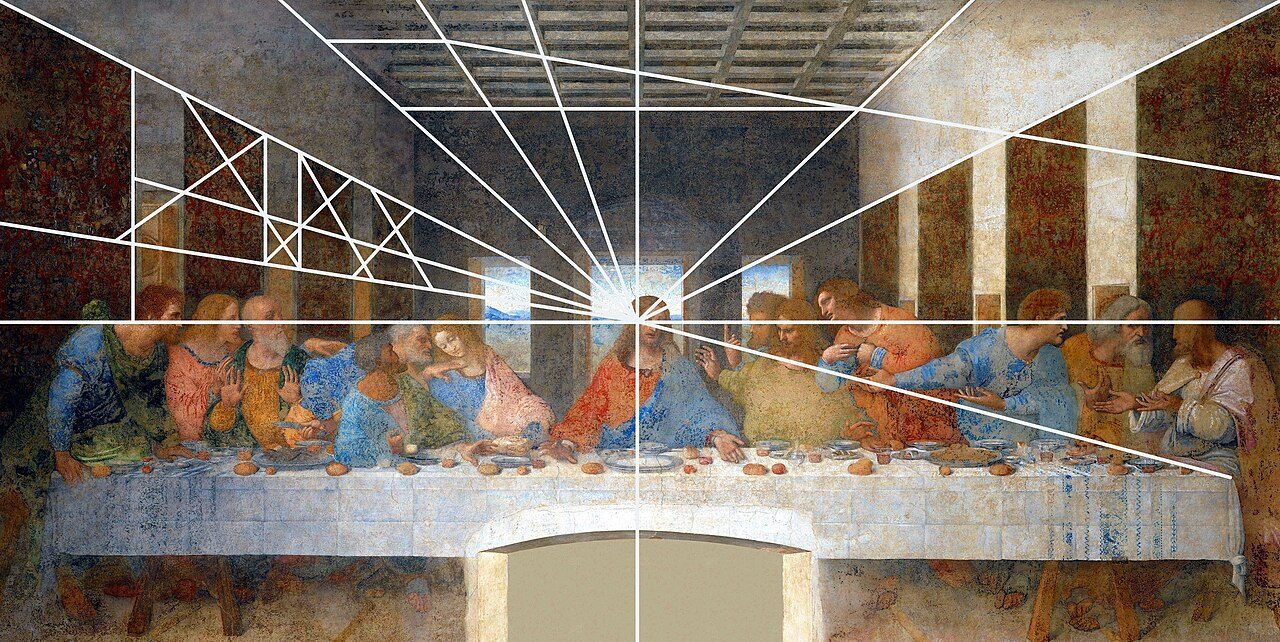
The painted room is built like a stage set: the lines of the ceiling and walls all run toward a single point, the head of Christ. Right there, the restorers found a nail hole.
Spot the detail
Follow the lines of the painted ceiling and the side walls with your eyes: where do they meet?
The full story
Take a step back, if you can, and look at the room before the people. It has a , dark walls with large panels and three windows at the back. All the lines run toward the center. The spot where they meet, the , falls on the head of Christ.
Leonardo did not leave it to chance. A nail hole was found at exactly that spot. It is thought to have held the strings he stretched to mark out the perspective on the wall: a builder's trick behind a masterpiece.
The effect on the viewer
You feel the effect even without knowing any of this. Wherever you look, your eye comes back to the center. The apostles are in turmoil, but the room stays still and holds them together.
It is a stage set, and you are in the audience, where the friars used to be. Then there is the light: of the three windows, the middle one frames Christ, and his head stands out against the pale sky.
Above and below the scene
Look up above the scene. The three , the half-moons painted at the top, carry the Sforza coats of arms inside garlands of fruit and leaves. They are the signature of the man who wanted the painting.
Two caveats. The you see is almost entirely an eighteenth-century remake: little of the original is left.
And at the bottom, in the center, the painting breaks off in an arched outline. That is the door the friars cut through to the kitchen in the 1600s, later walled up again. It took Christ's feet with it.
The perspective holds all the same. After five centuries, a door and a bomb, your eye still goes where Leonardo wanted it to.
About this stop
Because in the 1600s the friars cut a door to connect the to the kitchen, right under the figure of Christ. The opening destroyed his feet. By then the painting was already badly deteriorated. The door was later walled up, but its arched outline is still visible. To know what those feet looked like you have to turn to the early copies, such as the one by Giampietrino now in London.
Next stop
Stay where you are and move on to the apostles: now it's time to look at the faces