Stop 6 of 8
The wall across the room
Where to stand
In the refectory, with your back to the Last Supper, looking at the opposite wall
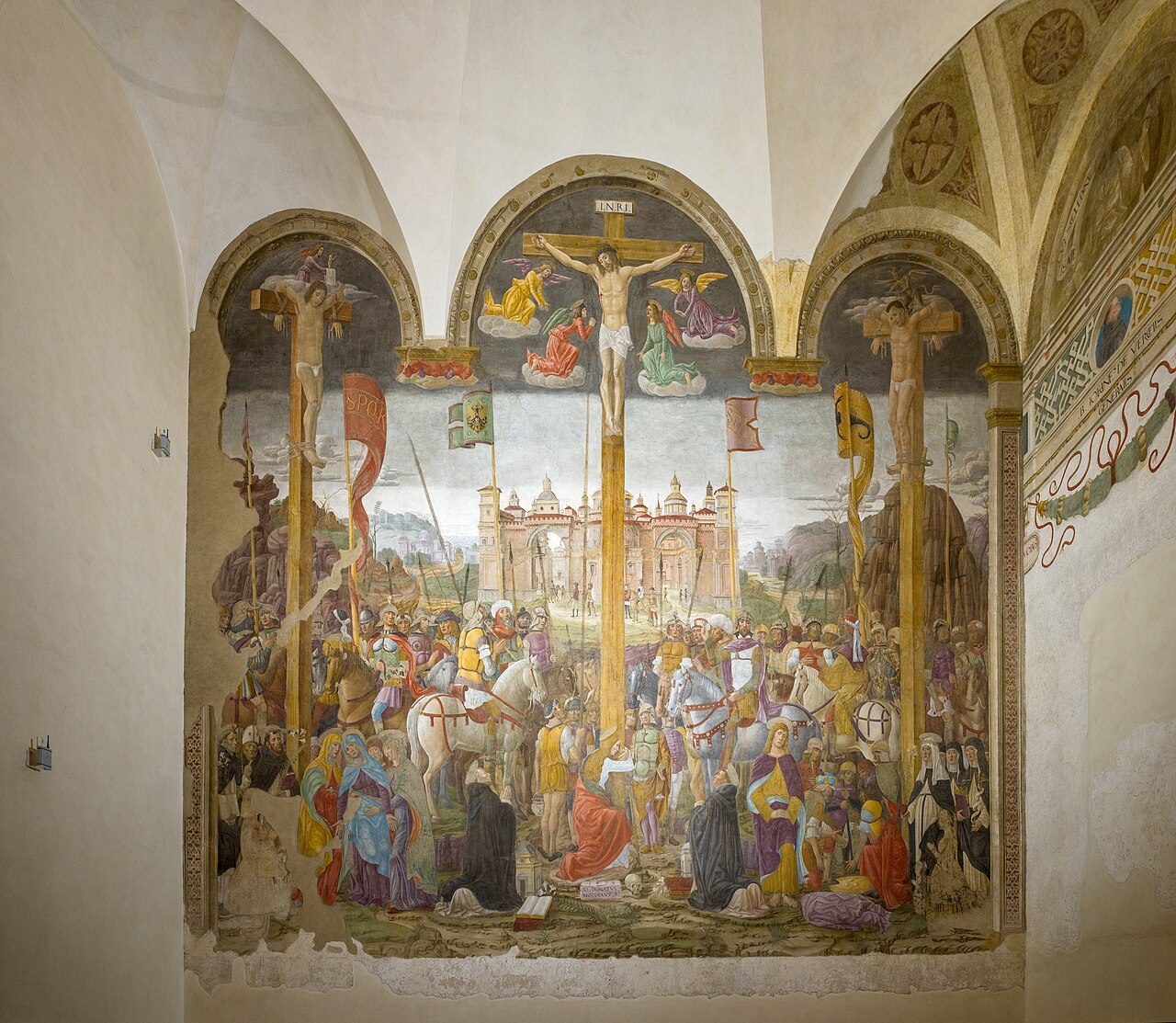
Facing Leonardo is the Crucifixion by Donato Montorfano, painted in the same years. It is a true and has come down to us in good condition. At the bottom are portraits of the ducal family, most likely added by Leonardo: they have all but vanished.
Spot the detail
At the bottom, on either side of the Crucifixion, look for kneeling figures reduced to shadows
The full story
Everyone comes in for Leonardo and turns their back on this wall. Turn around for at least a minute: it explains what you have just seen.
The Crucifixion is by Giovanni Donato Montorfano, a Lombard painter, and was finished in 1495, while Leonardo was at work on the other side. It fills the whole wall, inside a simple painted frame. The friars ate in between: the Supper at one end of the room, the Passion at the other.
Three crosses split the scene in three. Below is a crowd of sharply outlined figures, on jagged rocks. In the background an ancient-looking city stands in for Jerusalem. At the foot of the cross, look for a squared block of stone: Montorfano put his signature and the date on it, with pride.
Painting before Leonardo
It is not a scene that takes your breath away. Each group keeps to itself, nobody reacts to anybody. This is the painting that was done in Milan before Leonardo, and you only have to turn your head to measure the distance. Giorgio Vasari, the biographer of the artists, dismissed it as a Passion in the old manner.
Fresco versus painting a secco
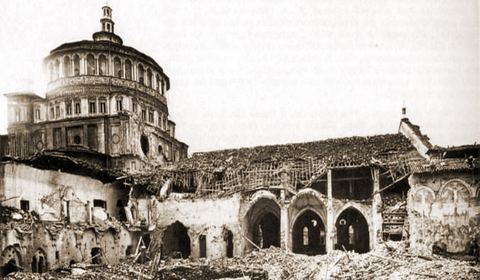
But look at the state it is in. Montorfano painted in , on fresh plaster, the way it had always been done. The color sank into the wall and after five centuries it is still there. Not even the bomb of 1943, which damaged this wall, managed to wipe it out.
Now look down, at the sides. There, according to Vasari, Leonardo stepped in, , with his own method. Vasari found those portraits divine. Today they are shadows.
The lesson is a cruel one, and it is all here in this room: the cautious technique won, the brilliant one lost. And yet you came for the other wall.
About this stop
A large Crucifixion by Donato Montorfano, a Lombard painter, finished in 1495. It is a true and is in good condition. At the bottom, on either side, are portraits of Ludovico il Moro, Duke of Milan, his wife Beatrice d'Este and their two children, most likely added by Leonardo. They are painted , like the Supper, and little more than shadows are left of them. So in one room you have the two techniques side by side, and the result after five centuries.
Next stop
When your fifteen minutes are up, head out: the last two stops are for reading outside, at your own pace