Stop 5 of 8
The choir and the starry sky
Where to stand
At the end of the central nave, at the entrance to the choir: look up, toward the arch and the vaults
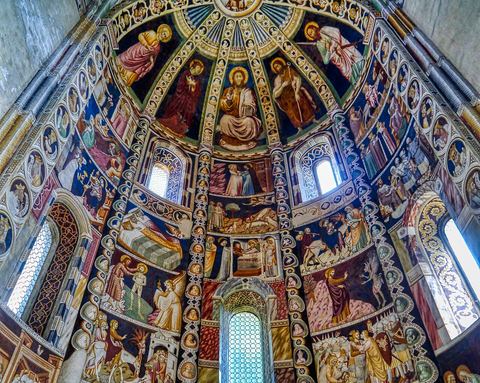
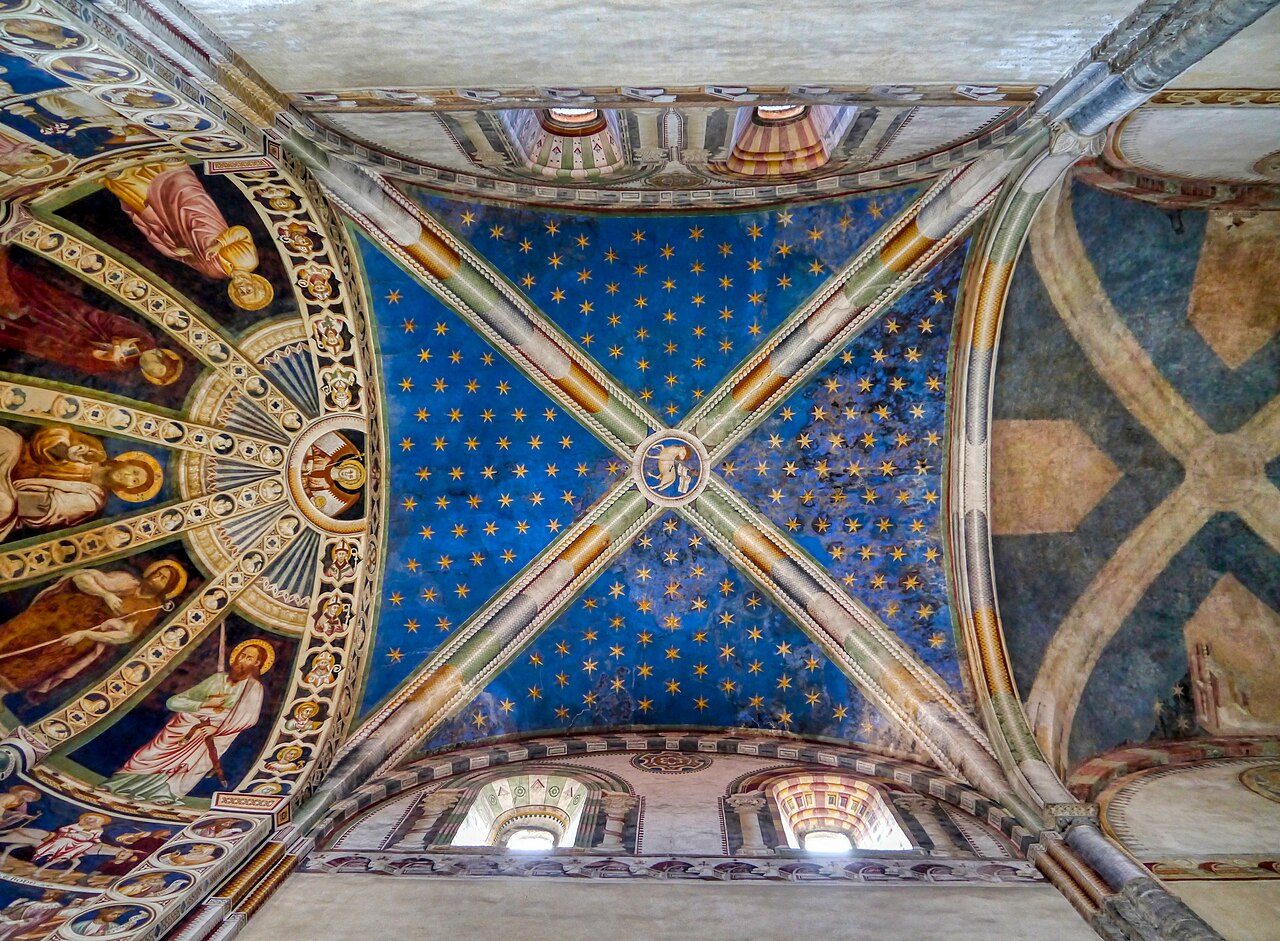
After five bare aisles, the is an explosion of color. It was the space reserved for the monks, and in the 1300s it was painted from the entrance arch up to the vaults, with a blue sky full of stars.
Spot the detail
In the first vault of the choir the starry sky survives only in pieces. Why?
The full story
The whole church is built to bring you here. The is the long space between the aisles and the , covered by masonry vaults, and for centuries it belonged to the monks, who gathered in it for sung prayer. The faithful stayed back, where you are now.
Who wanted the frescoes
Between 1315 and 1324 this space was painted from top to bottom. The bishop of Como was Leone Lambertenghi, a Franciscan friar, and his brother Benno was the abbot of Sant'Abbondio. In all likelihood they were the ones who wanted the frescoes and decided what they should tell.
The painter, on the other hand, left no name. Art historians call him the Maestro di Sant'Abbondio, the Master of Sant'Abbondio, after this church.
From entrance arch to semi-dome
Read from the outside in, as if on a journey. On the entrance arch is the Annunciation, the beginning of the story, accompanied by figures of saints.
Above you the vault is a night sky. The blue is powdered lapis lazuli, a stone ground down until it becomes paint: not a poor man's choice. On the next arch, the one that leads into the , Christ gives his blessing between two archangels, surrounded by medallions with patriarchs, prophets and saints.
Then raise your eyes to the , the curved vault that closes the top of the . The most solemn scene is there: Christ between Mary and Saint John, who pray for humankind. It is an image of Byzantine origin and has a Greek name, , meaning supplication.
Peter and Paul stand at the sides. They are not there by chance: they are the two apostles to whom the first basilica was dedicated, the one left under the floor. Nine centuries later, someone still remembered them.
The idea behind the scheme
There is an idea behind the whole. According to scholars, the scheme sets the episodes of the Gospel beside the figures of the Old Testament, the prophets and the patriarchs, to show a promise and its fulfillment. You don't need to know that to enjoy it.
Just notice that up here everything is still and solemn: thrones, medallions, posed figures. The real storytelling, the kind with people in motion, begins lower down, on the wall of the .
Next stop
Go up close to the apse to read the scenes painted on the curved wall