Stop 6 of 8Must-see
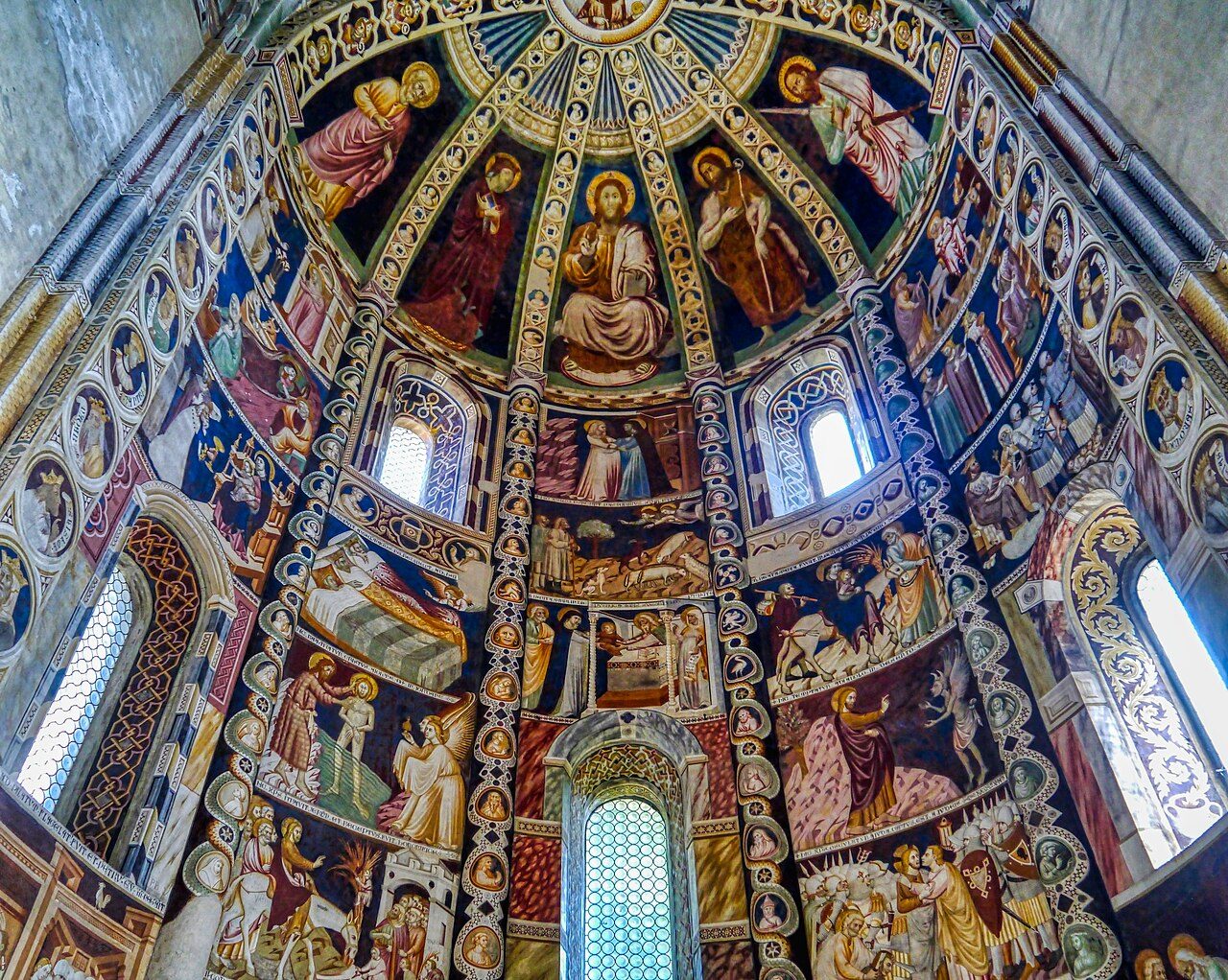
The stories of Christ in the apse
Where to stand
In the choir, as close as you can get to the apse, facing the painted curved wall
Twenty scenes tell the life of Jesus, from childhood to burial: one of the best-preserved early fourteenth-century cycles in Lombardy. It reads from top to bottom, like a page.
Spot the detail
Look for the three Magi asleep, with an angel waking them
The full story
This is a place to take your time. The curved wall of the is divided into panels by painted frames, and each panel is an episode. There are twenty in all, and together they make up a complete life of Christ, designed for the monks who had it in front of them every day.
How to read the scenes
The order runs from top to bottom. At the top is the childhood: the Visitation, the journey to Bethlehem, the Nativity, the announcement to the shepherds. Then comes the long story of the Magi and Herod, with the Massacre of the Innocents and the Flight into Egypt.
Lower down Jesus is an adult: the baptism, the temptations, the entry into Jerusalem. At the bottom, closest to the viewer, is the Passion: the kiss of Judas, the flagellation, Calvary, the crucifixion, the deposition, the burial. Joy is up high, far away. Sorrow is almost at eye level.
Look at the edges, too. The frames separating the scenes are populated with small figures: prophets, patriarchs, allegorical characters, grotesque animals. It is a whole world surrounding the main story.
The painter and his style
The painter, the Maestro di Sant'Abbondio, the unnamed master known by the name of this church, worked here in the first decades of the 1300s. Those were the years when Giotto's innovations were traveling around Italy, and he knew them: he left the stiffness of the Byzantine tradition behind.
Scholars also recognize in his style something of the painting of Siena and Umbria. But the tone is his own. He tells the story calmly, without theatrical gestures, even in the harshest moments.
And he loves details. Look at the clothes. The characters of the Gospel are dressed like people of the 1300s, and the painter observed them so carefully that these frescoes have become a record of the dress of his time. For those who looked at them back then, Herod and his soldiers were not distant figures: they wore everyday clothes.
What you have in front of you has come down almost whole, a rare thing for a cycle seven centuries old. It survived the collapse of a bell tower and centuries of alterations, and was restored in the twentieth century. If you have time for only one thing at Sant'Abbondio, make it this wall.
About this stop
Record
Seven centuries with barely a scratch
The frescoes in the of the basilica of Sant'Abbondio, with the stories of Christ, are considered one of the most intact early fourteenth-century cycles in Lombardy: twenty scenes still readable after seven centuries. That was far from guaranteed. The church was modernized in the 1500s, adapted for the nuns in the 1600s, hit by the collapse of a bell tower in the 1700s, abandoned and then thoroughly restored. The starry sky of the vaults, painted with powdered lapis lazuli, has lost pieces. The stories of Christ, lower down, are still there.
We don't know. His name is unknown, and art historians call him the Maestro di Sant'Abbondio, the Master of Sant'Abbondio. He worked here between 1315 and 1324, when the bishop of Como was the Franciscan Leone Lambertenghi, the probable patron and the brother of Benno, abbot of the monastery. He was an up-to-date Lombard painter: he knew Giotto's innovations, and his style shows links with the painting of Siena and Umbria. He probably did not work alone, but at the head of a workshop.
Next stop
Lower your gaze to the high altar, in the center of the presbytery