Stop 1 of 6Must-see
The piazza, between the Duomo and the mountain
Where to stand
In Piazza del Popolo, as far from the facade as you can get, with the apse of the Duomo behind you
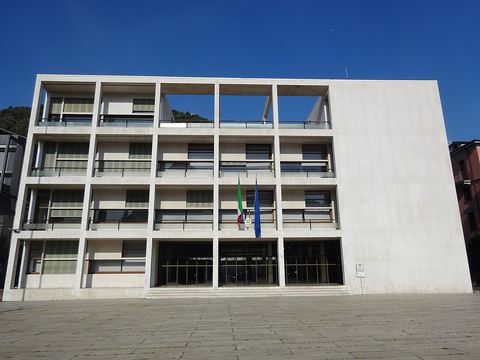
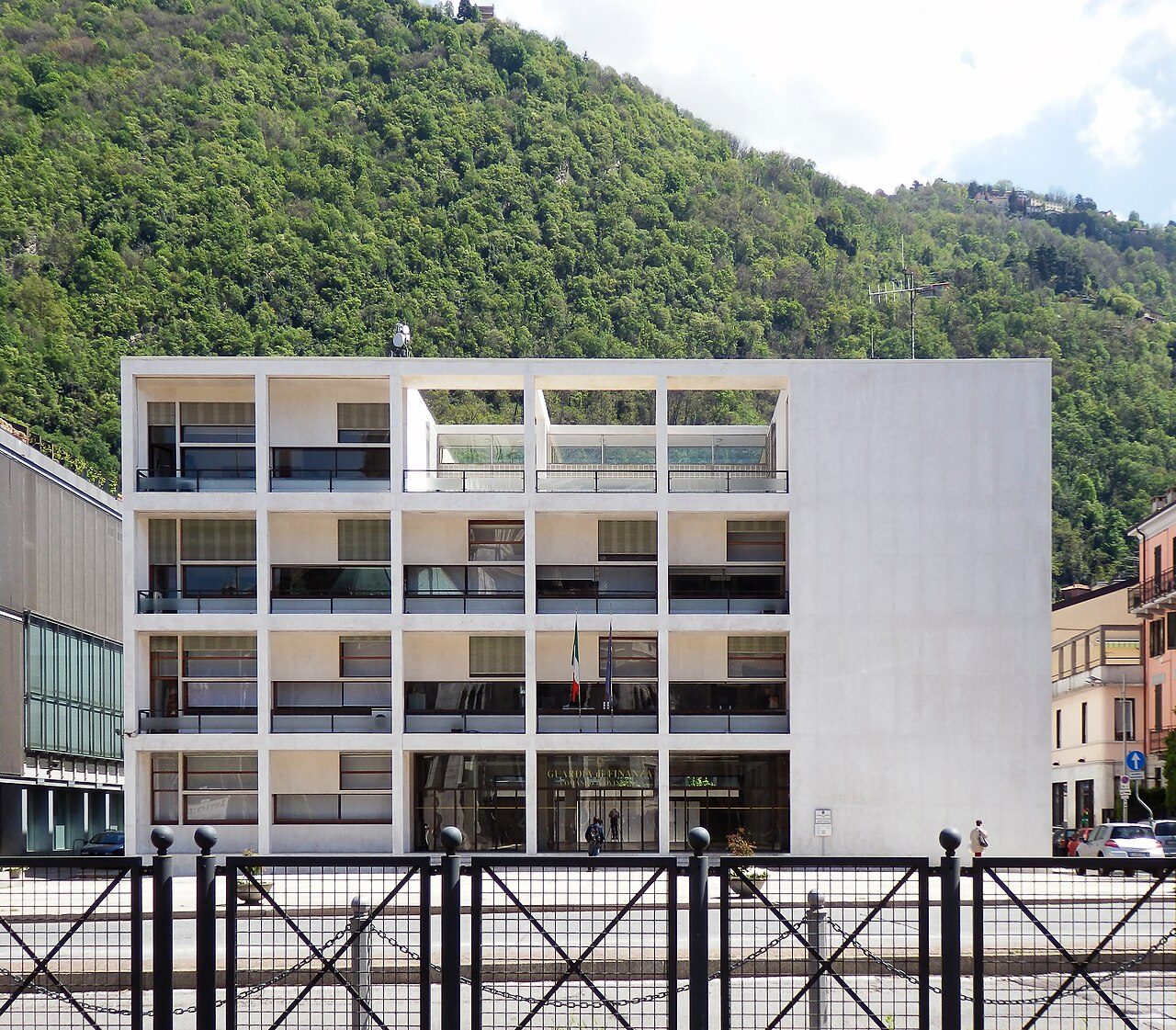
Before you move closer, take in the whole: a white block, twice as wide as it is tall, set deliberately across from the cathedral. This is where the regime wanted Como's new political heart.
Spot the detail
Compare the building's width and height by eye: what is the ratio?
The full story
Stay back, for now. From here you can hold everything in a single glance: behind you the apse of the Duomo, Como's cathedral; in front a white block without one ornament; in the background the green mountain that climbs to the village of Brunate. Three things with nothing in common. And yet someone decided to line them up.
The party facing the cathedral
That someone is Giuseppe Terragni, an architect who grew up in Como. When he receives the final commission, in 1932, he is twenty-eight. The client is the Fascist party, which wants its headquarters in town: a Casa del Fascio, a party house like the ones going up all over Italy.
The city offers a plot right here, behind the cathedral. The square will be named Piazza dell'Impero, Empire Square, and in the regime's plans it is to become the new political heart of Como. The Church on one side, the party on the other, staring each other in the face.
Half a cube, no decoration
Terragni could answer the Duomo with arches, columns, a tower. He does the opposite. He draws the purest of volumes on a square plan, exactly half as tall as it is wide, and clads it in pale marble.
No decoration. He leaves the solemnity to geometry and to position: the building takes up only part of the plot and leaves the piazza free, to serve as its audience floor.
The trick of the traditional drawings
One episode says a lot about the man. A design this modern risked being refused a building permit. Terragni knew it. Among his drawings are some with a more traditional look: according to those who have studied his papers, their main purpose was to win the city's approval.
Then he built what he had in mind. The trick was tried and tested: a few years earlier he had done the same with the Novocomum, his apartment block over by the stadium, and the city had only noticed once the scaffolding came down.
Now look at the cathedral again, then at the Casa. One is made of centuries and sculpture, the other of straight lines and voids. They are alike in nothing, and yet they sit well together. That is the first reason this building, born for a party, ended up in architecture books all over the world.
About this stop
Anecdote
A modern design in disguise
Between 1928 and 1932 the architect Giuseppe Terragni also drew versions of the Casa del Fascio in Como, the Fascist party headquarters, that looked more traditional than the one he had in mind. According to scholars, their main purpose was to win the city's permit. It was a trick he had already tried: a few years earlier he had done the same with the Novocomum, his first modern apartment block, changing everything on site. Some of those reassuring drawings resurfaced in the summer of 1964 in the attic of his old studio, under layers of dust, untouched since his death. The American architect Peter Eisenman made them known.
Anecdote
The retouched crowd
May 1936: Fascist Italy celebrates the conquest of Ethiopia, and the square in Como facing the newly built Casa del Fascio, the Fascist party headquarters, fills up. The photograph runs on the front page of the local newspaper: the American architect Steven Holl saw a crowd of over ten thousand in it. A few months later it also appears in the magazine Quadrante, in the issue devoted to the building. But according to the Spanish critic Luis Fernández-Galiano it was retouched: the crowd was filled out, and the flag with Mussolini's portrait vanished from the facade. Even a building all glass and transparency was retouched for its official photo.
This stop on the map
Next stop
Cross the piazza toward the building and stop in front of the facade, about twenty meters back