Stop 5 of 7Must-see
Under the portico: opening night, 1778
Where to stand
Under the theater's portico, in front of the entrances
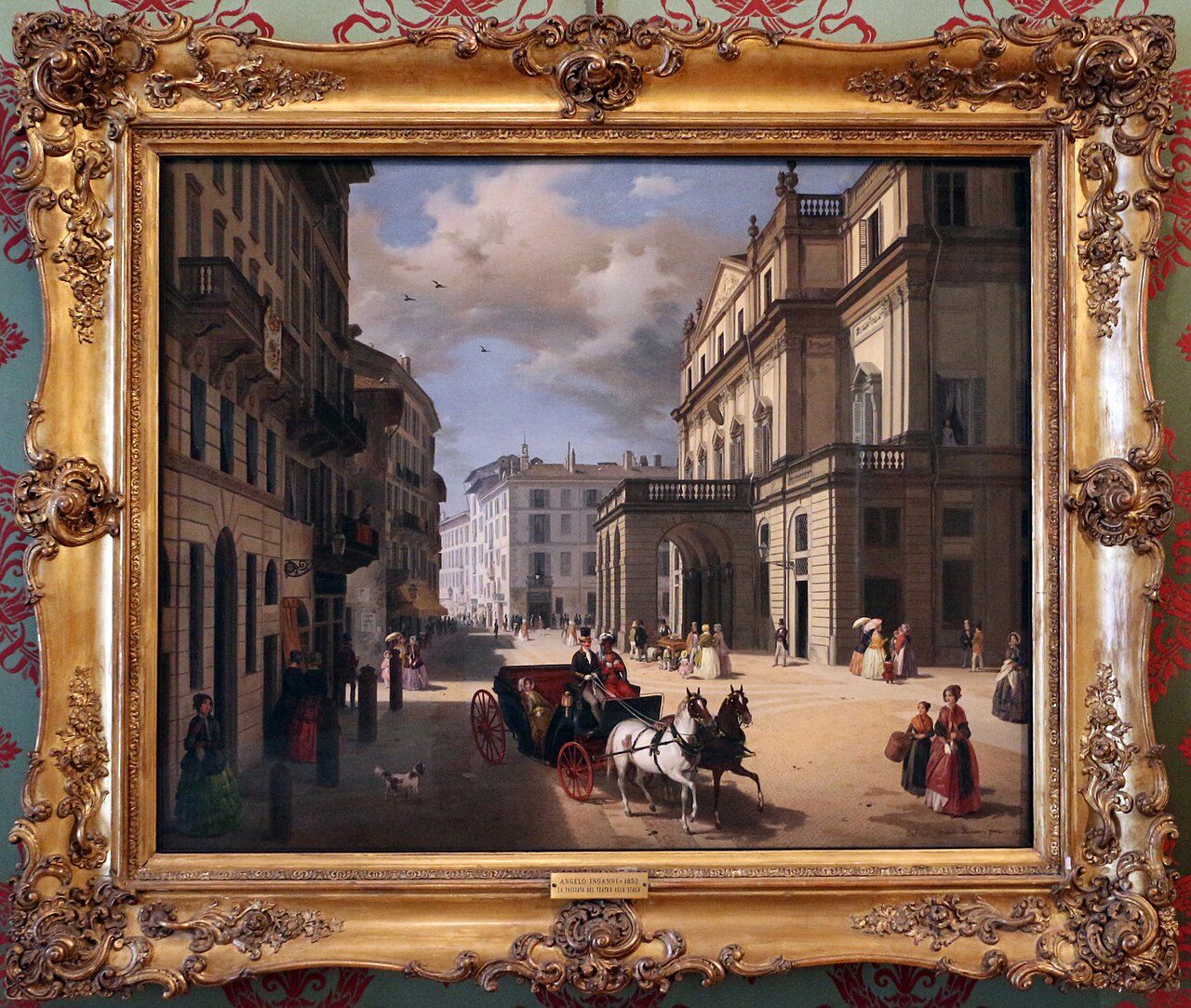
This is where the carriages pulled up. The theater was wanted and paid for by the nobles who owned the , and for decades they used it as a drawing room, dining room, and gaming house. The music was often just background.
Spot the detail
Look at how wide the arches of the portico are. Who were they made for?
The full story
Stand under the arches and imagine the noise: hooves, wheels, carriage doors swinging open. This portico was made for that. And the people stepping down from the carriages were no ordinary audience: they were the owners of the house.
A fire and a church
La Scala exists because another theater burned down. In February 1776, after a carnival evening, a fire destroyed the court theater, which stood inside the Palazzo Reale, the royal palace. The noble families who owned a there asked for a new theater right away, and paid for it in exchange for ownership of the future boxes. Maria Theresa of Austria, the empress who ruled Milan, gave her consent.
The chosen site was occupied by a church, Santa Maria alla Scala. It had been founded by Regina della Scala, of the family that ruled Verona. The church was demolished, and it left the theater its name. A Welsh painter who was passing through, Thomas Jones, noted his great surprise at seeing a church pulled down to make way for a theater.
The evening of August 3
In two years the architect Giuseppe Piermarini delivered the building. On the evening of August 3, 1778, the curtain went up on L'Europa riconosciuta, a new opera by the composer Antonio Salieri. The writer Pietro Verri described to his brother the lavish costumes and the more than a hundred figures on stage.
What went on in the hall
But do not picture a hall in reverent silence. There were no seats on the : people stood. The were private property, and in them people received guests, ate, and led their social lives.
In the they gambled, and not in secret: at the end of the 1700s gambling was banned everywhere in Milan, except in theaters during performances. Later the impresario Domenico Barbaja even brought in roulette.
The music, in all this, did what it could. Some sixty years after the opening, the English writer Mary Shelley, the author of Frankenstein, complained that on the people did business and chatted so much that only a few scraps of melody got through.
As you leave the portico, remember who used to walk in. La Scala was not born as a temple of art. It was born as the most exclusive meeting place in Milan, and the devotion to music came later.
About this stop
Anecdote
The café boy who invented barbajada
The impresario Domenico Barbaja, who ran the gambling at La Scala, was born in Milan in 1778, the same year as the theater, into a very poor family. He started out as a café boy, and there he had an idea: mix coffee, chocolate, and cream. The drink took his name, barbajada, and in 1800s Milan it was all the rage. With the profits came the rest: the gambling concession in La Scala's , then the running of the great theaters, from Naples to Vienna. They called him the prince of impresarios, and he hired the young composer Gioachino Rossini. A career that began with a cup.
It has nothing to do with a staircase, which is what scala means in Italian. The theater was built on the site of a church, Santa Maria alla Scala, demolished in 1776 to make room for it. The church in turn owed its name to its founder, Regina della Scala, who belonged to the family that ruled Verona. The new building was called the theater alla Scala, meaning at the Scala, and the name stuck. Every time you say La Scala, you are repeating the surname of a noblewoman from Verona.
Yes, and quite openly. People gambled in the , as was normal in the theaters of the time. From 1788 gambling was strictly forbidden in the city of Milan, but not in theaters during performances: so La Scala remained one of the few places where trying your luck was allowed. In 1805 the impresario Domenico Barbaja introduced roulette there as well. On those evenings, the music had fierce competition.
Next stop
Leave the portico and walk to the small arcaded building to the left of the theater, home of the Museo Teatrale