Stop 3 of 7Must-see
The facade
Where to stand
In the square, beside the monument to Leonardo, facing the theater
No statues, no domes: the facade by the architect Giuseppe Piermarini is an exercise in restraint. It was designed for a narrow street, where nobody could see the whole of it the way you can.
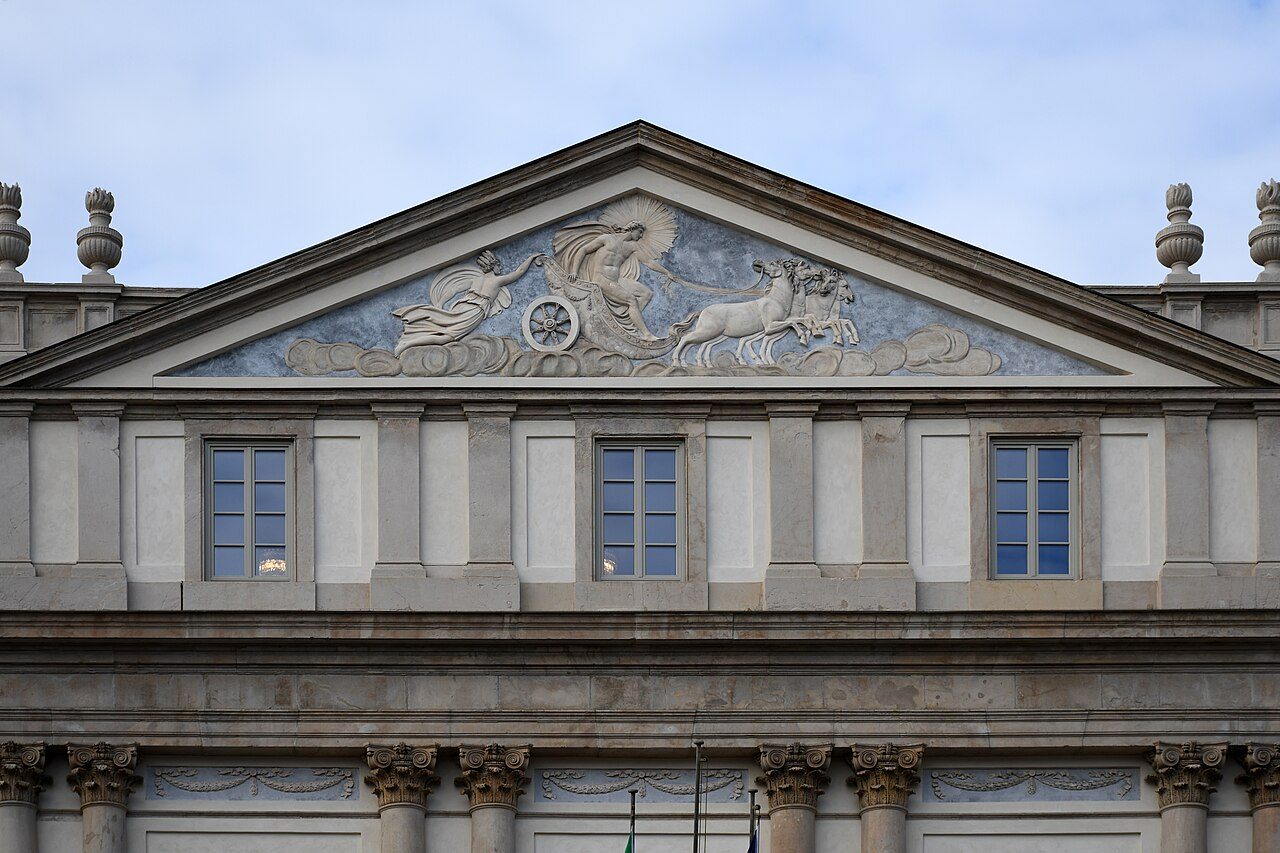
Spot the detail
At the top of the facade, inside the triangle of the pediment, there is a relief. Who is running, and who is chasing?
The full story
Let's be honest: from the outside, La Scala is a letdown. You expect the most famous theater in the world and you find a pale, orderly building without one gesture too many. It is not a lack of imagination. It is a choice, and also a consequence.
The choice: neoclassical style
The choice was made by Giuseppe Piermarini, the court architect in the Austrian-ruled Milan of the 1700s. His style is : clean lines, calculated proportions, ancient Greece and Rome as the model. Read the facade from the bottom up, like a page of three lines.
- At the bottom is a sturdy band of stone blocks, with the portico jutting forward.
- In the middle, pairs of half-columns and windows, each with its own small gable.
- At the top is the , the triangle that closes it all off.
Designed for a narrow street
The consequence comes from the place. When Piermarini was drawing, there was no square in front of the theater: there was a narrow street. The facade was conceived to be seen at an angle, in passing, and not head-on from a distance.
You are looking at it from a spot the architect never planned for. The frontal view has existed only since the mid-1800s, when the houses that stood here were torn down.
The portico, for its part, is not an ornament. It was for the carriages, which drove up under cover to within a few meters of the door. And the two small wings at the sides, with a terrace on top, are not by Piermarini: they were added in 1835.
The verdicts of Verri and Stendhal
Not everyone liked it. Pietro Verri, a writer and a voice of the Milanese Enlightenment, found the facade beautiful on paper. Once the theater was finished, he wrote that he was almost sorry.
A few decades later the French writer Stendhal called La Scala the first theater in the world. He was not talking about the walls, though. He was talking about what went on inside.
That is the deal La Scala offers to anyone who arrives: restraint outside, spectacle inside. Think of a violin case. It is plain, because what matters is what it protects.
About this stop
Anecdote
Eggs on the furs at La Scala's opening night
On December 7, 1968, the crowd for opening night, the evening that starts the season, reached La Scala in tuxedos and furs. Waiting were the young people of the Movimento studentesco, the student movement, with a volley of eggs and vegetables. Verdi's Don Carlo was on stage, but the music was not the point. Days earlier in Avola, Sicily, the police had killed two farm laborers at a demonstration. Mario Capanna, one of the protest's leaders, defended it years later as nonviolent: eggs against a few fur coats. Never before had a social protest targeted that evening. In later years, reports say, many ladies chose black and hid their jewels.
For two reasons. The first is style: the architect Giuseppe Piermarini worked in the taste, which prefers restraint and proportion to special effects. The second is the place: in the 1700s there was no square in front of the theater, only a narrow street. The facade was conceived to be seen at an angle, in passing, and not from a distance as you see it today. The square arrived only in 1858.
Next stop
Stay in the square and step back toward Palazzo Marino, keeping an eye on the theater's roof