Stop 7 of 8Must-see
The Golden Altar
Where to stand
At the far end of the nave, in front of the altar in its protective case, under the canopy with the red columns
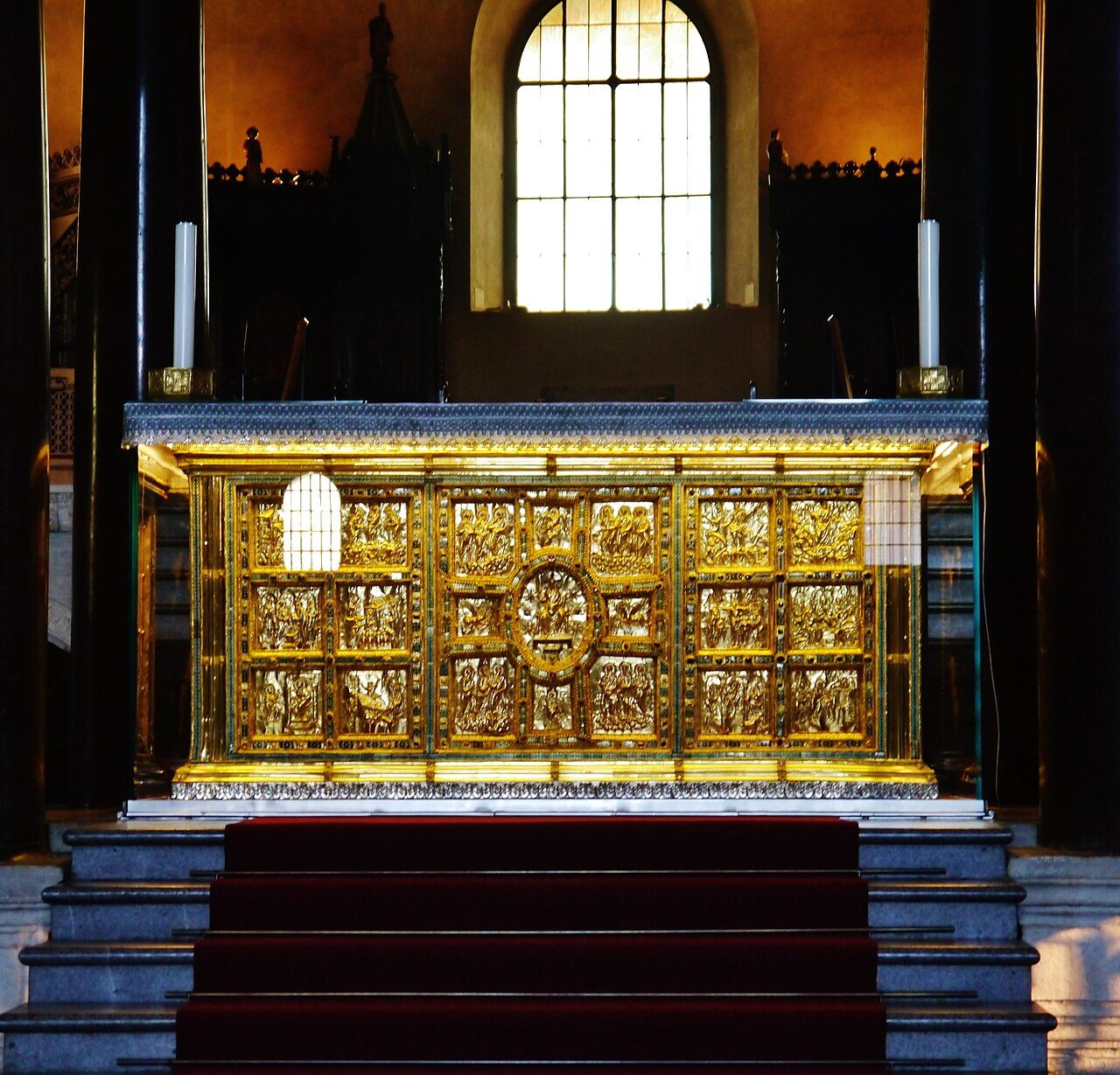
The most precious thing in the basilica: a casing of gold, silver, enamel and gems, made in the ninth century to mark the spot where Ambrose and two martyrs lie. The goldsmith left his name and his portrait on it.
Spot the detail
In the center of the gold side facing the nave, an enthroned figure inside an oval, in the middle of a cross
The full story
If you have time for only one thing in this basilica, this is it. It is almost twelve hundred years old, and it still shines.
Look at it first as an object. It is a box the size of a sarcophagus, more than two meters long, about seven feet. Underneath is wood. On top, sheets of gold on the side facing the nave and gilded silver on the back.
The figures are worked in repoussé: the sheet is hammered from the reverse until the image stands out. The frames are made of filigree, precious stones and small colored enamels.
Why it was made
It was commissioned by Angilbert II, archbishop of Milan from 824 to 859, in the time of Charlemagne's heirs. He didn't need a table for saying Mass. He needed a signal.
Three bodies lie beneath this spot: Ambrose, the bishop and patron saint, and the martyrs Gervasius and Protasius, whom Ambrose himself had laid here. The altar tells everyone who walks in, in the showiest way possible, that the saints are here.
The side in front of you tells the life of Christ. The one behind, facing the apse, tells the life of Ambrose in twelve scenes.
There is the miracle of the bees. There is Ambrose sick in bed, and under the cot the goldsmith has set his slippers. A homely detail, in the middle of all that gold.
The goldsmith's signature
Also on the back are two small doors. They closed the little window through which people looked toward the tomb. On one, Ambrose crowns Angilbert, who presents him with the altar.
On the other he crowns a second man, and an inscription says who he is: Vuolvino, magister phaber, master goldsmith. He is the maker. He put himself on the same level as the archbishop, with the same crown. It is an unusual gesture, and it says a lot about how much he counted.
The ciborium over the altar
Now look up. The canopy over the altar is called a . Its four columns are red porphyry and come from the basilica of the early centuries: they are older than the altar.
On the four gables are figures in colored stucco, modeled in the tenth century. On the side facing you, Christ hands the keys to Peter and the law to Paul.
On one flank two men pay homage to a saint. Some see two German emperors, Otto I and Otto II, and others two citizens of Milan. Scholars are still arguing about it.
And the saints really are here. In the nineteenth century a porphyry sarcophagus came to light beneath the altar. It was opened in 1871: inside were three skeletons, lying in water. Today they rest in the crypt below, in an urn of crystal and silver.
Angilbert wanted a signal. Twelve centuries later, it still works.
About this stop
Anecdote
Ambrose's Tomb: Three Skeletons in Water
Ambrose, the bishop of Milan who founded the basilica named after him in the fourth century, is buried there, under the golden altar. So the documents said. Nobody saw it with their own eyes until the nineteenth century. In 1864 the parish priest Francesco Maria Rossi uncovered a porphyry sarcophagus down there. It was opened on August 8, 1871. Inside was water, and lying in the water were three well-preserved skeletons: Ambrose and the martyrs Gervasius and Protasius, whom he himself had laid there. Today they rest in the crypt, in an urn of crystal and silver made in 1897.
Anecdote
The Altar That Missed the Bombs
The golden altar of the basilica of Sant'Ambrogio, a masterpiece of ninth-century goldsmithing, has spent two wars away from home. In 1917, during the First World War, it was moved to the Vatican for safety, and came back three years later. In the Second it was sent there again. That was lucky. In August 1943 the bombs hit the apse squarely, right behind it. The , the canopy that covers it, survived under a protection of sandbags. The altar, in those days, was not in the basilica. Almost twelve hundred years, two world wars, two round trips: what you see in the case is a professional survivor.
Yes. He died in 397 and was buried under the altar, beside the martyrs Gervasius and Protasius, whom he himself had laid there in 386. In the ninth century Archbishop Angilbert II gathered the three bodies into a porphyry sarcophagus and set the golden altar over it. The sarcophagus was found in 1864 and opened in 1871. Today the remains of the three saints are in the crypt beneath the altar, in an urn of crystal and silver.
For the most part, yes. The core is a wooden box, but the side facing the nave is covered in sheets of gold worked in repoussé. The back is gilded silver. Around the scenes run frames of filigree, precious stones and colored enamels. It was made between 824 and 859 for Archbishop Angilbert II, under the direction of the goldsmith Vuolvino. But the dedication engraved on the back warns that the treasure more precious than any metal is something else: the bones of the saints kept inside.
Next stop
Look for the entrance to the Sacello di San Vittore in ciel d'oro, the oldest chapel: you reach it from inside the basilica