Stop 6 of 6
The back on Via Falcone
Where to stand
On Via Falcone, the street behind the church, facing the back wall
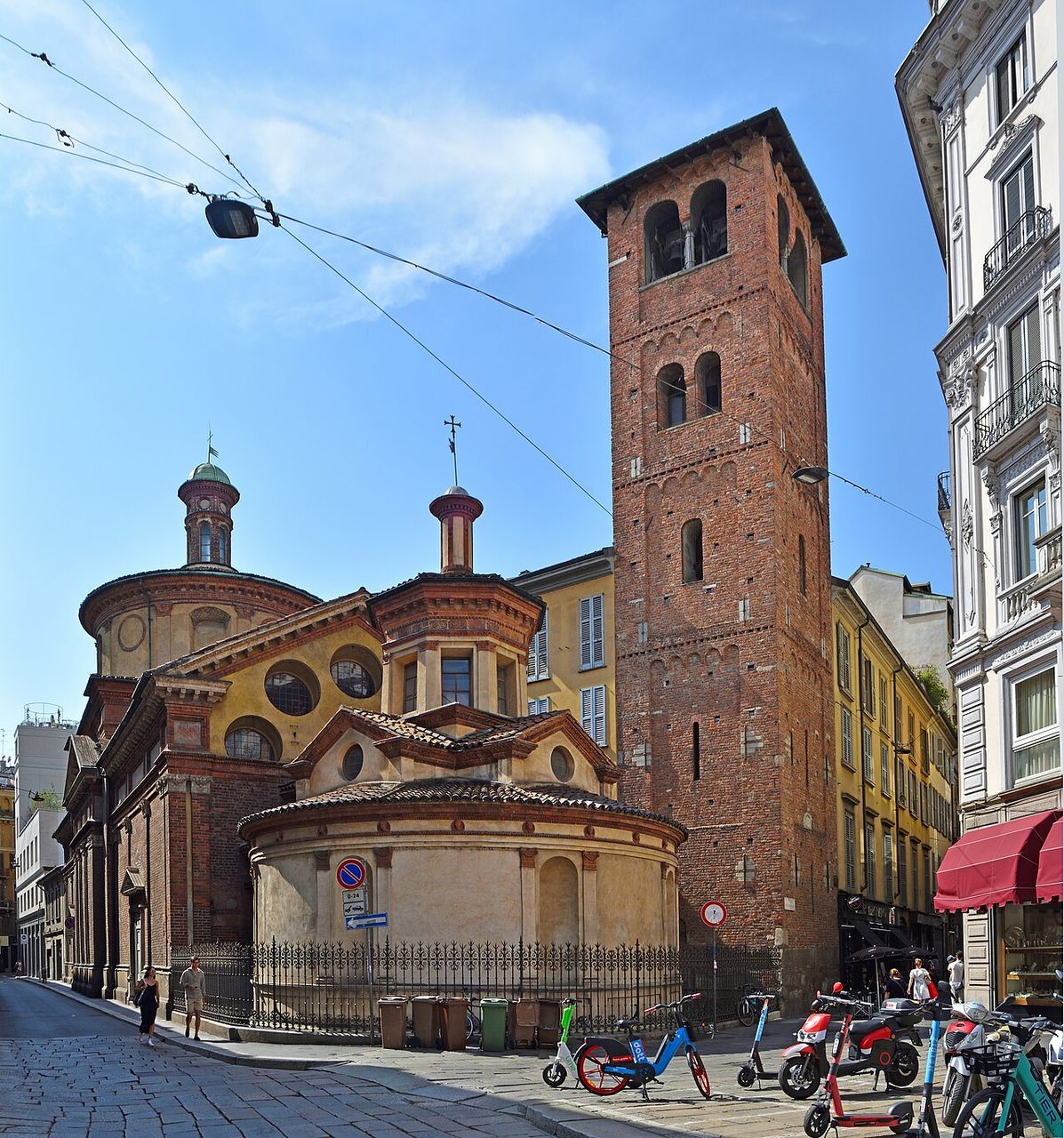
Here you see the trick from outside: behind the that looked so deep there is only a wall, flush with the street. Beside it rise the old chapel, re-clad in the fifteenth century, and a bell tower about a thousand years old.
Spot the detail
Find the central part of the back wall that juts out just slightly. What is behind it?
The full story
You are on the other side of the . Inside, a few minutes ago, you were looking at a depth of ten meters or so. Here is the answer: a wall, and then the street.
This is the street that decided the shape of the church. In the fifteenth century it was the contrada del Falcone, and closing it to make room for a was not an option. Bramante left it where it was.
Instead he designed this rear facade, sober, marked off by and closed at the top by a pediment. In the middle one part juts out slightly: it corresponds to the fake .
The chapel inside a cylinder
Now look around for a round structure with niches and a terracotta frieze decorated with roundels of putti. It is the outside of the of San Satiro, the old chapel you saw from the inside.
Inside it is ninth century. Outside it wears a fifteenth-century outfit: in Bramante's years the old chapel was wrapped in a cylinder and crowned with an eight-sided , with a small lantern on top. An elegant way of saying that you don't throw the past away, you frame it.
A thousand-year-old bell tower
Close by rises the bell tower. It is a square tower of bare brick, divided into four levels. Low down it has plain slits, higher up arched windows, and at the top with little stone columns.
Scholars disagree about its age: ninth century, like the , or eleventh. Either way it is cited as a prototype of the Lombard architecture that comes before the Romanesque.
It saw the Madonna of the miracle arrive, then the dukes, Bramante, the nineteenth-century facade. It stayed just as it was.
Line them up: a medieval tower, a chapel in disguise, a wall that hides a trick. In a few meters of street, San Satiro tells you a thousand years and one magnificent lie.
About this stop
Anecdote
The Roman epitaph in San Satiro's bell tower
The bell tower of Santa Maria presso San Satiro, in Milan, is partly built from stones older than itself. The Lombardy Region's heritage catalog calls it the oldest in the city after Sant'Ambrogio's, and its base, on the Via Speronari side, holds Roman and early Christian pieces. One is a Roman tombstone, at head height, set sideways and cut down: the name is lost. According to a 2019 reading in the newspaper Il Foglio, it is a dedication from a slave in the emperor's service to his wife, with whom he lived sine ulla macula, without a single blemish. Smog is wearing it away: find it while you still can.