Stop 4 of 6Must-see
The sacello of San Satiro
Where to stand
At the end of the left arm of the transept, inside the small chapel known as the chapel of the Pietà
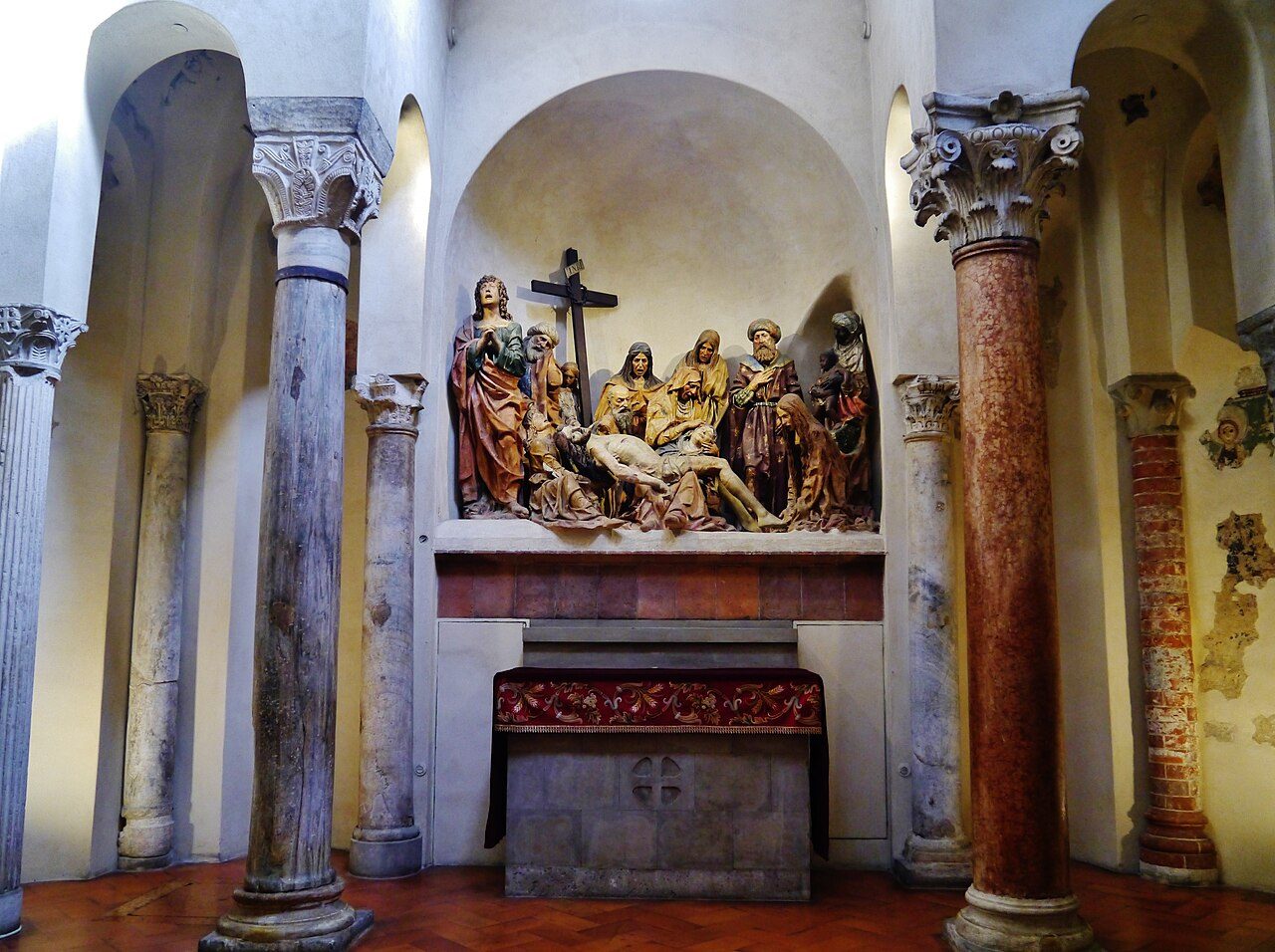
The oldest part: a ninth-century chapel, founded by Archbishop Ansperto and dedicated to the brother of Saint Ambrose. Inside, fourteen terracotta figures mourn the dead Christ.
Spot the detail
Look at the columns one by one. Are they all made of the same material?
The full story
You have taken a few steps and gone back six hundred years. This tiny room is the of San Satiro, the little chapel that gives the whole complex its name. When Bramante arrived, it was already old.
It was built in the ninth century for Ansperto, archbishop of Milan. The sources disagree on the year, but it certainly existed before 879. He dedicated it to three saints: Sylvester, Ambrose and Satiro, or Satyrus, who was Ambrose's brother.
A compact plan
Look at the shape. It is a small central plan: curved niches open around a square marked out by columns. Nobody knows for certain where the model comes from. The most widely held theory points to a chapel in the basilica of San Lorenzo, here in Milan.
There are also fragments of frescoes painted between the ninth and thirteenth centuries, with figures of saints in a Byzantine manner. They came back to light in the restoration begun in 1939, which gave the chapel back its original form.
Fourteen terracotta figures
Then there is the group that steals the scene. It is a Pietà, also called the Lamentation over the Dead Christ: fourteen figures in painted terracotta, pressed around Christ, whom Mary holds in her arms.
Agostino Fonduli modeled it around 1483, during the years of Bramante's building site. Fonduli came from a family workshop that had moved from Crema to Padua, the city where the lesson of Donatello and Mantegna was strongly felt. It shows. Saint John and two angels borrow from an engraving by Mantegna, and the Magdalene perhaps looks to Donatello.
Move in close to the robes. The fabric clings to the bodies as if it were wet, and lets you guess every gesture. Grief here is not told from a distance: it is staged, with characters who fill the space like actors.
Within a few meters you have a wall more than a thousand years old, columns that may be Roman, reused, and a Renaissance drama. It is the whole story of this place, in a single room.
About this stop
Anecdote
Ansperto, the founder deposed by the pope
The of San Satiro, the oldest chapel of Santa Maria presso San Satiro in Milan, was founded in the ninth century by Ansperto, an archbishop the pope ended up excommunicating. In 879 Pope John VIII summoned him to Rome, and he did not show up. He was excommunicated, and he would not let the pope's envoys into the city. In October he was declared deposed. Ansperto stayed in office, backed by much of the Milanese clergy, and later the two made peace. His epitaph, in the basilica of Sant'Ambrogio, records that he dedicated a church and a house to San Satiro, with property to support monks.
Anecdote
San Satiro, the brother who survived a shipwreck
The oldest chapel of Santa Maria presso San Satiro is dedicated to San Satiro, or Satyrus, the middle child between Saint Marcellina and Saint Ambrose. When Ambrose became bishop of Milan, in 374, Satiro left his public career to manage the family estate and help him. All we know about him is what Ambrose said in his funeral orations. Among other things, that he survived a shipwreck returning from Africa, and credited his rescue to a fragment of Eucharistic bread given by his fellow travelers and kept in a handkerchief. He died in 378. Ambrose buried him beside a martyr, in what is now the basilica of Sant'Ambrogio.
The brother of Saint Ambrose, bishop of Milan, and of Saint Marcellina. Known in English as Satyrus and born around 340, he made a career in the Roman administration and rose to govern a province. When Ambrose was elected bishop he left everything to look after the family estate and help his brother. He died in Milan in 378, and Ambrose devoted two funeral orations to him, which are the only source for his life. The sacristans of the diocese of Milan regard him as their patron.
Next stop
Head back toward the entrance and look for the sacristy door at the start of the right side aisle