Stop 2 of 5Must-see
The ossuary
Where to stand
In the ossuary chapel, at the center of the room, turning to take in all four walls
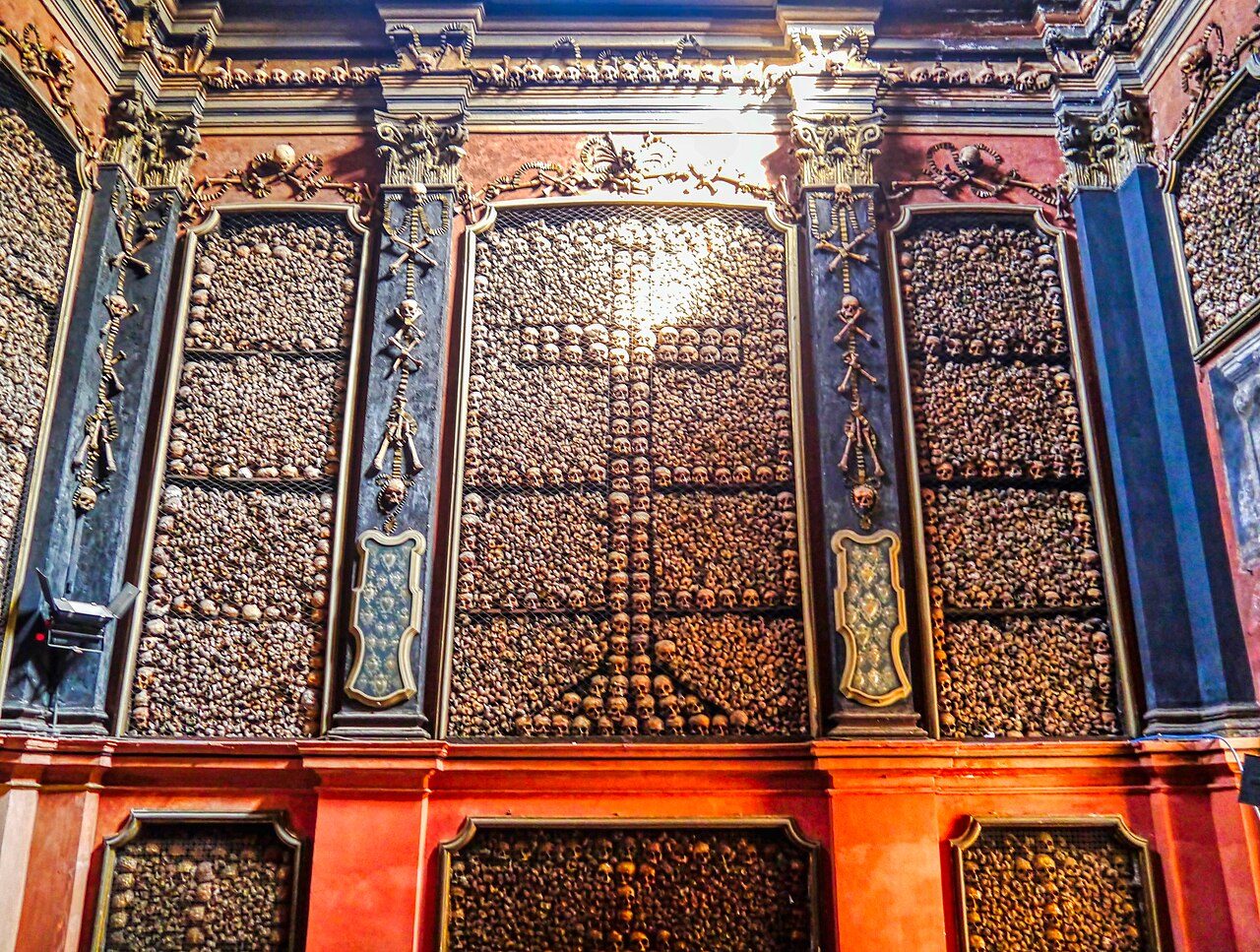
A square room with walls lined in skulls and bones, arranged in panels and crosses. These are the dead of a hospital, a cemetery, and the prisons: ordinary people, not the martyrs of legend.
Spot the detail
On one wall the skulls trace a cross in the middle of a field of long bones. Find it
The full story
The first moment is one of silence, and so it should be. Then take your time looking, because this room was made to be looked at.
The walls are almost entirely covered in skulls and bones. They are not piled up. They sit inside large panels, like pictures hung on a wall: long bones stacked in order and, in the middle, simple figures drawn with skulls. More skulls are lined up along the cornice, on the pillars, above the doors. Lower down, a few niches put them right at eye level.
Whose bones they are
The question asks itself. The answer the sources give is less romantic than the legends, and more moving.
First of all they are the sick poor who died in the old hospital of the , which stood right next door, and with them the priors and brothers who ran it. Then there are the prisoners who died in jail, the nobles buried in the nearby churches, the canons of Santo Stefano.
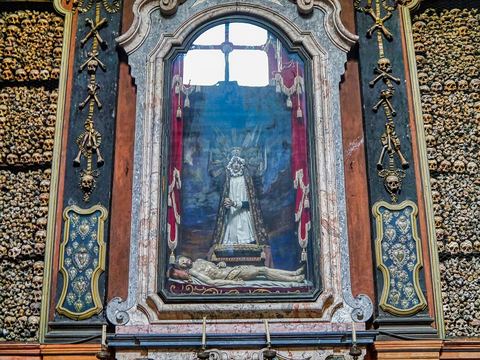
And there are the condemned, put to death by beheading. According to the sanctuary, theirs are the skulls gathered on the side opposite the altar.
The bones come from the old medieval and from the local cemeteries, closed after 1652, when the hospital was shut down. Rich and poor, priests and thieves: all in the same pattern. It is hard to think of a more direct image of equality.
From storeroom to chapel
For more than four centuries this was nothing but a storeroom. Everything changed after 1642, when the bell tower of the basilica next door collapsed and crushed it.
The of the , which looked after the place, had it rebuilt from the foundations. By 1695 the new chapel was finished, and that was when the bones were arranged as you see them.
The taste is that of the time, a baroque already sliding into rococo: frames, symmetries, repeating motifs. Except that where there would be stucco, there is what remains of people.
To our eyes it may look macabre. Those who built it had something else in mind: a chapel where you could pray for the dead without hiding them. To see what they were getting at, in a moment you will need to look up.
About this stop
Ordinary people's, for the most part. The sources point to the sick poor who died in the hospital of the , which stood next door, along with the priors and brothers who ran it. Then prisoners who died in jail, people condemned to beheading, some nobles buried in the nearby churches, and the canons of Santo Stefano. The bones come from the old medieval and from the cemeteries closed after the hospital was shut down in 1652. The tradition of martyrs killed in the days of Saint Ambrose is a legend.
Because after the collapse of 1642 the was rebuilt not as a storeroom but as a chapel. The that looked after it wanted a place to pray for the dead, and had the bones arranged on the walls in the taste of the time: panels, symmetries, crosses of skulls. To us it may look macabre. Back then it was a way of keeping the dead within the prayers of the living. The dome confirms it, with its souls rising to Paradise.
Next stop
Stay in the room and move closer to its only altar