Stop 5 of 5Must-see
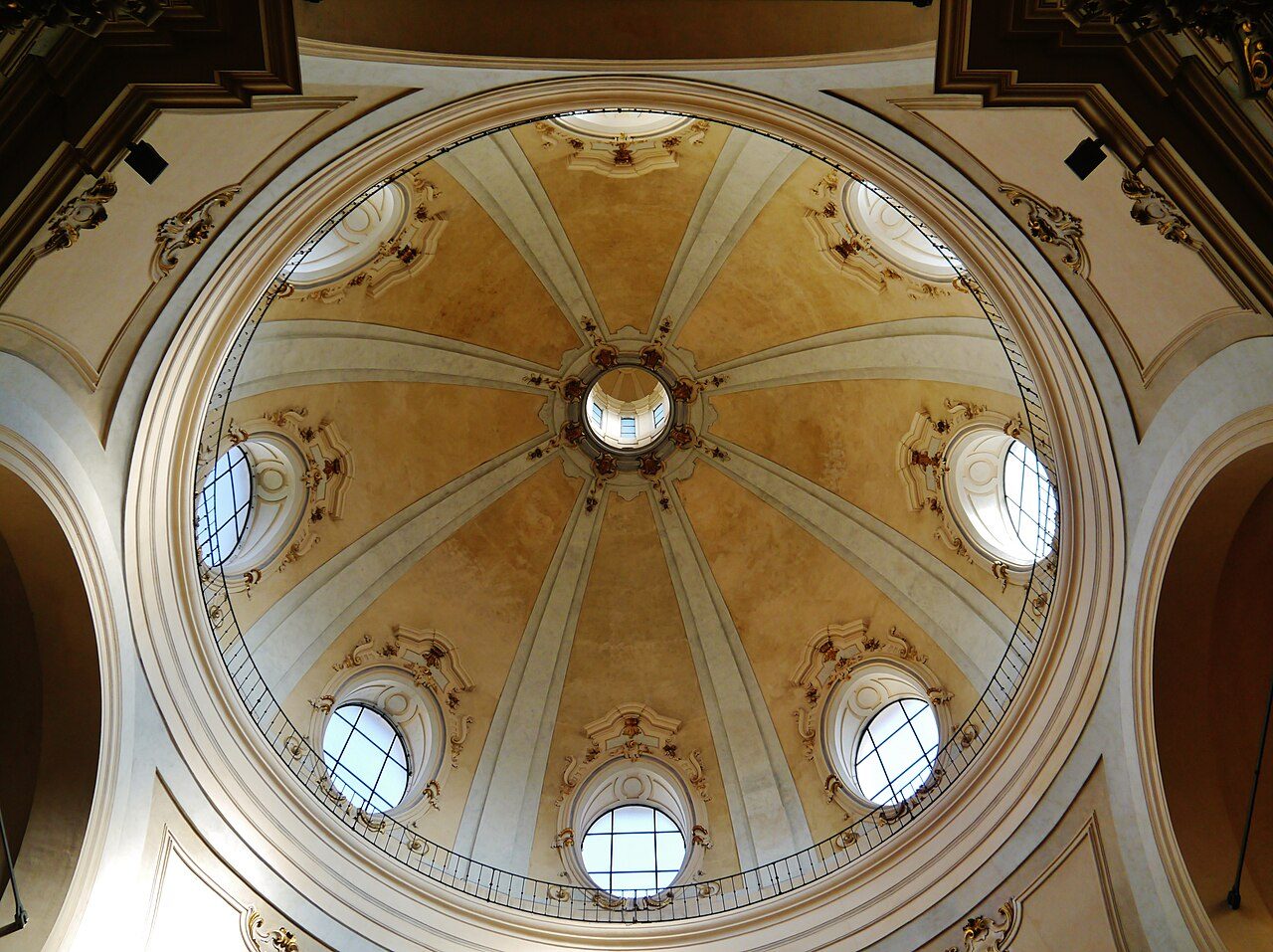
The eight-sided church and the crypt
Where to stand
At the center of the church hall, under the dome, facing the high altar
After the half-light of the , a bright eight-sided church, designed in the eighteenth century by Carlo Giuseppe Merlo. In front of the high altar a grate covers the where the brothers waited to become bones.
Spot the detail
In the floor in front of the high altar, look for a grate
The full story
As you come out of the corridor, the light changes. The hall is bright and intimate, with eight sides under a dome. No aisles: from any spot you can see all of it.
It was designed by Carlo Giuseppe Merlo, a Milanese architect, after a fire destroyed the earlier church in 1712. His drawings date from 1717. But work only started around 1750, and Merlo never saw it finished: he died in 1760. The consecration came in 1776.
Among the models was a Milanese church of the century before, San Giuseppe by Francesco Maria Richini, also built on a central plan. The job was a delicate one: adding a new hall while respecting what was already there, the and the old little church. Merlo tied them into a single complex.
What to look at
High up, toward the dome, four small baroque balconies jut out. The ones on the entrance side were reserved for nobles and officials.
On either side of the high altar, two large canvases tell the story of Milan more than of the Gospel. In one, Saint Ambrose prays during the battle of Parabiago. In the other, Saint Charles Borromeo brings communion to plague victims. They are by the painter Gerolamo Ottolini.
In the chapel on the right is a tomb with an ambitious motto: Colón gave the new world to Castile and León. Since 1768, the sanctuary says, some descendants of Christopher Columbus on the maternal side have rested here. Just who those gentlemen were, though, the sources consulted do not explain.
Under the floor
The most remarkable thing cannot be visited: you can only glimpse it. In front of the high altar a grate lets you see ten steps going down into the of the .
It is a room with five irregular sides and twenty-one masonry niches along the walls, like seats. There the dead brothers were set down sitting, in habit and hood, with their name written on a small tablet.
Each niche has a hole, which let the fluids drain away as the body decayed. A room like this is called a .
The circle closes here. It was the who wanted other people's bones arranged on the walls of the . For themselves they chose a burial just as unvarnished: sitting in a row under the floor of their own church, waiting to become bones in their turn.
About this stop
Anecdote
The cheesemakers' church
San Bernardino alle Ossa is known for its chapel lined with skulls, but it has had room for a very down-to-earth trade as well. The church has been home to the of the cheesemakers, who venerated their protector here, Saint Lucius the martyr. The church owns a large painting of the saint, a reminder of their presence. It is a detail that brings the place back down to scale: a neighborhood church, a short walk from the Verziere, the old fruit and vegetable market.
A of laypeople, meaning ordinary people rather than priests or friars, bound together by prayer and by penance, which they also practiced by whipping themselves. They wore a habit like that of the Franciscans. They were behind the rebuilding of the after 1642 and then the church you see today. Under the floor, in front of the high altar, they had their . The confraternity was suppressed in 1786 and its property passed to the state. The complex went back to the Church in 1929.