Stop 4 of 8Must-see
Canova's plaster reliefs
Where to stand
In the first rooms of the nineteenth-century route, facing the white reliefs hung on the walls
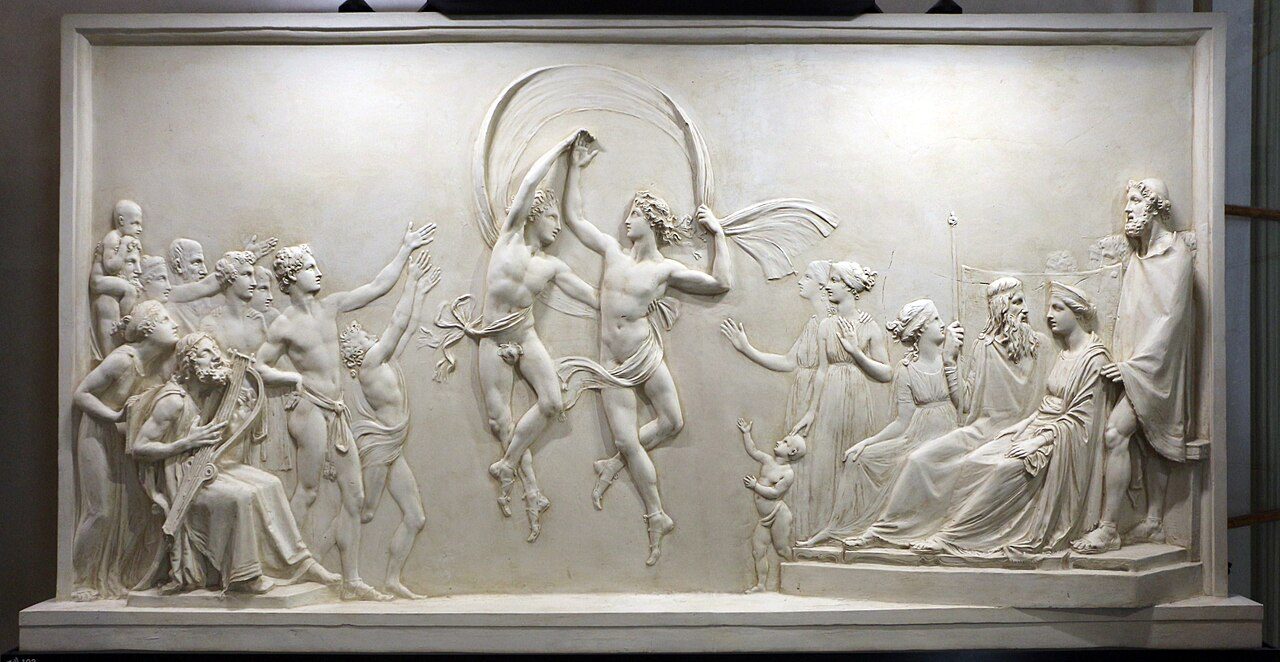
Thirteen plaster in which Antonio Canova tells Homer, the death of Socrates and the works of mercy. They are not drafts: they were born in plaster and in plaster they stayed.
Spot the detail
Find the Danza dei figli di Alcinoo, the dance of the sons of Alcinous. Everyone watches the dancers except two figures: who are they looking at?
The full story
A museum devoted to nineteenth-century painting opens with eighteenth-century sculpture, white on white. It is not a mistake: it is a statement. Everything you see afterward starts here, with Antonio Canova and his idea of beauty borrowed from the ancients.
There are thirteen reliefs. They are : the figures barely stand out from the background, as on a coin. Canova lines them up against an almost bare ground, with no ornament and no tricks of perspective, as in an ancient frieze.
What they tell
The subjects come from the books an educated man of the time knew by heart. There is the Trojan War: Achilles handing Briseis over to the heralds of King Agamemnon, Queen Hecuba offering a robe to the goddess Pallas, the death of King Priam. There is the Odyssey, with the return of Telemachus and the feast at the court of Alcinous.
And there is Socrates, in three moments that work like the panels of a comic strip. The philosopher sends his family away, drinks the hemlock, and finally his friend Crito closes his eyes. Read them in that order: it is the most moving sequence in the room.
The series is rounded out by three allegorical figures, Hope, Charity and Justice, and two works of mercy: feeding the hungry and teaching the ignorant. Hope and Charity come from another of Canova's projects: the tomb of Pope Clement XIII, which the sculptor was working on in the same years.
Why plaster
Canova was the sculptor of marble polished until it looks like skin. These reliefs, though, never became marble. He intended them for Prince Abbondio Rezzonico, a senator of Rome and his admirer and patron, who received them between 1793 and 1795.
Rezzonico hung them in his villa at Bassano, creating what nineteenth-century sources call a camera canoviana, a Canova room. The two reliefs on mercy ended up instead in a school for children, in the villa's park.
Plaster had one advantage. Each relief was taken from a model and then finished by hand: Canova insisted that it was a one-off piece, even though much of the work fell to his assistants. Similar series can be found in Possagno, the sculptor's hometown, and in Venice.
Take the time to look at them up close and from the side, where the light draws the shadows. They are whole stories, written with almost no depth at all.
About this stop
Because these reliefs are not preparatory models: they were made to stay this way. Canova most probably worked out the scenes between 1787 and 1792, then had copies cast in plaster for Prince Abbondio Rezzonico, who wanted them for his villa at Bassano. None was ever translated into marble. Each piece was taken from a model and finished by hand, and Canova was keen to present it as an original. The sources disagree on one point: for some it was a gift, for others a commission.
Next stop
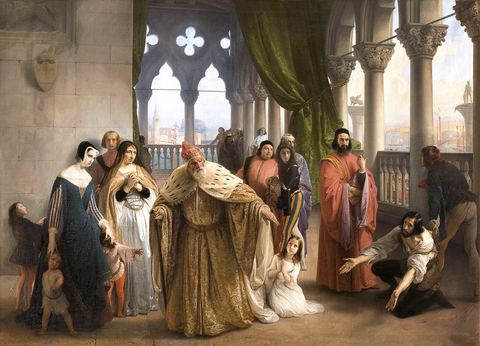
Carry on through the next rooms to the big history paintings by Francesco Hayez