Stop 7 of 8Must-see
Boccioni before Futurism
Where to stand
In the last room of the nineteenth-century route, facing the large canvas with three women
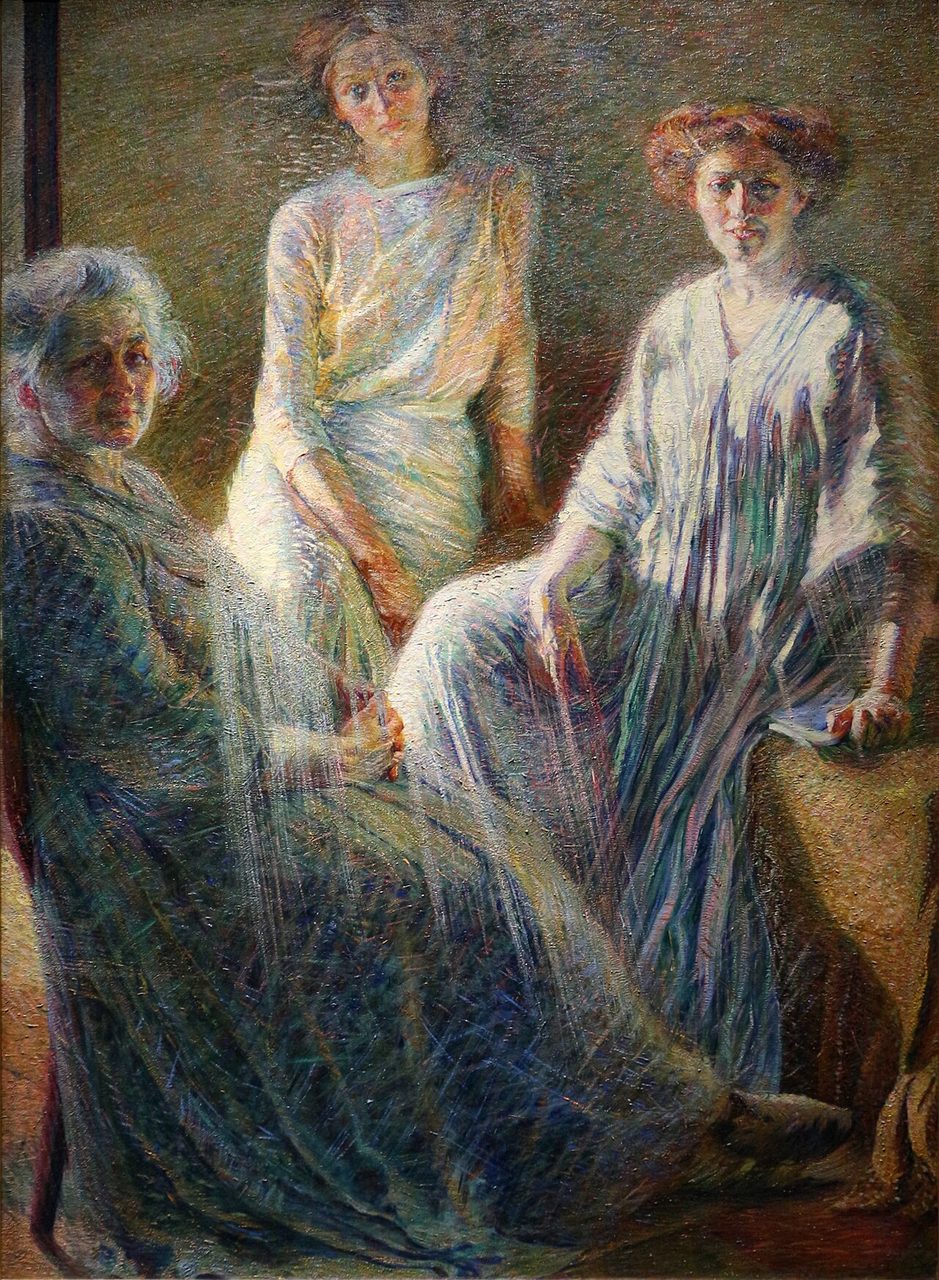
Four works from the years around 1910, a moment before Umberto Boccioni becomes the painter of Futurism. Tre donne, three women, portrays his mother, his sister and Ines, the woman he was involved with, in a light that floods the whole room.
Spot the detail
Step up close to Tre donne and look at how the paint is laid on the dresses and the hair
The full story
The route is called Da Canova a Boccioni, from Canova to Boccioni, and now you have reached the other end. You set out from white plaster and still figures. You arrive at a painter for whom light is a force that shakes things.
Three women in a room
The largest canvas is Tre donne, three women, over a meter and a half tall, about 5 feet. On the left is Cecilia, Boccioni's mother. On the right Amelia, his sister. In the center Ines, the woman the painter was involved with.
Nothing happens. Three women in a room, their faces a little melancholy, an entirely domestic calm. And yet everything vibrates, because the light comes in and takes over the dresses, the hair, the walls. You can see the brushstrokes one by one.
A bridge to Futurism
Umberto Boccioni painted this picture between 1909 and 1910. Those are the months when he met the poet Filippo Tommaso Marinetti. In 1910 he signed the manifesto of the Futurist painters together with Carlo Carrà, Luigi Russolo, Giacomo Balla and Gino Severini.
Here, though, Futurism has not arrived yet. There are no machines, no crowds, no speed. There is a painter who has taken all the way and is about to throw it out the window. The scholar Ester Coen has described it as a transitional painting, a bridge between the outskirts of Milan and the vision of La città che sale, the city rises, another of his famous pictures.
The growing outskirts
The outskirts are in another painting in the room, Officine a Porta Romana, workshops at Porta Romana, painted in the same months. The full title begins with the word Meriggio, midday: it is noon on the edge of the city, where the factories are arriving. Donna in giardino, a woman in a garden, and a country landscape complete the group.
That makes four works in all, and they belong to Intesa Sanpaolo. The Futurist Boccioni, the one of the sculptures in motion, is at the Museo del Novecento, in Piazza del Duomo.
Boccioni died in 1916, at just over thirty. Looking at this room, you understand how fast he was running.
About this stop
Anecdote
Boccioni painted the outskirts by his home
At the Gallerie d'Italia, in the room of painter Umberto Boccioni, hangs Officine a Porta Romana: a view of the outskirts, with smoke from chimneys in the distance. Boccioni did not go far for his subject. He lived on Via Adige, in Milan, in a still rural area where streets and factories were arriving. The painting, from 1909 to 1910, shows the landscape around his home. The balcony on Via Adige is also where the woman stands in a later painting of his, La strada entra nella casa. The painter who would soon celebrate the modern city did not need to look for it: it was growing on his doorstep.
He became one, but a moment later. The four works in this room date from the years around 1910, when Boccioni was still working in the technique of , with small separate strokes of color. In 1910 itself he signed the manifesto of the Futurist painters, and from then on everything changed. That is why Tre donne is so interesting: it is a transitional painting, the last step before the leap. The Futurist Boccioni is at the Museo del Novecento, in Piazza del Duomo.
Next stop
When the route ends, look for the cloister with the big columns and, from there, the garden