Stop 4 of 7Must-see
The ballroom
Where to stand
In the middle of the ballroom, looking up at the vault
The heart of the villa: a great hall with a vault frescoed by Domenico Pozzi and eight gods along the walls. The villa has welcomed queens, emperors and field marshals.
Spot the detail
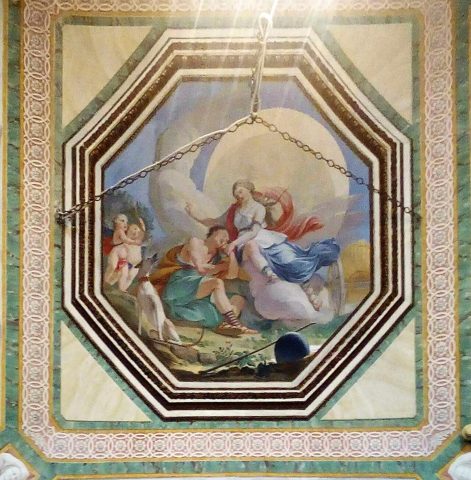
On the vault, two gods are competing for a city: can you tell which one?
The full story
If you have time for only one room in the villa, this is it. Go in, walk to the middle and look up.
The ceiling is a , meaning one large vault that rises from all four sides of the room. It was frescoed in 1789 by Domenico Pozzi, a painter from Ticino, across the Swiss border, brought in with his brothers by the architect Simone Cantoni.
There are two subjects. In one, Poseidon and Minerva contend to be patron of the city of Athens. In the other, Apollo sits among the nine Muses, the protectors of the arts. For a room made for music, you could not choose better.
Eight gods along the walls
Now let your eyes come down. Along the walls stand eight large figures: Zeus, Hera, Poseidon, Hades, Cronus, Rhea, Apollo and Artemis. It is Olympus on its feet, watching the dancers.
The sources disagree about who made them: some say Carlo Luca Pozzi, the painter's brother, others the sculptor Francesco Carabelli. What is certain is that they were all from Ticino, like the architect. This villa is in large part a job shared among artists from the same homeland.
So many gods are not just decoration. Marquis Innocenzo Odescalchi, who commissioned the villa, turned his house into a program: Greek sages on the facade, gods in the ballroom, a different myth in every room. Anyone who came in was meant to grasp at once who they were dealing with.
From emperor to barracks
The villa had its moment of glory under the next owners, the Raimondi marquises. In 1838 it welcomed Emperor Ferdinand I of Austria, with Prince Metternich and Field Marshal Radetzky in his retinue.
Ten years later Marquis Giorgio Raimondi was on the side of the rebels against Austria. He had to flee to Switzerland, and the Austrian government seized his villa, turned it into a barracks and stripped it of part of its contents.
Try to picture the soldiers camped out beneath Apollo and the Muses, in the same villa where their emperor had been the guest of honor. History, at times, has a rather heavy-handed sense of irony.
About this stop
They are eight gods of Olympus: Zeus, Hera, Poseidon, Hades, Cronus, Rhea, Apollo and Artemis. They stand along the walls of the room, beneath the vault frescoed with Apollo and the Muses. They are part of a program devised by Marquis Odescalchi: Greek sages on the facade, gods in the ballroom, a different myth in every room. The sources disagree about who made them: Carlo Luca Pozzi, brother of the painter of the vault, or the sculptor Francesco Carabelli.
Next stop
Carry on into the smaller rooms beyond the ballroom and look for a fireplace with a medallion