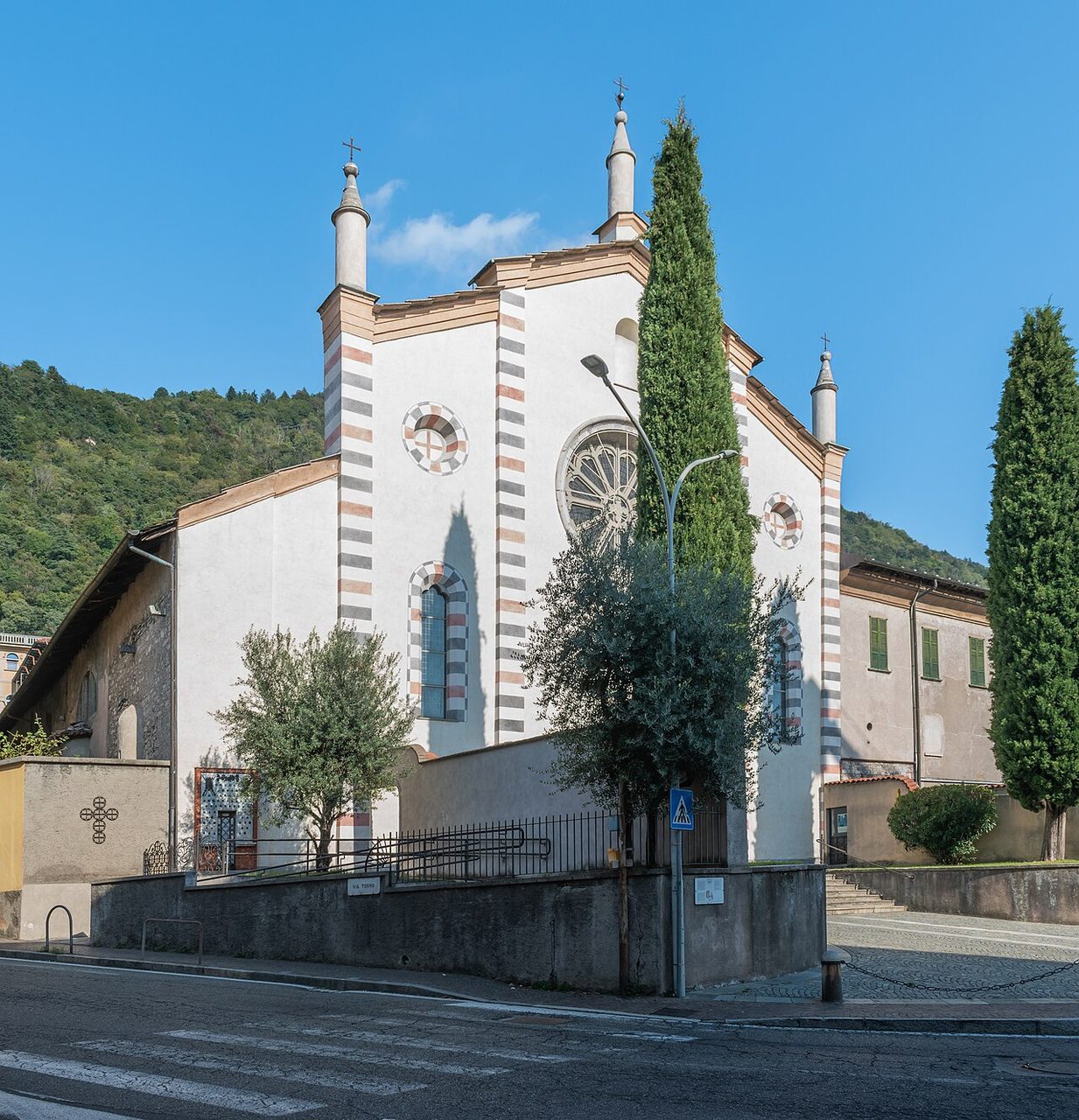
Church · The Borghi · XIV secolo, consacrata tra il 1379 e il 1384
Chiesa di Sant'Agostino
The church of the belted friars, Gothic again after two centuries in disguise
In brief
Built in the 1300s by Augustinian friars in the borgo of Coloniola, it is Como's only example of bare Gothic in the Cistercian manner. Outside, a facade with its old colors recovered; inside, an open timber roof, 14th-century frescoes and a chapel with canvases by Morazzone.
Stories of this place
- Anecdote · The Facade and the PortalReadBlessed, four centuries ahead of scheduleAbove the portal of the church of Sant'Agostino, in Como, a late 15th-century fresco shows the Madonna among four figures dear to the Augustinians, the friars who built the church. Three are saints of the order: Augustine, his mother Monica, Nicholas of Tolentino. The fourth is a woman from Como: Maddalena Albrici, abbess of the Augustinian convent at Brunate, who died in 1465. The friars painted her among the saints a few decades after her death. Rome was slower. Her veneration as a blessed was confirmed by Pope Pius X only in 1907. After many moves, her relics have been together since 1998 in the church of Sant'Andrea in Brunate.
- Legend · The Facade and the PortalReadOn January 17, the cars get blessedEvery January 17 the square in front of the church of Sant'Agostino, in Como, fills with cars waiting in line. They are waiting to be blessed. It is the feast of Saint Anthony the Abbot, the patron saint of animals, who has a statue inside the church, in the first chapel on the left: it comes from a nearby church dedicated to him, deconsecrated in the 18th century. Once, this was the day for blessing animals. Then engines came along, and the tradition adapted. Some people still bring their animals, pets or farm animals. The saint of the stables has learned to protect garages too.
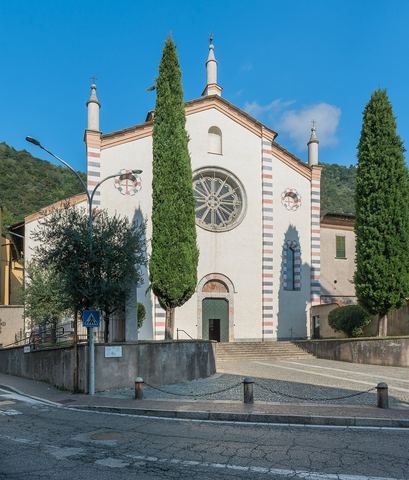
- Anecdote · The Facade and the PortalReadA marble vine around the doorThe portal of the church of Sant'Agostino, in Como, is from the 15th century, in white and red marble. Look at it up close: around the door run vine shoots, carved in relief among the flowers. This is no ordinary ornament. The vine gives wine, and the wine is the wine of the Mass: those who study the art of Como's churches call it the Eucharistic vine. Anyone going in passed under that sign before even seeing the altar. A city itinerary designed also for people who cannot see lists the relief among the things to touch. It is a sculpture you can read with your fingers too.
- Anecdote · The Facade and the PortalReadThe painter who signed from TornoThe fresco above the portal of the church of Sant'Agostino, in Como, is unsigned: it is attributed to Andrea De Passeri, a painter from Torno, on the lake, documented between 1487 and 1517. A signature of his does exist, though, and it is the basis of what we know about him. It is on his first certain work, an Assumption painted for the church of Santa Tecla in Torno: next to the date, March 27, 1488, he wrote in Latin that Andrea De Passeri of Torno had painted it. The panel is now in the Pinacoteca di Brera, the picture gallery in Milan.
- Legend · The Chapel of the Madonna della CinturaReadOur Lady of the Belt and her legendIn the church of Sant'Agostino, in Como, the main chapel is dedicated to the Madonna della Cintura, Our Lady of the Belt. The name comes from a legend of the Augustinians, the friars who built the church. Monica, the mother of Saint Augustine, asked the Virgin how she should dress once widowed. Mary showed her a black robe cinched with a belt: the same one Augustine and his friars would later wear. The tale spread after 1575, when in Bologna the cinturati, laypeople tied to the order, merged with a confraternity dedicated to Our Lady of Consolation. Ever since, in paintings, Mary hands the belt to Monica and Augustine.
- In culture · The Chapel of the Madonna della CinturaReadThe painter a poet called ApellesIn the chapel of the Madonna della Cintura, Our Lady of the Belt, in Sant'Agostino in Como, there are four canvases painted in 1612 by Pier Francesco Mazzucchelli, known as Morazzone. Three years later Giovan Battista Marino, the most celebrated Italian poet of the day, named him in a poem in praise of Maria de' Medici, queen of France. He called him "immortale, Apelle Insubro." Apelles was the most famous painter of ancient Greece, the Insubres an ancient people of Lombardy: in short, the Lombard Apelles. The company of devout laypeople that had commissioned the canvases had chosen well, and early.
- In culture · Caravaggio's Teacher and the Saints of the HouseReadCaravaggio's teacherIn the right aisle of the church of Sant'Agostino, in Como, there is a Madonna with Saints by Simone Peterzano. The painter had trained in Venice and signed himself a pupil of Titian. He was one of the leading figures of Lombard painting in the Counter-Reformation years. Today, though, his name turns up in books mostly for another reason: he is known as the teacher of the young Michelangelo Merisi, the future Caravaggio. The link is documented by a notary's deed, rediscovered in the late 1920s by the art historian Nikolaus Pevsner. In front of Peterzano, you are looking at the starting point of a revolution.
- Record · The Cloisters and the Lost FriaryReadThe last of the three friariesIn the Middle Ages three orders of mendicant friars settled around Como, almost at the corners of a triangle: the Franciscans at San Francesco, the Dominicans at San Giovanni in Pedemonte, the Augustinians at Sant'Agostino. Two of those friaries are gone. Where the Dominicans lived there is now the train station, which is why it is called Como San Giovanni. The Franciscan friary became a barracks and was later torn down to build the courthouse: its church survives, used for exhibitions. Sant'Agostino is the only one of the three where church and cloisters still stand together.
- In culture · The Cloisters and the Lost FriaryReadA friars' supper that ended up in a printIn 1620 a large fresco was painted for the refectory of the friary of Sant'Agostino, in Como: Saint Augustine at table with the saints of his order, like a Last Supper of friars. In the 19th century the engraver Giovanni Pedraglio copied it in an etching that numbers the figures one by one: Nicholas of Tolentino, Thomas, archbishop of Valencia, William, duke of Aquitaine. The record in Italy's national heritage catalog even points out a cat in the scene. The same record gives the fresco as lost, while local guides describe it as still in place. A copy of the print is kept in the Musei Civici in Lecco.
- AnecdoteReadColoniola, home of fishermen and washerwomenThe church of Sant'Agostino, in Como, stands a short walk from the lake, and its neighborhood lived off the water for centuries. It was called Coloniola: a place of fishermen, washerwomen and craftsmen, with boathouses on the shore and vineyards and vegetable gardens climbing the mountain toward Brunate. In the Middle Ages the lake probably reached further inland than it does now. In the second half of the 19th century the shore was redesigned and the port of Sant'Agostino was born. It took the place of the city's old commercial harbor and stayed in use until the middle of the 20th century. Today only private boats moor there.
Ready-made questions
Three things. Outside, the fresco in the above the portal, with Como's own Maddalena Albrici among the Augustinian saints. Inside, the sweep of the nave and aisles, with the open timber roof and the 14th-century frescoes at the far end. Then the second chapel in the left aisle, with Morazzone's canvases: the Birth of Mary is the best-known canvas in the church.
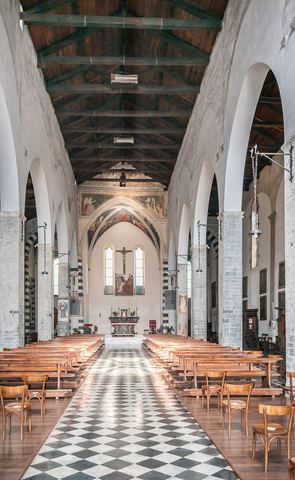
It is described as the only church in the city in the Cistercian Gothic style, meaning that restrained Gothic of , flat apses, a wooden roof and very little decoration. It owes that partly to the restoration of the 1960s. Without that work you would still be looking at the Neoclassical dress of 1773, and you would never suspect the 14th-century forms underneath.
Go to stop: The Aisles and the Rediscovered FrescoesHermits of Saint Augustine. The order is born in 1256, when Pope Alexander IV gathers into a single body several communities of hermits who followed the saint's rule. From then on the friars combine prayer with preaching. They wear a black wool habit cinched at the waist with a leather belt. The ones in Como came here from the friary of San Tommaso in Civiglio, in the first half of the 14th century.
Because in 1773 Sant'Agostino took the place of another church. Sant'Antonino, not far away, was already the parish church of the borgo in the 15th century. Once the Augustinian friary was suppressed, the parish was moved into the friars' church and the old Sant'Antonino was closed, and later torn down. The saint has stayed on in the official name, which means Saints Augustine and Antoninus, and in an altarpiece in the right aisle.
Go to stop: Caravaggio's Teacher and the Saints of the HouseBecause they belong to two different eras and two different ideas. The nave and aisles are from the 14th century, when the friars wanted a simple church, and the 1960s restoration took them back to that look. The chapels in the left aisle come later, between the Renaissance and the Baroque: in the 17th century five of them were decorated with stucco, frescoes and wooden altars. There, the people who wanted the work and paid for it were families and companies of the devout, and it shows.
Go to stop: The Chapel of the Madonna della CinturaNo. It is a fake rose window made of wood, fitted into the round window in the 19th century. What does belong to the old facade is the 15th-century stone portal, with its flower motifs, and the remains of the fresco in the . The colors have a story too: in 1995 a restoration removed the paint imitating yellow stone and took the facade back to what must have been its old appearance, with in bands of color.
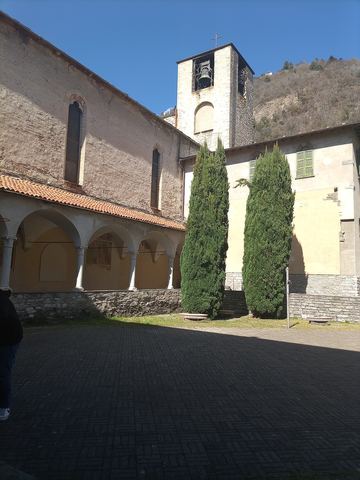
Go to stop: The Facade and the PortalIt was suppressed in 1772, in the age of the Habsburg reforms, and the following year the church became a parish church. Of the friars' buildings, the refectory and parts of two cloisters remain on the south side: seven of the more recent one and three sides of the older one, with traces of frescoes. In 1620 a Last Supper of Saint Augustine was painted for the refectory, and a 19th-century print reproduces it figure by figure.
Go to stop: The Cloisters and the Lost FriaryThe stops
1 The Facade and the Portal
A simple facade that already sketches the interior: three parts outside, three aisles inside. The colors are the old ones, recovered by a restoration in 1995. Above the stone portal, a late 15th-century fresco survives with the saints of the house.
2 The Aisles and the Rediscovered Frescoes
Pointed arches, an open timber roof, plain walls: this is the friars' Gothic, brought back to light in the 1960s after almost two centuries under a Neoclassical dress. At the far end, in the chancel, the 14th-century frescoes remain.
3 The Chapel of the Madonna della Cintura
The most important chapel in the church. In 1612 Morazzone, one of the great Lombard painters of the 17th century, painted four canvases here with the Life of Mary for a company of laypeople who wore the Augustinian belt.
4 Caravaggio's Teacher and the Saints of the House
In the right aisle there is a Madonna with Saints by Simone Peterzano, the painter who had the young Caravaggio in his workshop. Around it, two paintings from 1590 and the memory of a vanished church.
5 The Cloisters and the Lost Friary
Two mutilated cloisters are what is left of the Augustinian friary: seven bays of one, three sides of the other. On the walls, traces of late 15th-century frescoes. The refectory was given an unusual supper: Saint Augustine at table with the saints of his order.
Timeline
- First half of the 14th centuryThe Augustinians of the friary of San Tommaso in Civiglio settle in the borgo of Coloniola and build the church.
- 1379–1384The church is consecrated.
- 1393Pietro Pioppi, whose family had given the land to the friars, is buried in the church.
- Late 15th centuryThe Madonna among Augustinian saints, attributed to Andrea De Passeri, is painted in the lunette of the portal.
- 1612Morazzone paints the Life of Mary for the chapel of the Madonna della Cintura.
- 1772–1773The friary is suppressed. The church becomes the parish church of the borgo and is given a Neoclassical dress.
- 1960sA restoration removes the Neoclassical additions, reinstates the truss roof and brings medieval frescoes back to light.
- 1995A restoration strips the fake yellow stone from the facade and gives it back its old look, with pilaster strips in bands of color.
Who's who
Pietro Pioppi
benefactor of the friars
His family donated the land on which the Augustinians built the church. He was buried here in 1393.
Andrea De Passeri
painter from Torno, active in the late 1400s and early 1500s
The fresco in the lunette of the portal and some fragments in the cloisters are attributed to him. Como's Duomo has a Madonna delle Grazie by him.
Maddalena Albrici
Augustinian abbess of Brunate, blessed
Born in Como, died in 1465, she led the convent of Sant'Andrea in Brunate. She is painted among the saints in the lunette of the portal. Her veneration was confirmed in 1907.
Morazzone
Lombard painter of the early 17th century
Nickname of Pier Francesco Mazzucchelli, born in 1573 in Morazzone, near Varese. In 1612 he painted the Life of Mary for the chapel of the Madonna della Cintura.
Simone Peterzano
painter, Caravaggio's teacher
From a Bergamo family and trained in Venice, he called himself a pupil of Titian. He died in Milan in 1599. The Madonna with Saints in the right aisle is his.
Giovanni Paolo Recchi
painter from Como, pupil of Morazzone
Born in Borgovico, in Como, around 1600, he worked with his brother Giovanni Battista. Tradition assigns him the refectory's Last Supper of Saint Augustine, but the attribution is debated.
Words to know
Where it is
The neighborhood
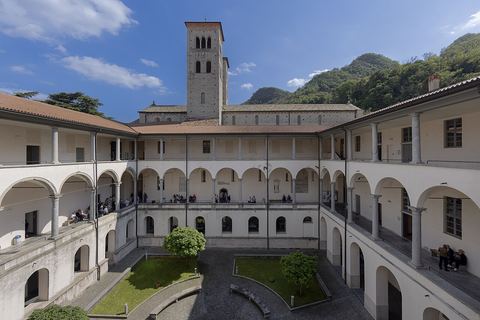
The Borghi
Related places
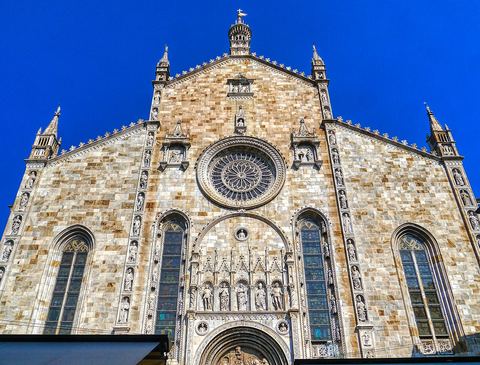
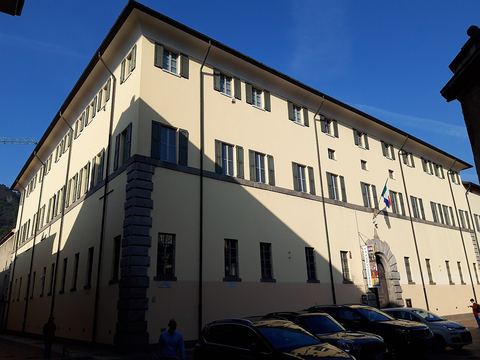
The story of the place
Sant'Agostino, the church of Saint Augustine, stands outside the city walls in Coloniola, one of the borghi, the old suburbs, close to the lake. It is not a church that demands attention. It is a friars' church, plain by choice, and that is exactly why it is worth the detour: in Como it is the only example of the lean Gothic usually linked to Cistercian monks.
The friars and the 14th century
The Augustinians build it in the first half of the 14th century, after moving here from the friary of San Tommaso in Civiglio. The land is a gift from the family of one Pietro Pioppi, who will be buried inside in 1393. It is the third church the put up in Como, after San Francesco and San Giovanni in Pedemonte. It is consecrated between 1379 and 1384.
The friary grows up beside it, with two cloisters and a cemetery. Over the centuries the church fills up. At the end of the 15th century a fresco appears above the portal.
Between the Renaissance and the Baroque a row of chapels opens along the left aisle, with stucco, wooden altars and canvases. The most important is the chapel of the Madonna della Cintura, Our Lady of the Belt, where in 1612 Morazzone is at work, one of the great Lombard painters of his day.
From suppression to restoration
Then comes the 18th century and its reforms. In 1772, under the Habsburgs, the friary is suppressed. A year later the church becomes the parish church of the borgo, replacing nearby Sant'Antonino, which is closed and later torn down: that is why the full name is Santi Agostino e Antonino. For the occasion it gets a fashionable Neoclassical makeover, and the Gothic vanishes under the new dress.
It stays hidden until the 1960s, when a restoration strips away the additions, gives the church back its timber roof and brings frescoes of the 14th and 15th centuries back to light. In 1995 it is the facade's turn, returned to what must have been its old appearance.
So the church you visit today is a church in layers: the friars' Gothic skeleton, the 17th century of the chapels, and a restoration that chose which past to show. Of the friary, on the south side, the refectory and two cloisters reduced to a few stretches remain. It is a short visit, but with more surprises than the square lets on.
Sources
- Chiesa di S. Agostino, complesso, Como, Lombardia Beni Culturali (scheda CO180-00136) (opens in a new tab)Institution
- Le difese settentrionali: i borghi di Coloniola e Borgovico, Società Archeologica Comense (opens in a new tab)Institution
- Alberto Rovi e Ambra Garancini, Chiesa e convento di S. Agostino, Cammina città (opens in a new tab)Other source
- Mazzucchelli, Pier Francesco, detto il Morazzone, Dizionario Biografico degli Italiani Treccani (opens in a new tab)Encyclopedia
- Agostiniani, Enciclopedia Italiana Treccani (opens in a new tab)Encyclopedia
- Cena degli Agostiniani, stampa di Giovanni Pedraglio, Catalogo generale dei beni culturali (scheda 0300649028) (opens in a new tab)Catalog
- Cena agostiniana, ex convento di S. Maria delle Grazie a Gravedona, Lombardia Beni Culturali (scheda CO170-00527) (opens in a new tab)Institution
- Giornate FAI di Primavera 2023, i tesori comaschi (complesso di Sant'Agostino), ComoZero (opens in a new tab)Other source
- Chiesa di Sant'Agostino (Church of Saint Augustine), Como, GPSmyCity (opens in a new tab)Other source
- Alberto Rovi, La rappresentazione di Cristo nell'arte delle chiese di Como (Vedere il Verbo, lezione 2), Diocesi di Como (opens in a new tab)Institution
- Sant'Antonio Abate, la tradizionale benedizione delle auto a Como (16 gennaio 2025), Espansione TV (opens in a new tab)Other source
- Festa di Sant'Antonio a Como, la benedizione di auto ed animali (17 gennaio 2019), Espansione TV (opens in a new tab)Other source
- Alberto Rovi, S. Francesco, Cammina città (opens in a new tab)Other source
- Lorenzo Marazzi, Chiesa, convento e ospedale di S. Antonio, Cammina città (opens in a new tab)Other source
- Lorenzo Marazzi e Ambra Garancini, Riva del Voo e Punta di Geno, Cammina città (opens in a new tab)Other source
- CamminaCittà, il progetto di itinerari accessibili dell'associazione Iubilantes (opens in a new tab)Other source
- Mario Menghini, La vita e le opere di Giambattista Marino (1888), Internet Archive (opens in a new tab)Other source
- Stazioni ferroviarie d'Italia: un antico monastero per lo scalo Como San Giovanni, Trasporti-Italia (opens in a new tab)Other source
- Riqualificazione del porto di Sant'Agostino (18 novembre 2019), Espansione TV (opens in a new tab)Other source
- Ex chiesa di San Francesco (Como), Wikipedia in italiano (opens in a new tab)Wikipedia
- Stazione di Como San Giovanni, Wikipedia in italiano (opens in a new tab)Wikipedia
- Chiesa di Sant'Agostino (Como), Wikipedia in italiano (opens in a new tab)Wikipedia
- Andrea De Passeri, Wikipedia in italiano (opens in a new tab)Wikipedia
- Maddalena Albrici, Wikipedia in italiano (opens in a new tab)Wikipedia
- Morazzone (pittore), Wikipedia in italiano (opens in a new tab)Wikipedia
- Simone Peterzano, Wikipedia in italiano (opens in a new tab)Wikipedia
- Giovanni Paolo Recchi, Wikipedia in italiano (opens in a new tab)Wikipedia
- Madre della Consolazione, Wikipedia in italiano (opens in a new tab)Wikipedia