Stop 3 of 8Must-see
The five aisles
Where to stand
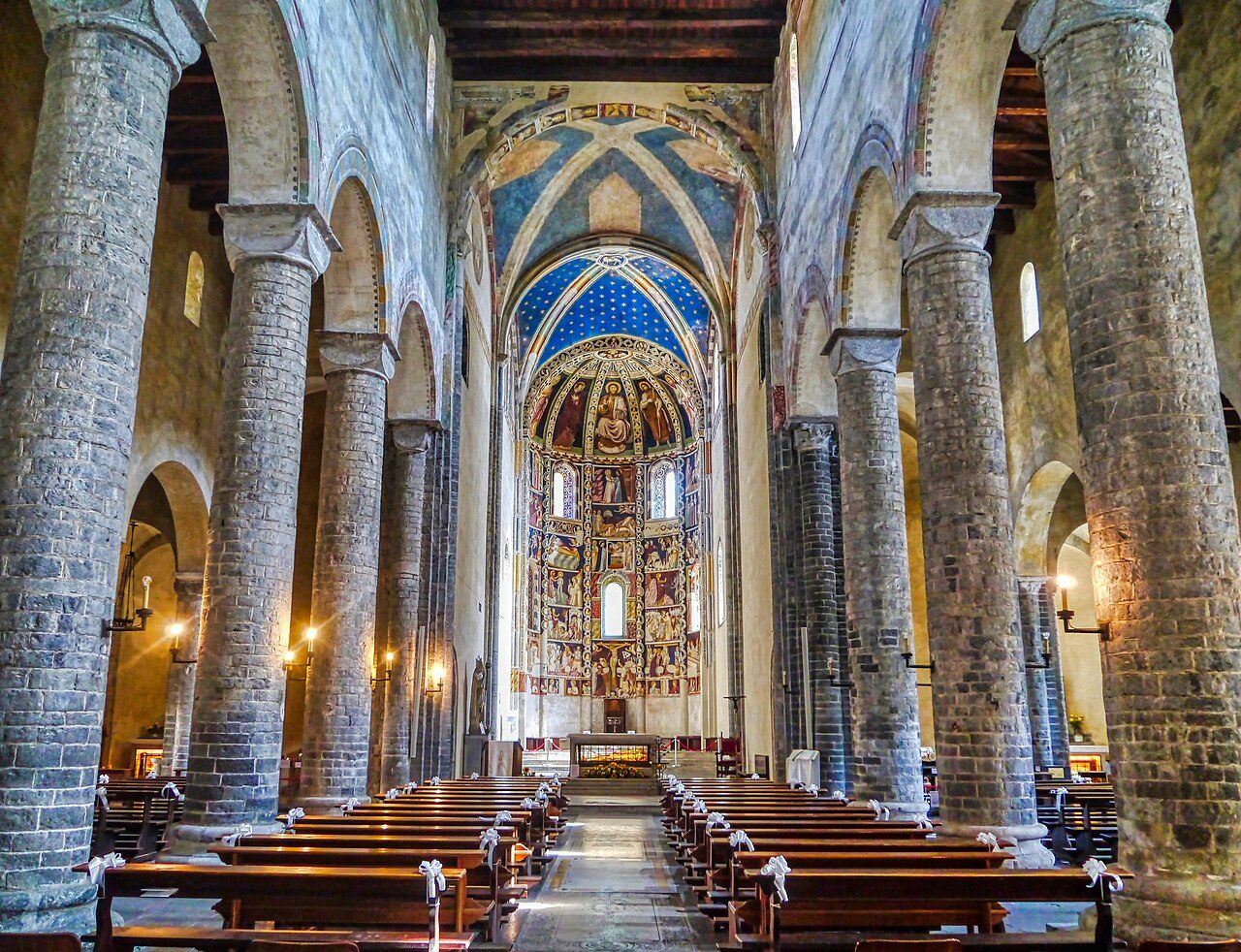
Just inside, at the start of the central nave, looking toward the altar
Five tall, narrow aisles, with great cylindrical piers in the center: a very rare plan in Como's . The walls, bare today, were once covered in frescoes.
Spot the detail
The columns are granite. All but one: look for it
The full story
Stop on the threshold and look to the far end. The space pulls you forward: six arches one after another, no transept to break the run, and down there the only patch of color, the painted . The nave is the road, the is the destination.
Five aisles, light in steps
Then look to the sides and count. There are five aisles, a rare thing in the of this area. The central one is twice as wide as the others. Each is taller than the one beside it and has its own row of windows, so the light comes down in steps toward the outer walls.
Holding up the central nave are great cylindrical piers, with capitals shaped like cubes with rounded-off corners. Between the side aisles run rows of slender columns instead.
Above your head is a wooden ceiling. To find a masonry vault you have to go as far as the . That, too, is a way of saying where the part that matters is.
The gallery and the restoration
Turn toward the entrance. Above the door there is a gallery, a loggia on the upper level. In the monks' church it held the relics of two saints, Rubiano and Adalberto, and fragments of its frescoes survive.
What you see, though, is a reconstruction. At the end of the 1500s the gallery was knocked down, the aisles were covered with vaults and the windows were altered, to give the basilica a modern look. Three centuries later Don Serafino Balestra, the priest who led the restoration, did the reverse: vaults out, floor lowered again, gallery rebuilt.
The bare walls are the children of that story. Originally they were frescoed, and a few remains with geometric patterns came back to light during the restorations. Today people love Sant'Abbondio precisely because it is stripped bare, but that is a beauty its builders never planned.
Under this floor are the tombs of several bishops of Como. And there is the tomb of the last abbot, Cardinal Angelo Maria Durini, buried in the basilica in 1796.
About this stop
Legend
The pagan's son brought back to life
Sant'Abbondio, the fifth-century bishop of Como for whom the basilica is named, went down in history as the pope's ambassador to Constantinople. Tradition prefers a miracle: he is said to have raised from the dead the son of a pagan official, and the father to have then converted. Artists have depicted no episode more often. Here a canvas attributed to the painter Gian Battista Recchi shows it, near the entrance: in the 1600s, when the church was divided in two for the nuns, it stood on the high altar of the part for the faithful. It is a devotional tale, not documented fact: of Abbondio's life, little is certain.
Anecdote
Underfoot, the cardinal of Balbianello
Among the slabs in the floor of the nave, in the basilica of Sant'Abbondio, is that of Cardinal Angelo Maria Durini, the last abbot: the outside prelate who collected the abbey's income without belonging to the community. His life, in fact, was elsewhere. He had been the pope's representative in Warsaw, and on Lake Como he had the Villa del Balbianello built, conceived as a retreat for pleasure and literary leisure. Today it belongs to the FAI, Italy's national trust. He died in 1796 and was buried here. At his death the state took over the commendam's assets, estimated at four times those of the monastery.
Next stop
Move down the central nave, keeping an eye on the floor