Stop 8 of 8
The cloister, from monastery to university
Where to stand
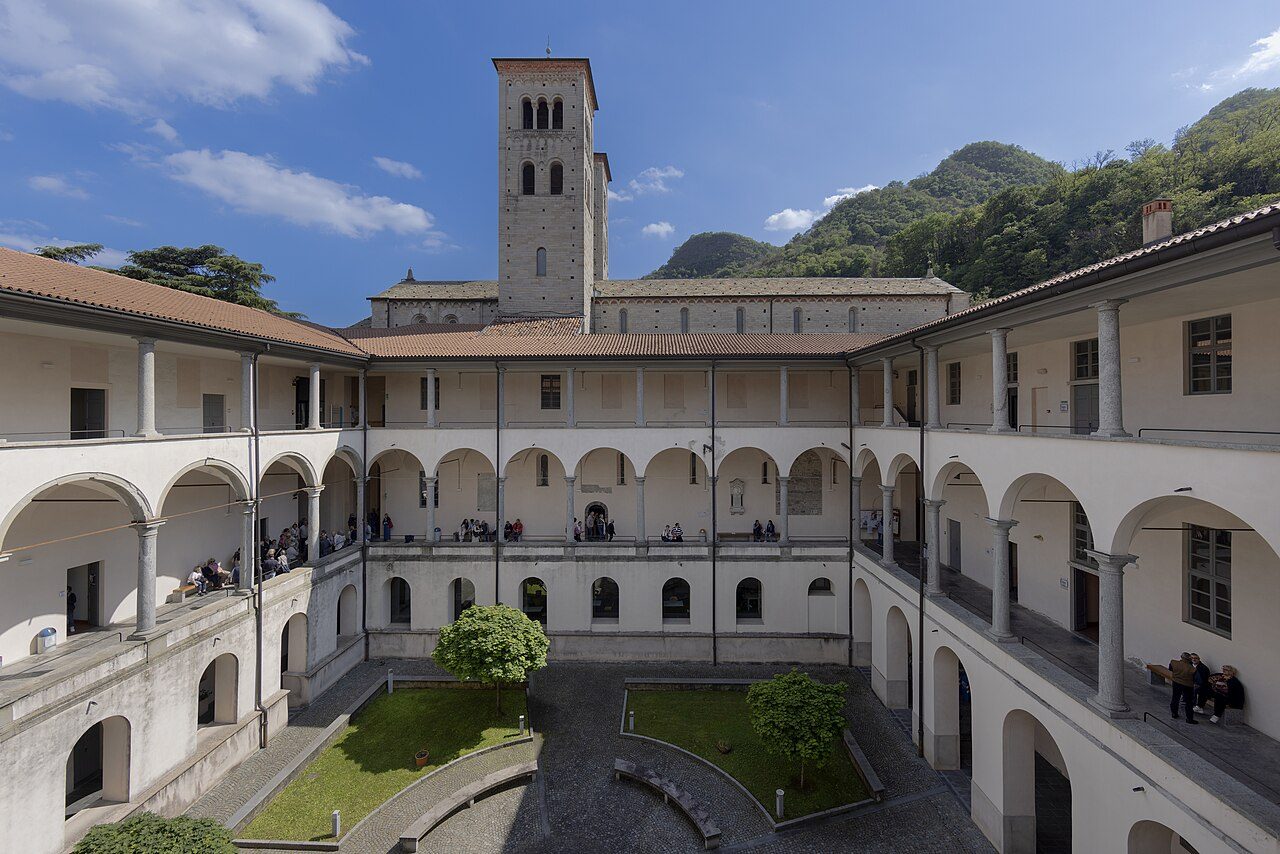
In the cloister of the former monastery, next to the basilica
The sixteenth-century cloister has changed tenants many times: nuns, seminarians, cholera patients, wounded soldiers. Today it is a campus of the Università dell'Insubria.
Spot the detail
Look at the shapes of the cloister and the buildings around it: do they seem as medieval as the basilica?
The full story
A Benedictine basilica never stood alone. Next to it was the monastery, and the heart of the monastery was the cloister: a courtyard ringed by porticoes, onto which the rooms of communal life opened. What you see is no longer the cloister of the first monks. It was built in the 1500s, when the great age of the Benedictines of Sant'Abbondio was already over.
Commendatory abbots and the nuns
The reason has a name: . From the end of the 1400s the abbey was no longer led by an abbot chosen by the community, but entrusted to an outside prelate, often a cardinal, who collected its income.
One of these abbots, Cardinal Tolomeo Gallio, had the church modernized. One of his successors, in the 1600s, handed church and monastery over to a community of Augustinian nuns who had come from Civiglio. For them the church was adapted to the needs of a community of women.
Seminary, quarantine hospital, military hospital
From then on this place has done a bit of everything. At the end of the 1700s the convent was suppressed, and the empty rooms took in people displaced by a flood of the lake. In 1834 Bishop Carlo Romanò bought the entire complex to make it a seminary, and had it partly rebuilt by the architect Giuseppe Tazzini. During the 1800s it also served as a quarantine hospital for cholera patients and as a military hospital, during the battle of San Fermo.
The seminarians left in the 1960s, and the complex was abandoned. It was saved by the city of Como, which bought it in 1974 and began its restoration. Today the students walking under the porticoes are studying law at the Università dell'Insubria, the local university.
A capital at the Pinacoteca
One piece of the old Sant'Abbondio, though, is to be found elsewhere. At the Pinacoteca Civica, Como's city art gallery, you can see the capital of the Magi, a block of twelfth-century marble carved with the stories of Christ's childhood.
It comes from here. It is worth the detour: you can compare its Magi with the ones painted in the two centuries later.
About this stop
In culture
The capital that ended up in a gallery
One of the most precious sculptures of the basilica of Sant'Abbondio is no longer in the church: it is at the Pinacoteca Civica, Como's city art gallery, in the medieval section. It is a twelfth-century capital, in marble from Musso, carved with the stories of Christ's childhood and known as the capital of the Magi. It is not the only piece that left: sculptures from the Carolingian age and some capitals replaced during the restoration of the 1800s are in the city's museums too. If you go and find it, compare it with the fourteenth-century frescoes in the basilica's : the same story, told in stone two centuries earlier.
It occupies the former monastery. Next to the church the Benedictines had their convent, which over the centuries passed to the Augustinian nuns and then, from the 1800s, to the diocesan seminary. When the seminarians left, in the 1960s, the complex stood empty. The city of Como bought it in 1974 and had it restored. Today the sixteenth-century cloister is home to the law courses of the Università dell'Insubria, the local university. The basilica, meanwhile, has remained a church.