Stop 4 of 8Must-see
The Virgo Advocata
Where to stand
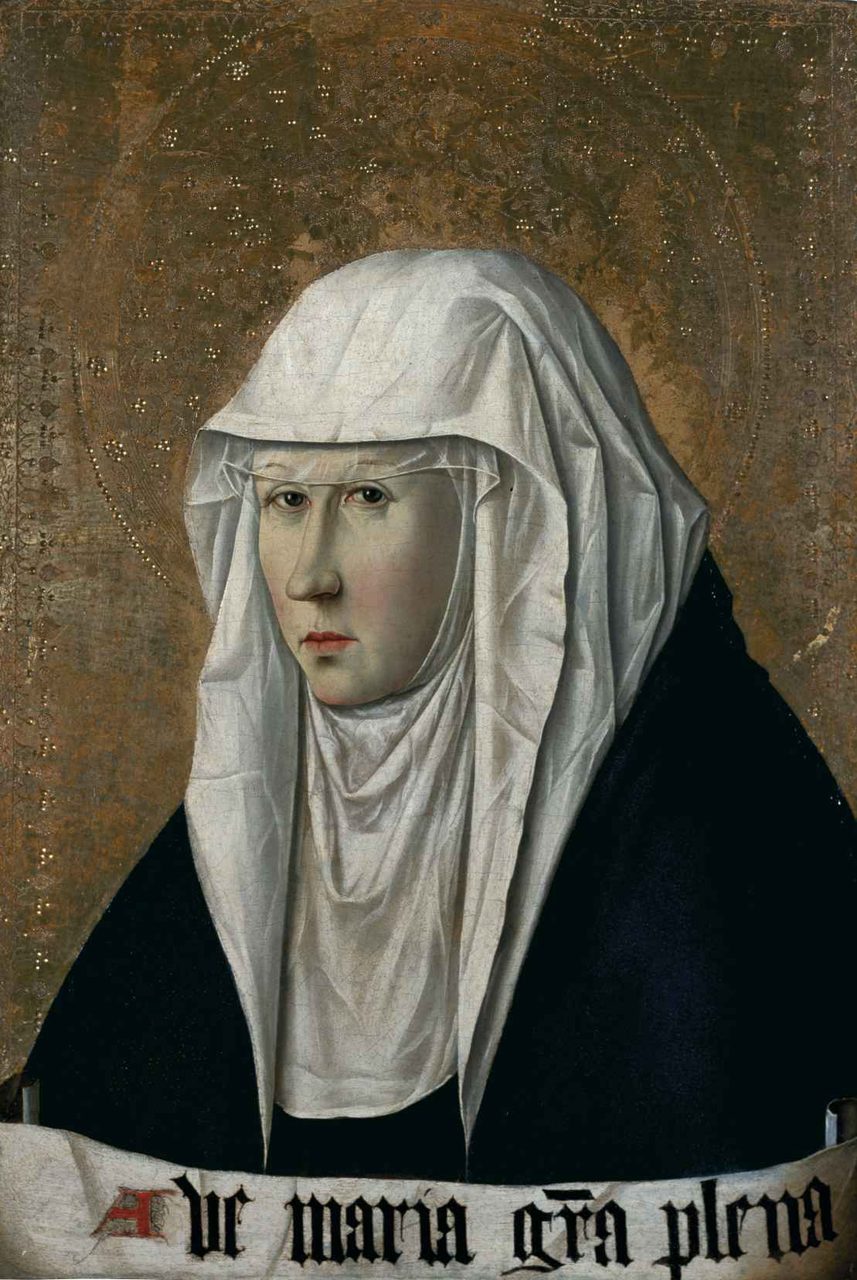
In the Renaissance rooms, on the ground floor, facing the small gold-ground panel of a woman in a white veil
A panel just over half a meter tall and a century of arguments. It entered the museum as a portrait of a nun by an unknown artist. Today it is presented as attributed to Antonello da Messina, but many scholars think of a painter from Valencia.
Spot the detail
The painted scroll at the bottom: can you read what it says?
The full story
It is small, and you could easily walk right past it. Don't: if you have time for only one old painting in this museum, this is it.
Look at her first. A woman shown half-length, turned three-quarters, with a large white veil and her eyes fixed on you. Behind her, a decorated with tiny punched marks.
No angel, no child, no landscape. Just a face, and it is not the face of a girl.
Annunciate or advocate
That is exactly what set off the debate. For a long time she was thought to be a Virgin Annunciate, meaning Mary at the moment she receives the angel's message. But her age, no longer young, and her headdress, typical of married women, tell a different story.
Hence the name she bears today: Virgo advocata, the Virgin as advocate, the one who intercedes for those who pray to her. That is what the direct gaze is for. She is not listening to an angel, she is listening to you.
The mystery of the painter
Then there is the mystery of who painted her. The panel entered the city's collections in 1905, donated by Giovanni Antonio Galli di Rondineto, who had bought it on a trip to Spain. In the list of the donation it was described this way: portrait of a nun, fifteenth-century school, artist unknown, purchased in Spain.
Later it was believed to be Flemish. In 1953 it went to Messina, to an exhibition on Antonello, still as the work of an unknown Spaniard. Years later the art historian Ferdinando Bologna assigned it firmly to the young Antonello da Messina.
Not everyone followed him. Many scholars consider it the work of Jacomart, a painter from Valencia called to Naples to the court of Alfonso of Aragon, perhaps together with a collaborator. In Naples, in those same years, Antonello was training too: the two worlds touched, and that is why telling them apart is so hard. On the date, at least, there is agreement: the middle of the fifteenth century.
There are other remarkable things in these rooms, starting with the large tapestry of the Birth of the Virgin that comes from the Duomo, the cathedral. But stay one more minute in front of that gaze, and decide whether you really care who painted it.
About this stop
Anecdote
Virgo advocata: From Unknown Nun to Poster
On the Pinacoteca's ground floor hangs a small panel of a woman in a white veil: the Virgo advocata. It has changed labels several times. In 1905 it entered the museum as a portrait of a nun by an unknown artist. In the 1940s it was shown as Flemish, in 1953 as Spanish. Then came the name of Antonello da Messina, never unanimously accepted. In 2019 the panel went to Matera, European Capital of Culture, for a show on the Renaissance seen from the south: presented as an Antonello, it became a main image of the ad campaign. Not bad for a picture nobody could name a century earlier.
Nobody knows, and it is only honest to say so. The museum presents it as attributed to Antonello, following the art historian Ferdinando Bologna, who considered it an early work by the Sicilian painter. Other scholars assign it to Jacomart, a painter from Valencia active in Naples at the Aragonese court, and to his collaborator Pere Joan Reixach. Everyone agrees on the date, the middle of the fifteenth century, and on the setting: that Mediterranean world between Spain and southern Italy where Flemish painting was the model to imitate.
Next stop
Go up one floor and look for the rooms of the Giovio portraits