Stop 2 of 7Must-see
The Two Plinys
Where to stand
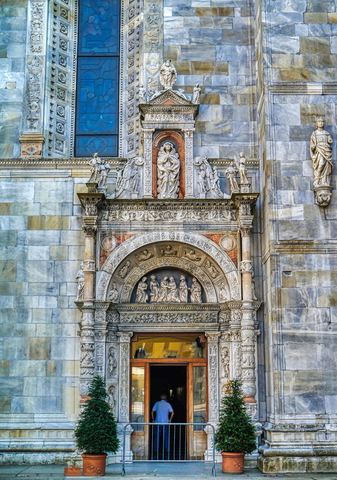
A few steps from the central portal of the facade: the two statues are in the aedicules beside the door, one on the left and one on the right
Beside the main door of a cathedral you expect two saints. Here you get two writers of ancient Rome, born in Como and never Christian. The city put them there out of pride, and defended them when an envoy of the pope ordered them removed.
Spot the detail
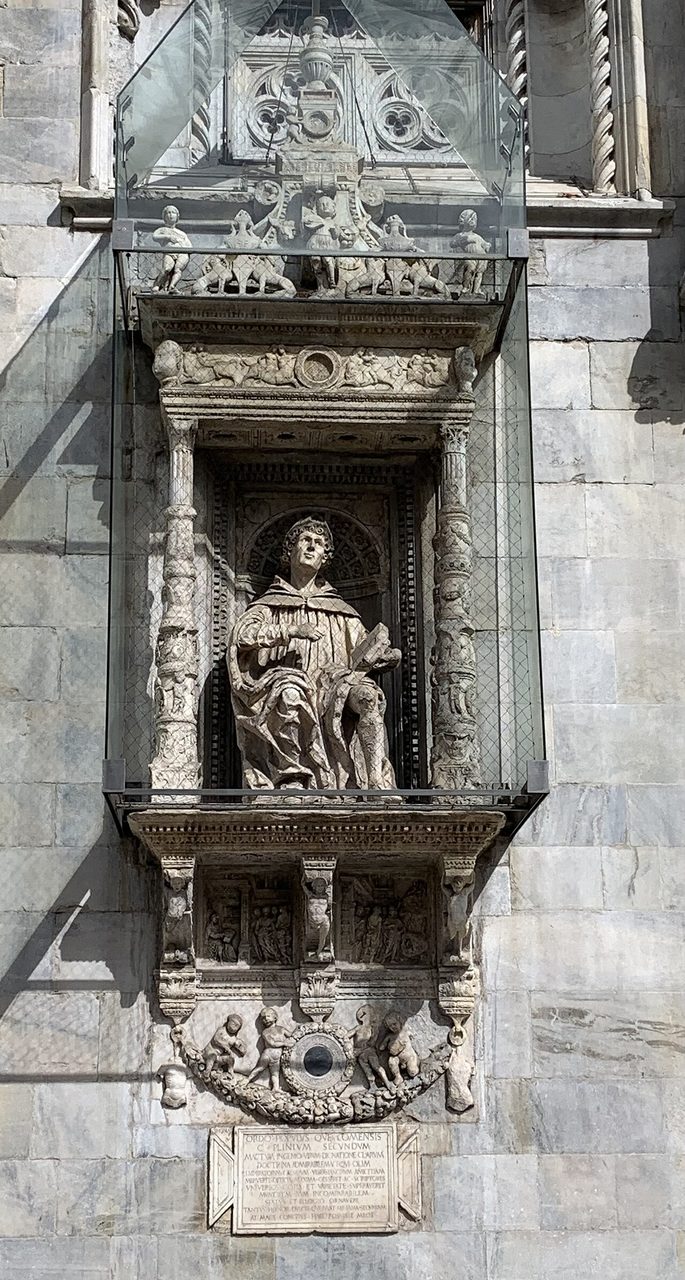
Under the statue on the left, find a small relief of a volcano erupting
The full story
Walk up to the central portal and look to either side. In the place of honor, where a cathedral usually puts its most important saints, are two figures who have nothing to do with the Gospel.
Each one sits inside a marble worked like a piece of jewelry. On the left Pliny the Elder, on the right Pliny the Younger. Two writers of ancient Rome. Two pagans.
Who the two Plinys were
The Elder is the author of the Natural History, the great encyclopedia of the ancient world. He died during the eruption of Vesuvius, which he had insisted on rushing toward.
The Younger, his nephew and adopted son, was a lawyer and a consul under the emperor Trajan, for whom he wrote a famous speech of praise. What survives of him are his letters, including the one that describes that very eruption. And one detail makes his presence here even stranger: as governor of a province, Pliny the Younger put Christians on trial, and writing to Trajan about them he called their faith a superstition.
Why they are on the facade
So why are they here? Civic pride. In the 1400s Como and Verona were fighting over the title of hometown of the two Plinys, and Verona celebrated them on its Loggia del Consiglio, the council hall. Como raised the stakes and carved them onto the facade of its cathedral.
It could do so because the Duomo's building site answered not to the bishop but to the city authorities. Statues and date from the end of the 1400s and bear the signature of two sculptor brothers, Tommaso and Giacomo Rodari.
Under each statue is a plaque in Latin. They were composed in 1498 by Benedetto Giovio, a scholar and historian from Como, and the last lines have the two Plinys speak in the first person. The Elder says that fame pleases him, but that being remembered by his fellow citizens pleases him even more. The Younger says, more or less: I am dead, and yet even now I have a life.
The order to remove them
The showdown came eighty years later. In 1578 Giovanni Francesco Bonomi, bishop of Vercelli, came to inspect the diocese on behalf of the pope. He found it unworthy that two pagans should stand on the facade of a church and ordered them removed.
He even suggested where to put them: on two columns, in the square right here in front. The bishop of Como and the city council thought otherwise, and the statues stayed where they are.
Take a good look at them, because they tell you what the Renaissance meant in a small city: the idea that descending from Rome was worth as much as belonging to the Church, and that the two things could share the same wall.
About this stop
Anecdote
The eviction of the Plinys that never happened
Beside the central portal of the Duomo di Como, the city's cathedral, stand statues of two ancient Roman writers born in the city, Pliny the Elder and Pliny the Younger. They were not Christians. In 1578, at the height of the Counter-Reformation, the bishop of Vercelli, Giovanni Francesco Bonomi, visited the diocese for the pope and found two pagans on a cathedral facade unworthy. He ordered the statues and their removed, and advised setting them on columns in the square. The bishop of Como, Gian Antonio Volpi, and the city council took the opposite view. The two Plinys are still there, where the city wanted them a century earlier.
Anecdote
Hercules carved on the altar
On the facade of the Duomo di Como, beside the central portal, stand two ancient Roman writers, Pliny the Elder and Pliny the Younger. They are not the only pagans. Look at the Younger's , on the right: a column base shows Hercules wrestling the giant Antaeus, and nearby he fights the lion and the Hydra. Next, the right-hand portal. In the the infant Jesus is presented at the Temple, and on the altar in the scene is Hercules with Antaeus again. The model seems to come from the Florentine artist Antonio del Pollaiolo, by way of engravings. In late-1400s Como, this is how antiquity entered a church.
Because they were the most famous sons Como ever had, and in the 1400s that mattered. Pliny the Elder and Pliny the Younger, writers of ancient Rome, were claimed by both Como and Verona, each calling itself their hometown. Como carved them next to the cathedral portal to set the record straight. It could do so because the Duomo's building site answered to the city authorities and not to the bishop. A century later the Church tried to take them down, and failed.
Next stop
Go to the left side of the cathedral, the one facing the Broletto and the bishop's palace, and look for the carved portal