Stop 3 of 7Must-see
The Porta della Rana
Where to stand
Outside, on the north side of the Duomo, in front of the carved portal that faces the Broletto and the bishop's palace
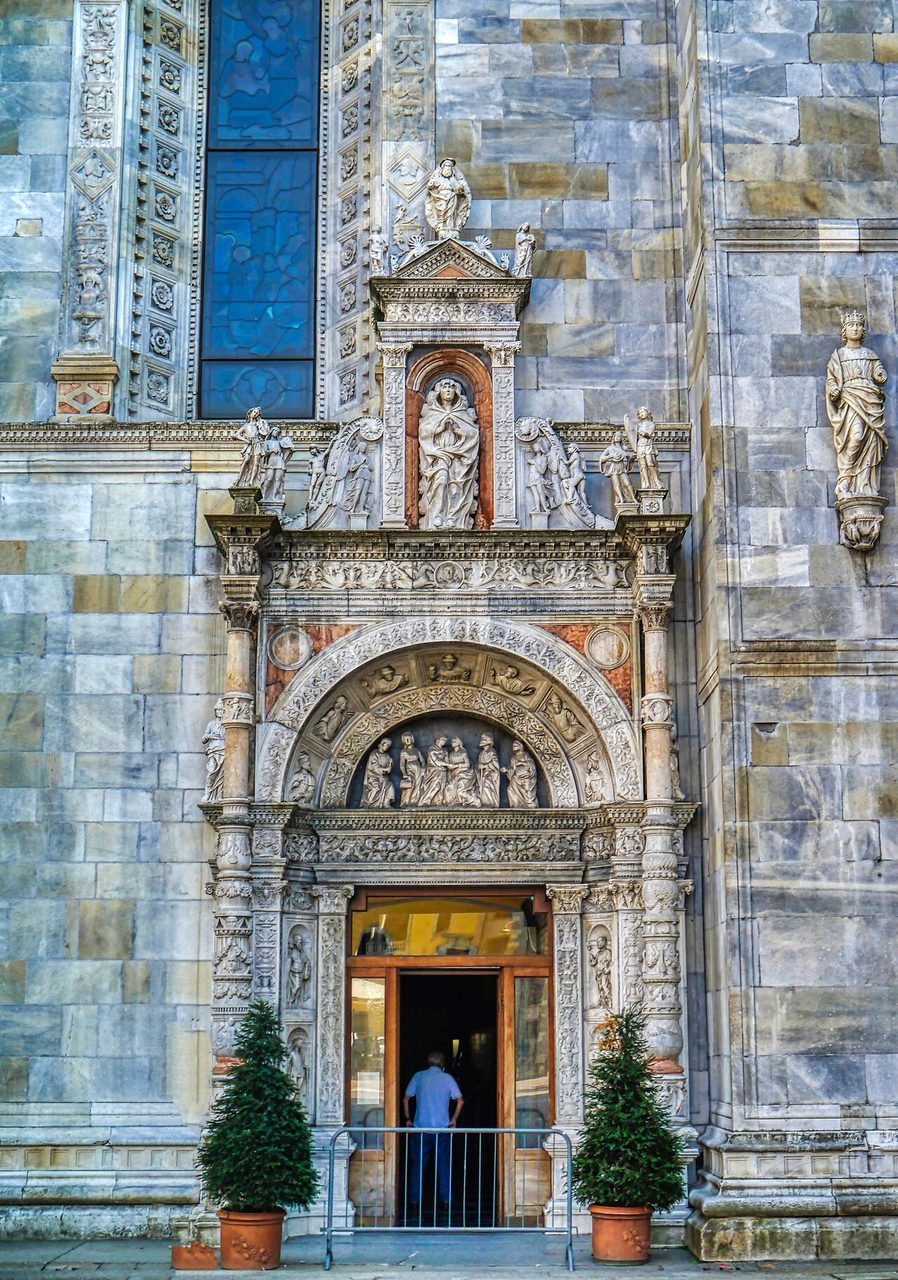
The richest portal of the Duomo, carved in the early 1500s by the Rodari brothers. Porta della Rana means Frog Door: it is named for a small frog hidden among the leaves, the star of a legend, a treasure hunt and a hammer blow.
Spot the detail
On the left jamb, in the middle of the carved foliage, find a frog seen from behind. Careful: it is missing something
The full story
After the facade, so orderly, this door is an explosion. Not an inch of marble has been left smooth: cherubs, garlands, grotesque masks, festoons, animals, profiles in medallions that look copied from ancient coins.
On either side are two columns carved like candelabra, meaning in elements stacked one on top of the other. Above the door, in the , is the Visitation: Mary going to visit Elizabeth. Higher still, an with the Virgin Mary and, on top of everything, God the Father.
A signed and mysterious portal
It is the work of the brothers Tommaso and Giacomo Rodari, who carved it in the first years of the 1500s and signed it: their names are cut into the jambs on the inner side. It is considered one of the best things in the whole Duomo, and also one of the most mysterious.
Bible stories and ancient myths are mixed together so densely that not even scholars have managed to decipher it all. On the inner side of the portal, for instance, a double procession of cherubs in the ancient manner parades by, as in a Roman triumph. Some have read into it a comparison between Christ and the pagan myths of Orpheus and Bacchus, but no reading is certain.
The legend of the frog
Yet the door owes its name to an animal a couple of inches long. Among the leaves of one jamb there is a frog, and the people of Como have built a legend around it.
The story goes that during one of the lake's many floods the water came all the way up to the Duomo, and a frog took the chance to climb up the portal. When the lake drew back, the frog was so won over by the beauty of the cathedral that it decided to stay, and turned to stone. To this day children in Como are told to look sharp and find it.
The treasure that wasn't there
Then there is a second story, a greedier one. In the early 1800s a rumor began to spread that a treasure was buried a short distance from the frog. The story caught on to the point that, in May 1852, people really did dig beside the door.
The result: no treasure. On the other hand, according to a scholar of the late 1800s, this little tale also helped make the door famous.
The treasure, come to think of it, was the door.
About this stop
Legend
The frog that would not leave
On the north side of the Duomo di Como, the city's cathedral, is the Porta della Rana, the Frog Door, named after a small frog carved among the leaves of one jamb. According to a popular legend, during one of the lake's floods the water swamped the cathedral, and a frog climbed up the portal. When the lake drew back, won over by the beauty of the church, it decided never to leave and turned to stone. To this day parents in Como tell their children to look sharp and find it. Since 1912, though, the frog has had no head: a hammer blow knocked it off.
Anecdote
The treasure hunt at the Porta della Rana
On the north side of the Duomo di Como, the city's cathedral, is the Porta della Rana, the Frog Door, a carved portal named after a small frog hidden among its marble leaves. In the early 1800s word got around that a treasure lay buried a short distance from the frog. The story, first put in writing in 1810, caught on well enough that in May 1852 people really did dig beside the door. No trace of the treasure was found. According to a scholar of the late 1800s, though, it was partly this little tale, together with the frog, that made the door famous.
Next stop
Go into the cathedral and stop at the start of the nave, with the main portal behind you