Stop 6 of 7Must-see
Juvarra's Dome
Where to stand
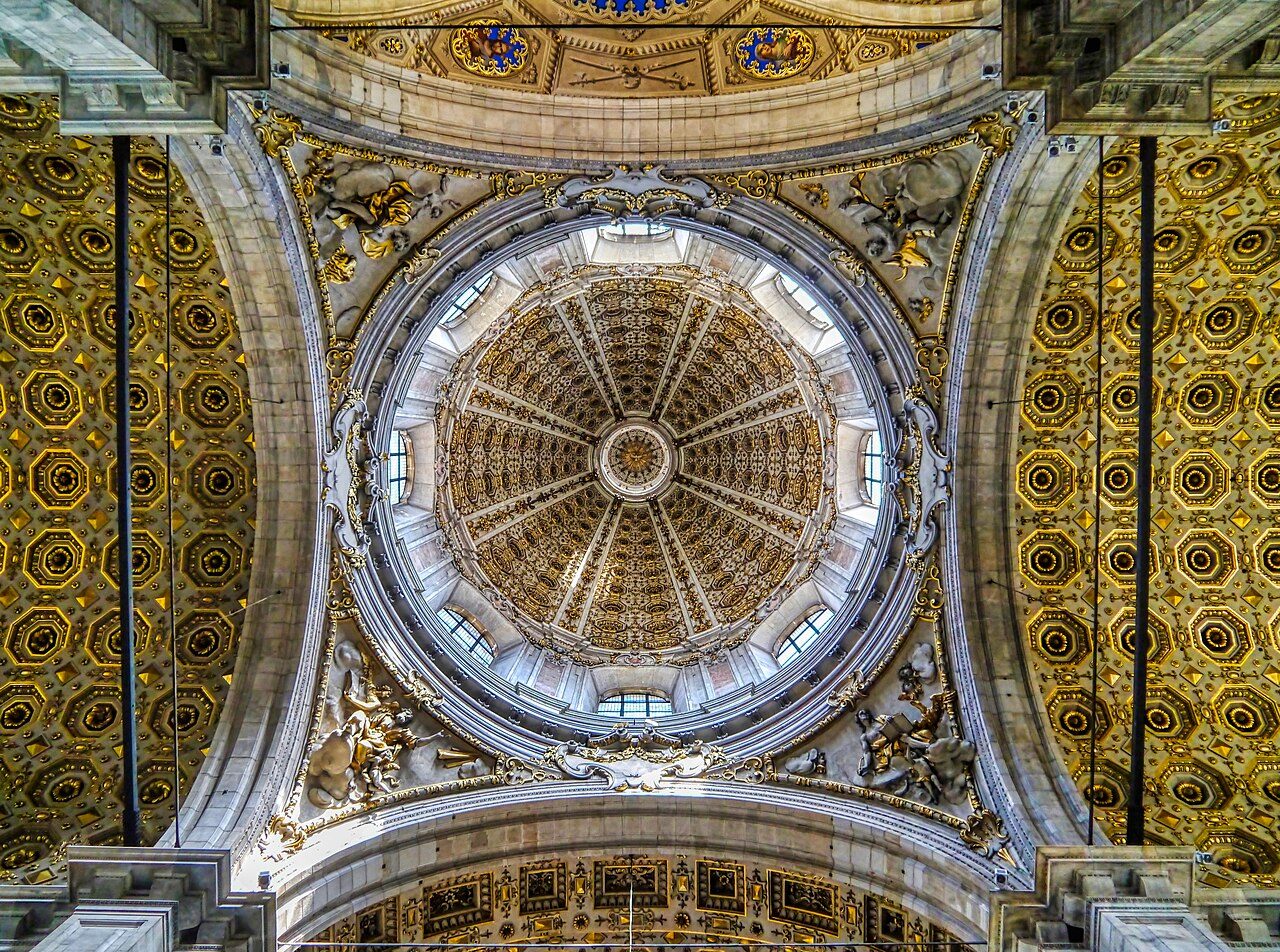
Where the nave crosses the transept, in front of the chancel, looking up
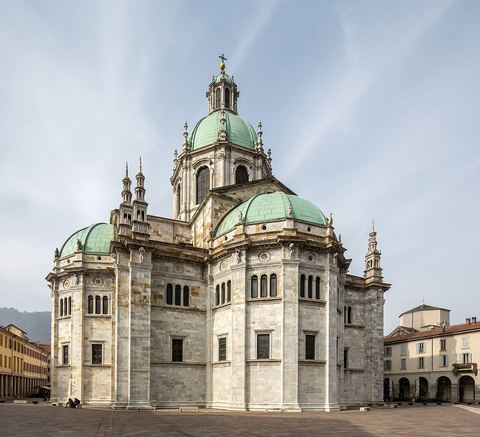
The last piece of the Duomo, arriving more than three centuries after the first. Filippo Juvarra, architect to the House of Savoy, designed it, and in 1935 a fire ravaged it. That very disaster gave it back the shape its author intended.
Spot the detail
At the four corners, at the base of the dome, find four large stucco figures
The full story
Now that you are here, look up. After the half-light of the nave, this is where the Duomo breathes: the light falls from above, full, and spreads across the whole space in front of the altar. It is the only part of the church where the light does exactly what the architect wanted.
Look around you too. You are at the point where the nave crosses the , and you are no longer in a Gothic church. The three that open in front of you and to the sides are identical and arranged like a clover leaf, following a Renaissance idea that turns up in Milan in the east end of Santa Maria delle Grazie, the church of the Last Supper.
This is where the building site changed style, in the early 1500s. And from that moment on, a dome was planned for the center.
Filippo Juvarra's design
Getting it took another two centuries. In the 1600s the architect Carlo Fontana had a go, with three designs that stayed on paper.
Then, in 1731, came Filippo Juvarra, from Messina, chief architect to the House of Savoy in Turin. He designed a hemispherical dome with a lantern, set on a tall eight-sided . And he did something you could not take for granted from a celebrity: he respected the proportions set by those who had worked before him.
He died in Madrid a few years later, while designing the royal palace. The sources disagree on when the dome was truly finished: let's say around 1740. At 75 meters, about 245 feet, it is the highest point of the Duomo.
The fire of 1935
It did not have a quiet life. Water got in, and thirty years later the architect Giulio Galliori enclosed it in a copper-clad shell, which changed its outline. It stayed that way until the afternoon of September 27, 1935.
Work was under way on the roofing. The last workman had just come down when, as was later pieced together, a small flame that escaped from a soldering tool slipped under the copper and caught on the oak framework.
While the fire devoured the roofing, the houses all around were evacuated. The paintings by Luini and Ferrari and the were carried to safety in the nearby church of San Giacomo. Reporting on that day for a newspaper was an exceptional correspondent: the writer Carlo Emilio Gadda.
The dome after the fire
The disaster had an upside. For the repairs, what was left of the shell was removed and the dome was given back the shape Juvarra had drawn. What you see from outside today is closer to his design than what the people of Como looked at for a century and a half.
About this stop
In culture
Gadda, reporter at the dome fire
On September 27, 1935, the dome of the Duomo di Como, the city's cathedral, caught fire during work on its copper roofing. The nearby houses were evacuated, while the canvases by the painters Bernardino Luini and Gaudenzio Ferrari and the cathedral's were moved to the church of San Giacomo, a few steps away. According to the local press, the episode was reported in the pages of a daily newspaper, the Gazzetta del Popolo, by an exceptional correspondent: the writer Carlo Emilio Gadda, who had ties to nearby Brianza, the hill country between Como and Milan.
In culture
The Duomo that opens like a flower
In the second half of the 1800s the English writer John Addington Symonds, a historian of the Renaissance, devoted a few pages of a travel essay, Como and Il Medeghino, to the Duomo di Como. For him it was perhaps the most perfect building in Italy for seeing Gothic and Renaissance blend without discord. He found an image for it: the Gothic nave, severe and dim, opens out into the luminous harmonies of choir and like a flower unfolding. Try it: walk from the entrance toward the altar and watch the light grow. Symonds, mind you, was biased: among the Italian lakes his vote went to Lake Como.
Yes, and paradoxically more so today than two centuries ago. Thirty years after it was built water was getting in, and the architect Giulio Galliori enclosed it in a copper-clad shell that altered its outline. In 1935 a fire ravaged the roofing. In the restoration the shell was removed and the dome went back to the shape drawn by Filippo Juvarra. Work on the dome and its interior decoration went on until the early 1950s.
Next stop
Go outside and walk around the cathedral to the side opposite the facade, where the apses jut out