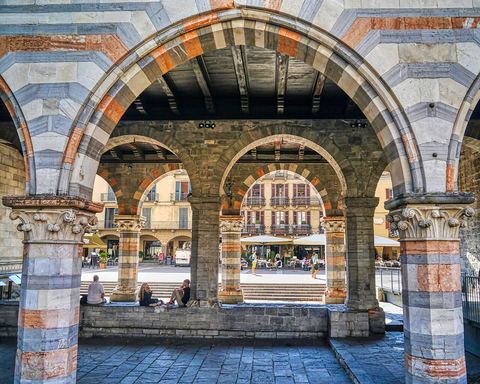
Stop 3 of 5Must-see
The Torre civica
Where to stand
At the foot of the stone tower, at the left end of the Broletto as you look from the square
The city's tower: rough stone, a clock, bells at the top. It called citizens to assembly and today it rings for the Duomo, the cathedral, which has no bell tower of its own. The upper part was rebuilt in the 20th century.
Spot the detail
On the tower, on the side facing the square, there is a clock: look at what sits above it
The full story
After all those stripes, a block of bare stone. The Torre civica, the civic tower that closes the , Como's medieval city hall, on its left side has no colored marble and no decoration. It is built in , with stone blocks whose faces are left rough and projecting. It was meant to look solid, and it does.
Climb it with your eyes. Level with the second floor of the palace is a , divided in two. A little higher is the clock, sheltered by a small roof. At the top sits the , open on all four sides.
The voice of the Comune
The bell was the reason the tower existed. In the Middle Ages it was the voice of the Comune, the self-governing city: when it rang, citizens knew they were being summoned to assembly. It was the bell of civic power, not that of the church next door.
Then things got mixed up. When the cathedral was rebuilt on a larger scale, the bell tower of the old church was demolished to make room, and the bells were moved here, as a temporary measure. They are still here.
The Duomo, Como's cathedral, has no bell tower of its own: its bells ring from the tower of the city hall. A stopgap that has lasted for centuries.
Taken down and rebuilt
How old is what you are looking at? The tower was most likely built together with the palace, in the early 13th century.
But in 1910 the upper part was judged unsafe and taken down. It was rebuilt only between 1926 and 1927. And here is a detail that the regional heritage records admit with honesty: nobody knows whether today's height is the original one.
The clue Turner left
There is one clue, though, and it was left by a famous traveler. In 1819 William Turner, the English painter, passed through Como on his first journey to Italy. He stood in a corner of the square and drew the Duomo and the in pencil on a sketchbook page the size of a postcard, noting down colors and proportions. In that drawing, now at the Tate in London, the clock tower is taller than the present one.
So the tower you are looking at is three things at once. A piece of the 13th century at the bottom, a piece of the 20th century at the top, and the bell tower of a cathedral that is not its own.
About this stop
Anecdote
A cathedral without a bell tower
The Duomo, Como's cathedral, has no bell tower. The one belonging to the old cathedral was demolished when the church was enlarged, and the bells were moved as a temporary measure to the tower of the , the medieval city hall next door. They never left: to this day the cathedral's bells ring from the Torre civica, the civic tower. The tower built to summon the citizens' assemblies has become, without anyone ever really deciding it, the bell tower of the church next door.
In culture
Turner and the tower that was taller
In 1819 William Turner, the English painter, began the lakes leg of his first journey to Italy in Como. From the northwest corner of Piazza del Duomo he drew the cathedral and the , the medieval city hall with its tower, in pencil, noting colors and proportions on the page. The scholar who cataloged his sketchbooks called it a marvel of notes taken on the fly. The drawing, now at the Tate in London, is also a document: it shows the Broletto with an extra floor and the clock tower taller than it is today.
Only in part. The tower was most likely built together with the palace, in the early 13th century, to carry the bell that summoned the assemblies. In 1910 the upper part was taken down because it was judged unsafe, and it was rebuilt between 1926 and 1927. The heritage records of the Lombardy Region warn that nobody knows whether the present height matches the original. A drawing by Turner from 1819 shows a tower taller than today's.
This stop on the map
Next stop
Go back toward the palace and stop under the arches of the portico