Stop 4 of 5
Under the portico
Where to stand
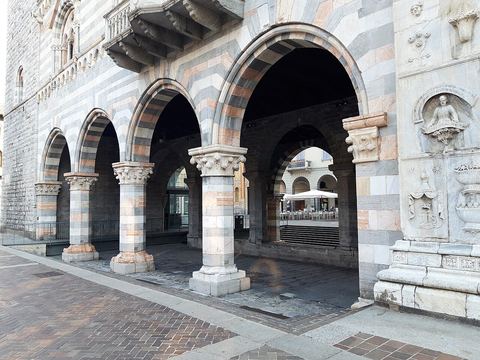
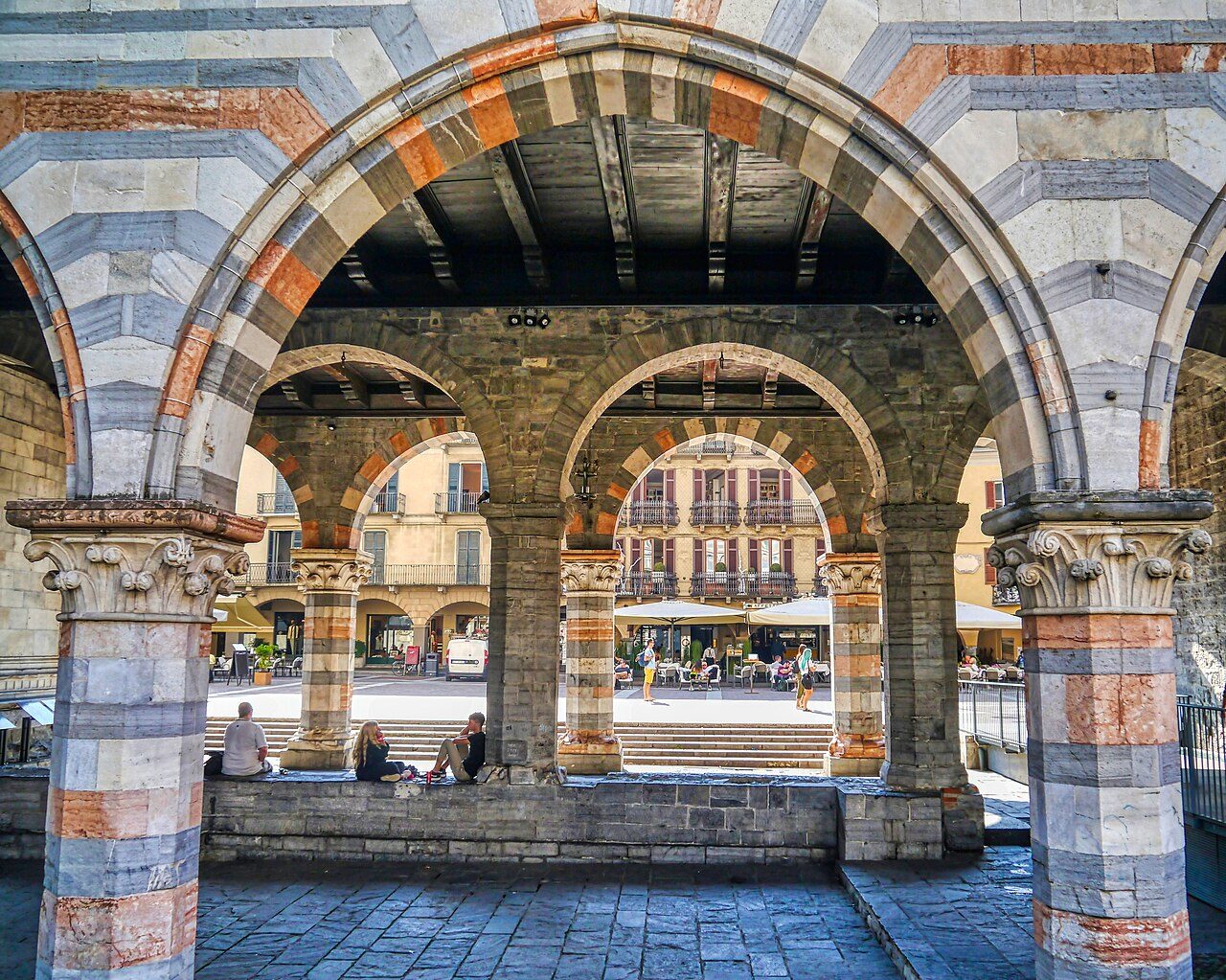
Under the arches of the Broletto, among the piers of the portico
The ground floor was a covered square. The floor is lower than today's piazza, because the city around it was raised. The piers in the middle are plainer: they were rebuilt after the fire of 1408.
Spot the detail
Compare the outer piers with the ones in the middle of the portico: they are not the same
The full story
Before you look up, look down. The floor of the portico is lower than the square. The palace has not sunk: the city has risen.
Over the centuries the level of the square was raised, according to the most common explanation as a defense against the lake's floods, and the portico was filled in up to the new level. The bases of the piers ended up underground and the , Como's medieval city hall, took on a squat look, like a building without legs. Only the restorations completed in the early 1970s brought the floor back to where it originally was.
Now look around. This space was not an entrance: it was a square with a roof. Open through its arches on both long sides, it let people pass from one side to the other and gave shelter to those who gathered. Above their heads, the assembly hall.
The piers and the fire
Then look at the piers. The outer ones, eight-sided, are the 13th-century originals. The ones in the middle are plainer, and they have a violent history.
Originally there were no piers here but a wall, which split the portico in two and carried the ceiling beams. In 1408 two families, the Rusca and the Vittani, were fighting over Como. One of the Rusca's men, a certain Lorenzo from Morcote, set fire to the palace.
The archive with the notaries' deeds burned, the roof and the walls of the hall were damaged, and the middle wall came out in such a bad state that it was replaced with arches. The Comune, the city government, had to move into rented houses.
The restoration was directed by Pietro da Breggia, the same architect who was running the building site of the Duomo, the cathedral next door, in those years. The work was finished only in 1436: almost thirty years after the fire.
There is also a piece older than everything else. Among the capitals of the piers, one is dated to the late Roman period: it is older than the palace by several centuries.
What went on here
Before you leave, think about what went on under here. People argued, waited for a verdict, listened to an announcement shouted from the window above. The hall was for those who made the decisions. The portico was for everyone else, and it was the most public place in the city.
About this stop
Anecdote
The Broletto fire of 1408
In 1408 two families, the Rusca and the Vittani, were fighting over Como. During the clashes a man from Franchino Rusca's faction, Lorenzo da Morcote, set fire to the , the city's medieval city hall. The archive with the notaries' registers was destroyed, and the building was so badly damaged that the offices were moved into rented houses. The restoration, directed by Pietro da Breggia, the architect who also ran the building site of the Duomo, the cathedral, was finished in 1436. The plainer piers in the middle of the portico date from that work. The palace returned to its public functions only in 1449.
Anecdote
The short-lived Repubblica di Sant'Abbondio
In the summer of 1447 Filippo Maria Visconti, Duke of Milan, died, and Como seized the chance to be free again: the Repubblica di Sant'Abbondio was born, a republic named after the city's patron saint. One of its first acts was to demolish the Visconti's fortified citadel. Its walls had swallowed a corner of the , the medieval city hall, and removing them left a mark: the arch at that corner had to be repaired, and the palace returned to its public functions only in 1449. Freedom did not last. Between 1450 and 1451 Como submitted to Francesco Sforza, the new Duke of Milan, and the republic ended there.
Anecdote
The city hall that looked lower
For centuries the , Como's medieval city hall on Piazza del Duomo, looked lower than it is. The level of the square had been raised by more than a meter, according to the most common explanation because of the lake's floods, and the ground-floor portico had been filled in up to the new level, hiding the bases of the piers. The arches looked squat and squashed. Only the restorations completed in the early 1970s brought the floor of the portico back to its original level: that is why today it sits lower than the square.
Because the floor of the portico is the 13th-century one, while the square was raised in the centuries that followed. The most common explanation points to the lake's floods, which pushed the people of Como to raise the level of the streets. The portico was filled in up to the new level and the bases of the piers vanished underground. The 20th-century restorations, completed in the early 1970s, brought the original level back to light.
Yes: the has two facades. The rear one repeats the layout of the one on the square, with four wider arches and, above, four instead of three. The last arch on the right is round, that is, semicircular, and was probably rebuilt in the 15th century. Among the windows, the second from the right is the most elaborate: at its center are four colonnettes knotted together, a showpiece by the medieval stonecutters.
Next stop
Walk to the end of the portico on the Duomo side, where the palace touches the cathedral