Stop 6 of 7
The Visconti teatrino
Where to stand
At the entrance to the teatrino, the little theater fitted inside the villa
A miniature theater with about ninety seats, commissioned by the Visconti di Modrone dukes in the late 1800s. It is the most personal mark left by the villa's last private owners.
Spot the detail
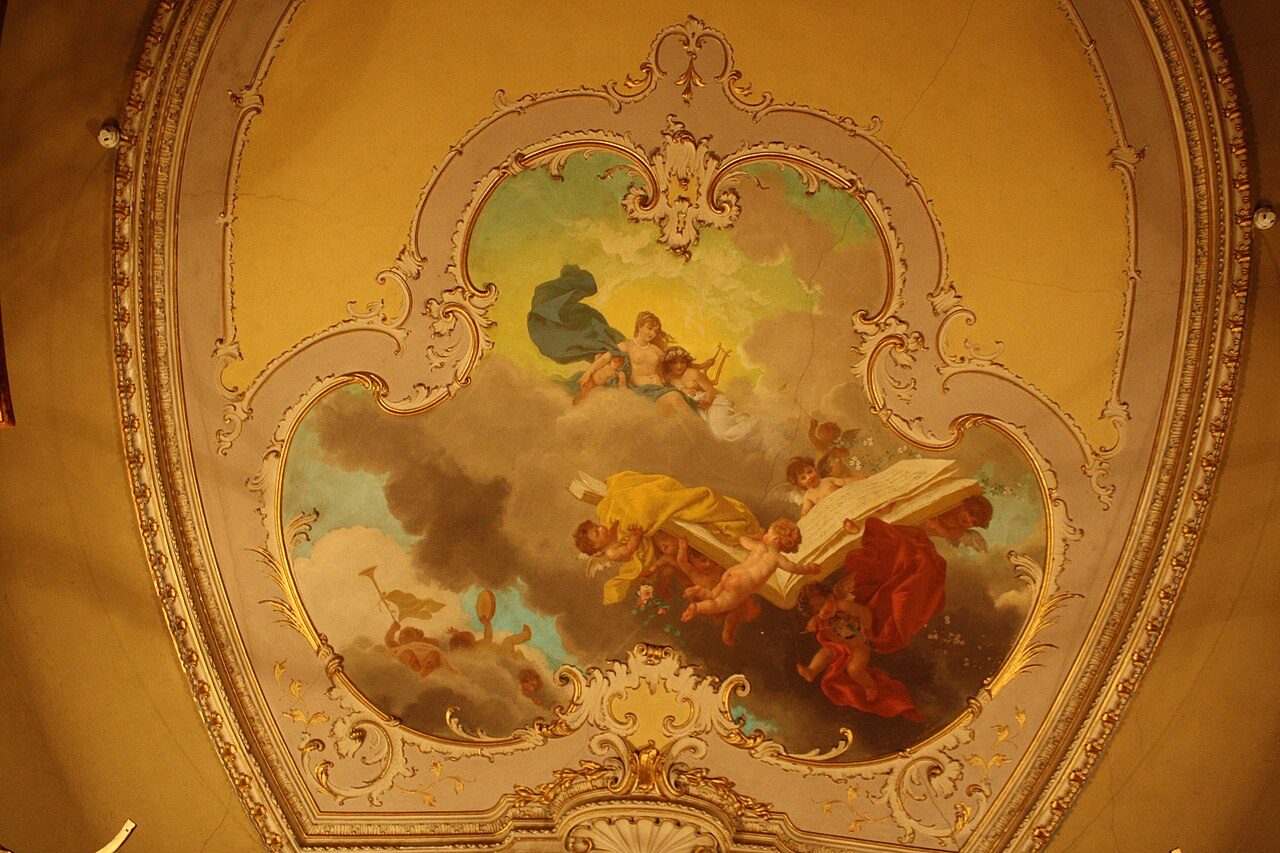
Look at the frescoes in the teatrino: they have nothing to do with the villa's eighteenth century. Whose are they?
The full story
A villa with a theater inside it. This is no ordinary whim: it says a lot about the family that wanted it.
In 1883 Villa Olmo passed to its last private owner. It was bought by Duke Guido Visconti di Modrone, a Milanese textile industrialist and later a senator. For him theater was a serious matter: in the last years of his life he was the founder and first president of the company that ran La Scala, Milan's opera house. And one of his grandsons was named Luchino Visconti, the film director.
The work of Emilio Alemagna
The duke entrusted the villa to the Milanese architect Emilio Alemagna, with a clear brief: bring it up to date. Outside, the side wings and a portico disappeared, two panoramic balconies were opened, and a fountain arrived in the garden and a small temple in the park.
Inside, the decoration on the ground floor was redone. And inside the villa this room was created: a private teatrino with about ninety seats, inaugurated a few years after the purchase. The frescoes are by Ernesto Fontana.
Think about what it was for. An evening at Villa Olmo in the late 1800s meant crossing the atrium, passing through the ballroom and then sitting down here in a small group, among friends, to listen to music or watch a play. Court theater in pocket format.
The chapel and the duke's bedroom
Not all the Visconti's alterations were gentle. To make room for an elevator shaft, they cut into the Odescalchi chapel, which preserves decorations by Giocondo Albertolli. The chapel was restored in the 1960s.
On the upper floor is the other room that speaks of the duke: his bedroom, now called the Sala del Duca, the Duke's Room. Alemagna lined it with friezes in neo-baroque taste and Fontana painted Fortune in the middle of the ceiling. It was restored in 2015: before that the public could not go in. Fortune painted above the bed: for an industrialist, a fine way to fall asleep.
About this stop
In culture
A Giacosa premiere acted by aristocrats
The teatrino of Villa Olmo, the small private theater added by the Visconti di Modrone dukes, hosted a world premiere on September 30, 1886: La tardi ravveduta, a verse comedy by Giuseppe Giacosa, ten years later one of the librettists of Puccini's La Bohème. Giacosa wrote it for the duke's household and dedicated it to Duchess Ida. No professional actors went on stage, just the duchess and other nobles. The plot has an irony of its own. A marquise who was an actress in her youth, and whom the court will not receive because of it, ends up dumping three titled suitors and going back to the stage.
Next stop
Leave the villa and walk around it to reach the park at the back