Stop 2 of 7
The garden and the fountain
Where to stand
Beside the fountain basin, in the middle of the garden between the villa and the lake
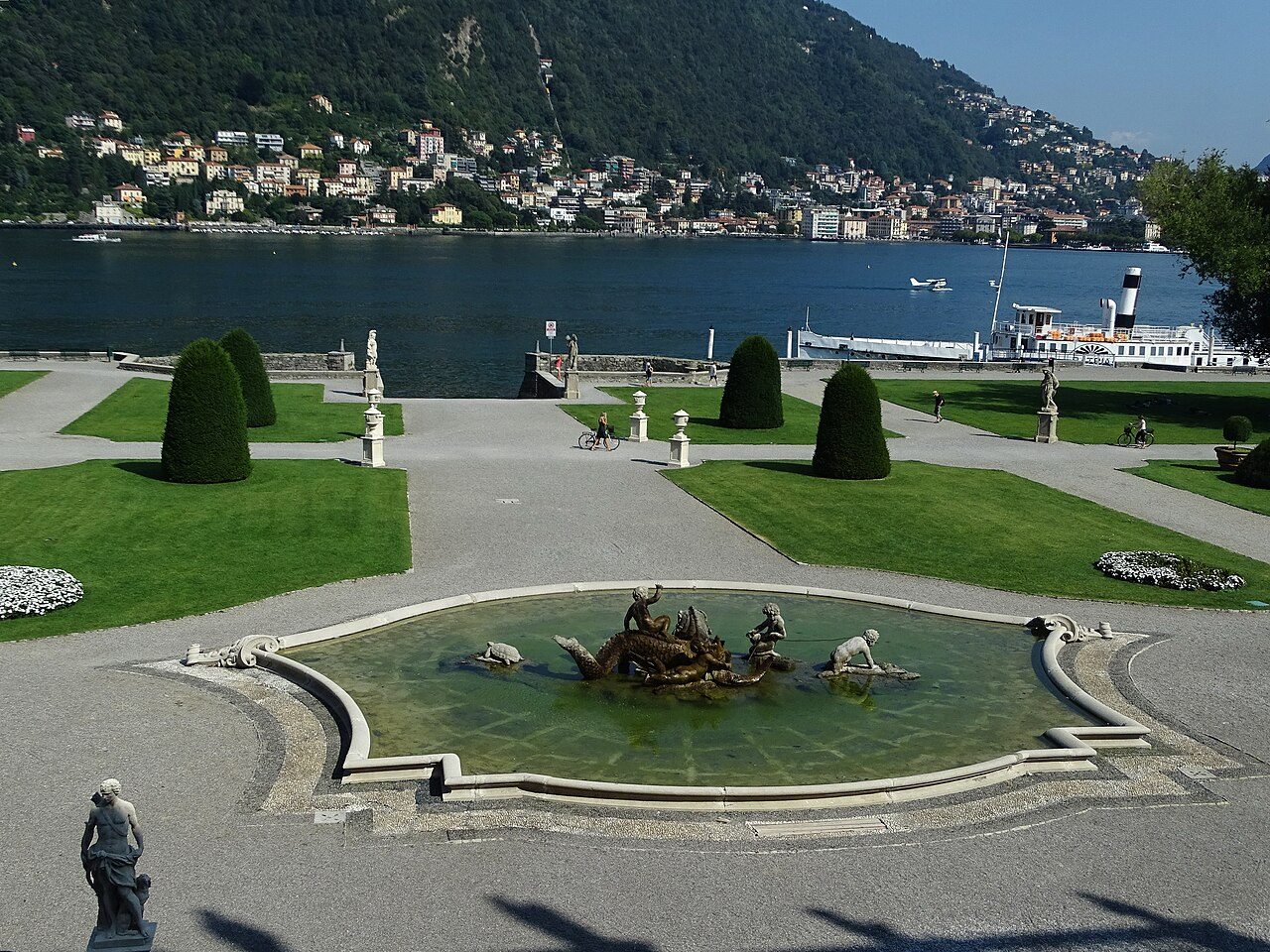
Geometric flower beds, statues of gods and a fountain with a sea monster: this is the formal Italian garden, the orderly side of the villa. It is also where you find out where the name Olmo comes from.
Spot the detail
Look closely at the group in the middle of the basin: how many children are fighting the sea monster?
The full story
You are in the , the part of the garden drawn with ruler and compass. Symmetrical flower beds, box hedges, yews clipped into regular shapes. This is the formal Italian garden: nature tidied up to serve as a carpet for the facade. It runs from the villa all the way to the lakeshore.
The fountain and the statues
In the middle stands the fountain. Look at it up close: a sea monster is wrestling with three putti. It is the work of the Milanese sculptor Gerolamo Oldofredi, and it was placed here in the late 1800s by the Visconti di Modrone dukes, the last private owners.
Its taste is baroque, restless, almost theatrical, and has little to do with the composure of the villa. That is exactly why it works.
The statues of pagan gods among the flower beds, on the other hand, are older. They were carved by Francesco Carabelli, the same sculptor from Ticino who worked on the facade alongside the architect Simone Cantoni.
Where the name comes from
And the elm? Olmo is Italian for elm, and the name is older than the villa. As early as the 1600s this land, which belonged to an abbey, was known as dell'Olmo, of the elm.
According to a tradition that no document confirms, an enormous elm grew here, or perhaps two, already more than a hundred years old when building began. That tree is gone. But the garden has not given up its symbol: the latest restoration made a point of keeping two large elms near the .
Convent and plague hospital
The history of the place goes back much further. In the Middle Ages a convent of the Umiliati, a religious order, stood here, dedicated to Santa Maria. It later passed to the Minim friars, who turned it into a plague hospital during the epidemic of 1630. The , the villa's small private harbor, was built in the 1800s on the very spot where plague victims had once been sheltered.
One last thing to imagine. Until the 1960s the road to Cernobbio ran right between the villa and the lake. Then it was moved uphill, and the garden got its shore back. The gain is obvious: today the garden reaches all the way to the water.
About this stop
Legend
How Villa Olmo got its name
Where does the name Villa Olmo come from? According to a tradition that no document confirms, from a gigantic elm, olmo in Italian, or from two: the versions vary. One popular story even claims the tree was planted by Pliny the Younger, the Latin writer. Another tradition, championed in the early 1800s by the Como scholar Giovanni Battista Giovio, places here the villa of Caninius Rufus, a poet and friend of Pliny. There is no firm proof, but remains of Roman walls really did turn up during building work, in the 1960s and again in 2015.
Because of a tree that is no longer there. Olmo means elm, and the land was already known as dell'Olmo in the 1600s, when it belonged to an abbey. Tradition, which no document confirms, speaks of an enormous elm, more than a century old when building began; another version speaks of two elms. In fact the house was at first also called Palazzo dell'Olmo, and until the late 1800s the name was written on a plaque at the top of the facade, where the Visconti di Modrone coat of arms is today.
This stop on the map
Next stop
Walk back toward the facade and enter the villa through the arches of the central block